• Fri frakt över 249 kr
  • •
  • Snabba leveranser
  • •
  • Billiga böcker
Kundservice

Du är på sajten för privatpersoner.

Företag, bibliotek eller offentlig verksamhet?

Du handlar på classic.bokus.com, där alla dina funktioner finns intakta.
Till classic.bokus.com
Bokus logotyp. Gå till startsidan.
  • Erbjudanden
  • Nyheter
  • Student
  • Topplistor
  • Barn & ungdom
  • Bokus Play
  • E-böcker
  • Pocketböcker
  • Spel & pussel

10% studentrabatt med kod TERM26

Sidfot

Mina sidor

    Hjälp

    • Kundservice
    • Vanliga frågor och svar
    • Frakt och leverans
    • Retur vid ångerrätt
    • Reklamera vara
    • Betalning
    • Köpvillkor
    • Allmänna villkor
    • Information om webbplatsens tillgänglighet

    Om Bokus

    • Om oss
    • Pressrum
    • För studenter
    • För företag
    • För bibliotek och offentlig verksamhet
    • För leverantörer
    • Hållbarhet

    Populärt

    • Aktuella erbjudanden
    • Presentkort
    • Studentlitteratur
    • Nya böcker
    • Topplistor
    • Signerade böcker
    • Engelska böcker

    Inspiration

    • Boktips
    • BookTok
    • Populära bokserier
    • Barnbokskaraktärer
    • Populära författare
    Logotyp för Bokus
    Följ oss på Facebook (extern länk)Följ oss på Instagram (extern länk)Följ oss på YouTube (extern länk)Följ oss på TikTok (extern länk)
    bokus @ CookiesAnpassa cookiesIntegritetspolicyKöpvillkor
    Till Citymail hemsida (extern länk)Till Budbee hemsida (extern länk)Till Postnord hemsida (extern länk)Till Schenker hemsida (extern länk)Till Early Bird hemsida (extern länk)Till Walleys hemsida (extern länk)
    1. Samhälle och politik
    2. Politik och statsskick
    3. Centralt styre och förvaltning

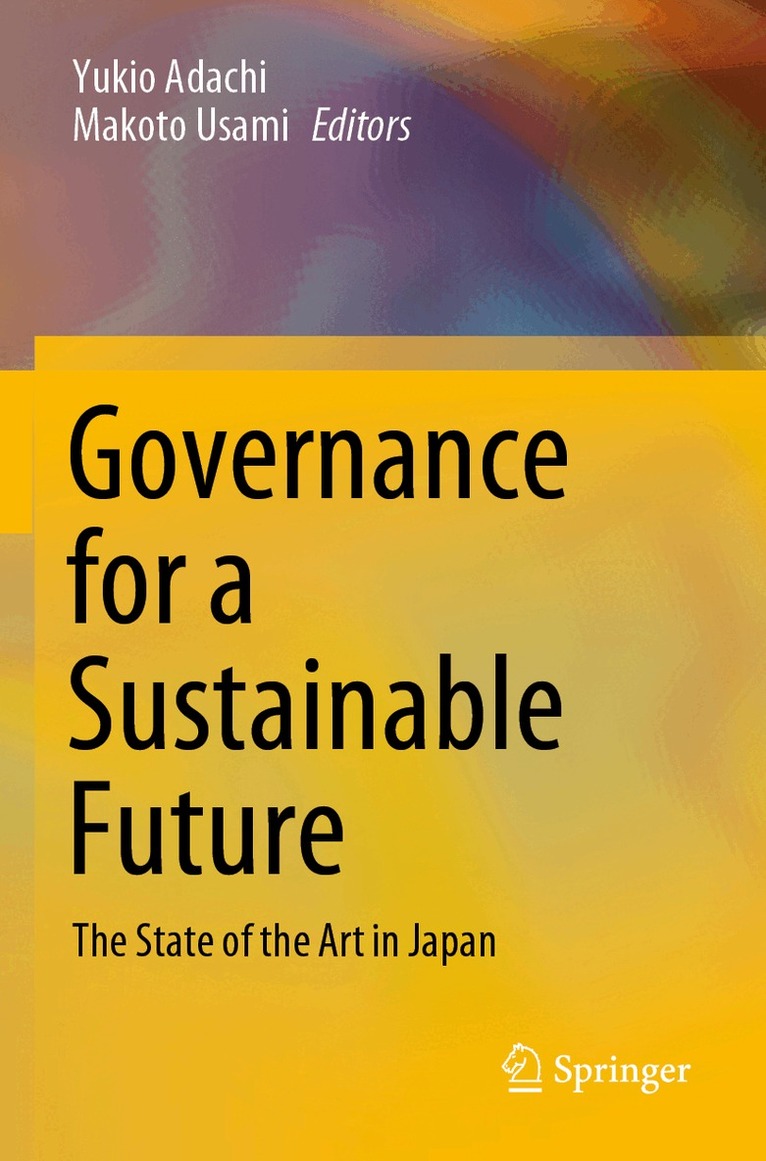
    Governance for a Sustainable Future

    The State of the Art in Japan

    AvYukio Adachi,Makoto Usami

    Häftad, Engelska, 2024

    1 743 kr

    Beställningsvara. Skickas inom 10-15 vardagar. Fri frakt över 249 kr.

    Beskrivning

    Although the expression “responsibility to future generations” is firmly established in public and political vocabulary, its operational meaning and practice are inadequately understood and yet to be systematically evaluated. Moreover, the term has not been successfully translated into viable ethical and theoretical concepts that can guide public policies and actions. How can the modes of governance and established policy priorities become compatible with the well-being of future generations? The primary objective of this book is to identify the conditions of and obstacles to governance for a sustainable future, or future-regarding governance. Governance concerns steering a society over extended periods of time, not responding to particular policy issues. The ideas and strategies proposed by contributors in this book to establish future-regarding governance are based on the theoretical and empirical analyses of the major long-term problems facing advanced democracies in general, and Japan in particular. Japan is an interesting case indeed. Relatively poor climate policy, rapidly decreasing birth rate, aging population, extensive public debt, prolonged economic recession, healthcare and pension systems that urgently require redesigning, hollowing-out of industries and subsequent loss of jobs, deteriorating infrastructures, increasing nuclear waste, and intensifying social polarization have caused a decline in people’s trust in the government and democratic processes. Currently, Japanese citizens are widely circulating their doubts about the social system’s sustainability. This book comprises two parts. In Part I, authors from various disciplinary backgrounds examine the idea of governance for a sustainable future from theoretical perspectives. This part discusses issues associated with future-regarding governance that are wicked in nature, such as the philosophical/ethical foundation on which to base the idea of governance for a sustainable future, major impediments to the development of future-regarding governance, and the modes of thinking and action required by leaders and citizens to realize such governance. Chapters in Part II largely focus on the state of long-term governance in Japan. This part uses empirical and in-depth analyses with cross-sectoral and cross-national policy perspectives to identify the state of future-regarding governance in various policy fields and major sectors or organizations mainly in Japan, while also examining strategies and measures to improve their performance. From this perspective, Western democracies and weak democratic regimes elsewhere will be provided with valuable lessons to avoid fatal policy mistakes, thereby improving future-oriented governance worldwide. By combining theoretical discussions on far-reaching issues and empirical analyses of Japanese cases, the book will shed a new light on governance for a sustainable future.

    Produktinformation

    • Utgivningsdatum:2024-09-25
    • Mått:155 x 235 x 21 mm
    • Vikt:563 g
    • Format:Häftad
    • Språk:Engelska
    • Antal sidor:364
    • Upplaga:2023
    • Förlag:Springer Verlag, Singapore
    • ISBN:9789819947737

    Utforska kategorier

    • Centralt styre och förvaltning inom Samhälle och politik
    • Miljöekonomi inom Ekonomi och Ledarskap
    • Offentlig förvaltning inom Samhälle och politik

    Mer om författaren

    Yukio Adachi, Professor Emeritus at Kyoto University, is one of the founding fathers of the Public Policy Studies Association, Japan (PPSAJ), which was given birth to in June 1996. He started his academic career as a student of political philosophy, having shifted his research interest into modes of thinking required of policy professionals, via intensive study of the theories and practices of deliberations and debates. His ‘intellectual’ mentors are John Passmore, Stephen Toulmin, and Yehezkel Dror. He has published extensively over a wide range of theoretical and ethics-related issues facing policy professionals, among which are, to mention just a few, how to deal with complexities, uncertainties, and ideological conflicts among key policy actors, how it is possible to make responsibility to future generations and ecosystem a ‘living ethics’ to be substantiated by public policies, and how to improve their capacity for context-specific policy design. Makoto Usami is Professor of Philosophy and Public Policy at Kyoto University, Vice-Dean of the Graduate School of Global Environmental Studies, and Councilor of the university. His areas of specialty are the philosophy of law and moral and political philosophy. He has published extensively on distributive justice, climate justice, global justice, intergenerational justice, and transitional justice. He is the author of four books and more than seventy journal articles and book chapters written in English or Japanese, while also coauthoring two textbooks and editing seven anthologies as well as one special issue of international journal.

    Innehållsförteckning

    • Preface.- Chapter 1  Introduction.- Part I  Principles for Sustainability.- Chapter 2  Role of Legislators in Creating and Sustaining Governance for a Sustainable Future.- Chapter 3  Another Boundary Problem: Democracy, Future Generations, and the All-affected Principle.- Chapter 4  Another Reason for Caring about Future Generations.- Chapter 5  Responding to Existential Risks: Grounds, Targets, and Strategies.- Chapter 6  Trade-off between Repugnant and Sadistic Conclusions under the Separability of People’s Lives.- Chapter 7  Dealing with “Wickedness” in Long-term Problem-solving.- Chapter 8  Governing Long-term Structural Changes in Socio-technological Systems and Their Difficulties: What do Sustainability Transition Studies Have to Address?.- Chapter 9  The Politics of Eco-nomics: A Critical Investigation of ‘the Governance for a Sustainable Future’ from the Perspective of Heterodox Economics.- Part II  Strategies for Futurity.- Chapter 10  Tokyo’s Linked CO2 Cap-and-Trade Program: A Blueprint for Cooperative Market-based Megacity Climate Policy?.- Chapter 11  Multidimensional Policy Analysis of the Energy System Transition in Japan: Case Studies of Local Energy Systems and Lessons to Improve Sustainability.- Chapter 12  Climate Change Adaptation for Futurity: Public-Private Partnerships in the Japanese Insurance Sector.- Chapter 13  Keeping Your Fossil-fuel Cake While Eating It? Comparing the Decarbonization Approach of BP, Chevron, ExxonMobil and Shell.- Chapter 14  Decarbonization and Critical Raw Materials.- Chapter 15  The Politics of Evidence in Japan: Struggling between Efficiency and Effectiveness and Beyond.- Chapter 16  Governance under Uncertainties for the COVID-19 Pandemic: Policy Lessons Learned in Japan from Resilience Perspectives.- Chapter 17  The Challenges for Health Systems and Policies: Growing Medicalization and Global Risks.