Z. Bechler - Böcker
Visar alla böcker från författaren Z. Bechler. Handla med fri frakt och snabb leverans.
4 produkter
4 produkter
Del 127 - Boston Studies in the Philosophy and History of Science
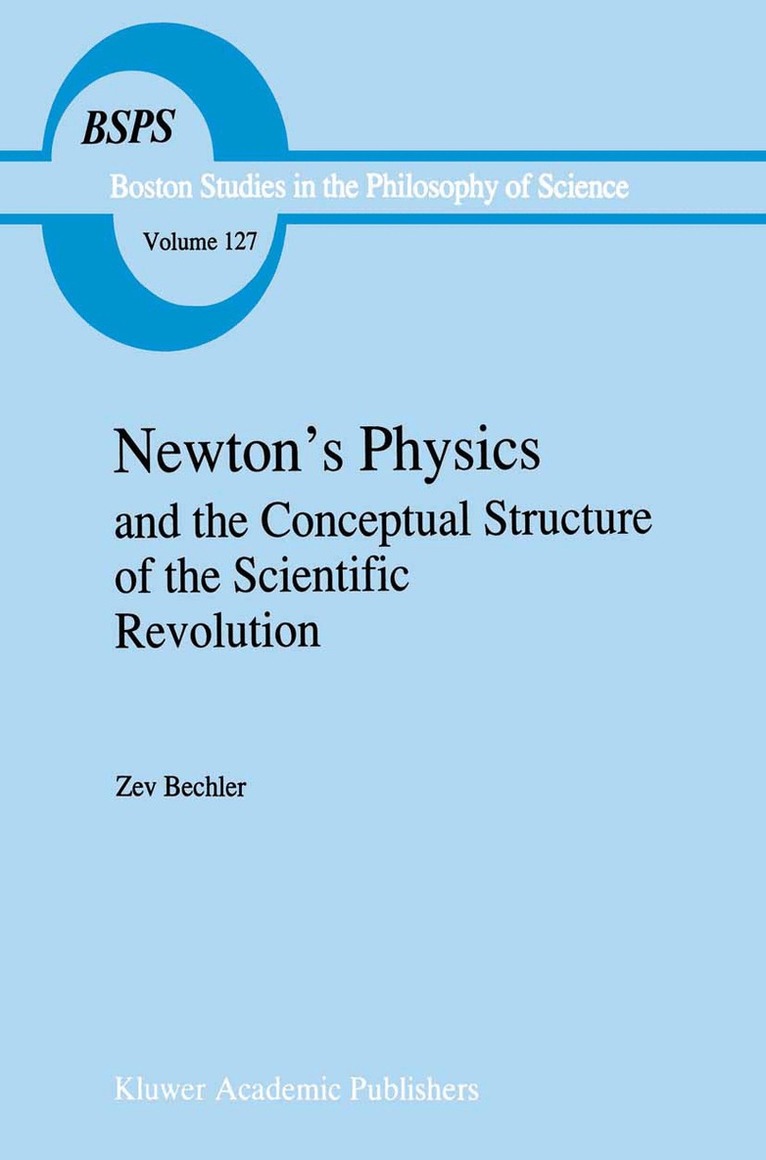
Newton’s Physics and the Conceptual Structure of the Scientific Revolution
Inbunden, Engelska, 1991
3 172 kr
Skickas inom 10-15 vardagar
Three events, which happened all within the same week some ten years ago, set me on the track which the book describes. The first was a reading of Emile Meyerson works in the course of a prolonged research on Einstein's relativity theory, which sent me back to Meyerson's Ident- ity and Reality, where I read and reread the striking chapter on "Ir- rationality". In my earlier researches into the origins of French Conven- tionalism I came to know similar views, all apparently deriving from Emile Boutroux's doctoral thesis of 1874 De fa contingence des lois de la nature and his notes of the 1892-3 course he taught at the Sorbonne De ['idee de fa loi naturelle dans la science et la philosophie contempo- raines. But never before was the full effect of the argument so suddenly clear as when I read Meyerson. On the same week I read, by sheer accident, Ernest Moody's two- parts paper in the JHIof 1951, "Galileo and Avempace".Put near Meyerson's thesis, what Moody argued was a striking confirmation: it was the sheer irrationality of the Platonic tradition, leading from A vem- pace to Galileo, which was the working conceptual force behind the notion of a non-appearing nature, active all the time but always sub- merged, as it is embodied in the concept of void and motion in it.
1 094 kr
Skickas inom 10-15 vardagar
them in his cheat-preface to Copernicus De Revolutionibus, but the main change in their import has been that whereas Osiander defended Copernicus, Mach and Duhem defended science. The modem conception of hypothetico deductive science is, again, geared to defend the respectability of science in much the same way: the physical interpretation, it says, is merely and always hypothetical, and so the scientist is never really committed to it. Hence, when science sheds the physical interpretation off its mathematical skeleton as time and refutation catch up with it, the scientist is not really caught in error, for he never was committed to this interpretation in the first place. This is the apologetic essence of present day, Popper-like, versions of the idea of science as a mathematical-core-cum-interpretational shell. This is also Cohen's view, for it aims to free Newton of any existential commitment to which his theory might allegedly commit him. It will be readily seen that Cohen regards this methodological distinction between mathematics and physics to be the backbone of the Newtonian revolution in science (which is, in its tum, the climax of the whole Scientific Revolution) for a very clear reason: it enables us to argue that Newton could use freely the new concept of centripetal force, even though he did not be lieve in physical action at a distance and could not conceive how such a force could act to produce its effects". ([3] pp.
1 094 kr
Skickas inom 10-15 vardagar
them in his cheat-preface to Copernicus De Revolutionibus, but the main change in their import has been that whereas Osiander defended Copernicus, Mach and Duhem defended science. The modem conception of hypothetico deductive science is, again, geared to defend the respectability of science in much the same way: the physical interpretation, it says, is merely and always hypothetical, and so the scientist is never really committed to it. Hence, when science sheds the physical interpretation off its mathematical skeleton as time and refutation catch up with it, the scientist is not really caught in error, for he never was committed to this interpretation in the first place. This is the apologetic essence of present day, Popper-like, versions of the idea of science as a mathematical-core-cum-interpretational shell. This is also Cohen's view, for it aims to free Newton of any existential commitment to which his theory might allegedly commit him. It will be readily seen that Cohen regards this methodological distinction between mathematics and physics to be the backbone of the Newtonian revolution in science (which is, in its tum, the climax of the whole Scientific Revolution) for a very clear reason: it enables us to argue that Newton could use freely the new concept of centripetal force, even though he did not be lieve in physical action at a distance and could not conceive how such a force could act to produce its effects". ([3] pp.
Del 127 - Boston Studies in the Philosophy and History of Science
Newton’s Physics and the Conceptual Structure of the Scientific Revolution
Häftad, Engelska, 2012
3 266 kr
Skickas inom 10-15 vardagar
Three events, which happened all within the same week some ten years ago, set me on the track which the book describes. The first was a reading of Emile Meyerson works in the course of a prolonged research on Einstein's relativity theory, which sent me back to Meyerson's Ident- ity and Reality, where I read and reread the striking chapter on "Ir- rationality". In my earlier researches into the origins of French Conven- tionalism I came to know similar views, all apparently deriving from Emile Boutroux's doctoral thesis of 1874 De fa contingence des lois de la nature and his notes of the 1892-3 course he taught at the Sorbonne De ['idee de fa loi naturelle dans la science et la philosophie contempo- raines. But never before was the full effect of the argument so suddenly clear as when I read Meyerson. On the same week I read, by sheer accident, Ernest Moody's two- parts paper in the JHIof 1951, "Galileo and Avempace".Put near Meyerson's thesis, what Moody argued was a striking confirmation: it was the sheer irrationality of the Platonic tradition, leading from A vem- pace to Galileo, which was the working conceptual force behind the notion of a non-appearing nature, active all the time but always sub- merged, as it is embodied in the concept of void and motion in it.