Z. Harris - Böcker
Visar alla böcker från författaren Z. Harris. Handla med fri frakt och snabb leverans.
4 produkter
4 produkter
1 640 kr
Skickas inom 10-15 vardagar
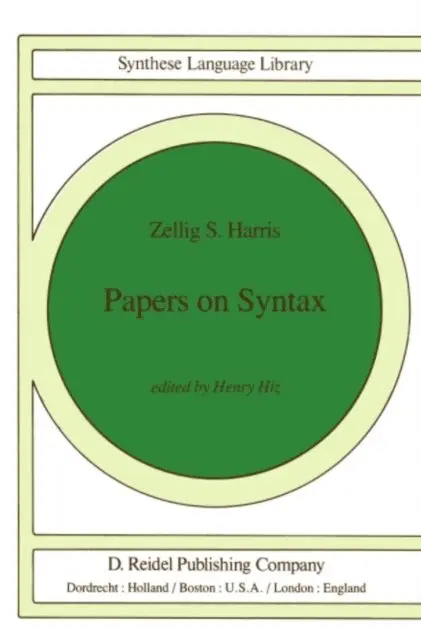
The selection of papers reprinted here traces the development of syntax from structural linguistics through transformational linguistics to operator gram mar. These three are not opposing views or independent assumptions about language. Rather, they are successive stages of investigation into the word combinations which constitue the sentences of a language in contrast to those which do not. Throughout, the goal has been to find the systemati cities of these combinations, and then to obtain each sentence in a uniform way from its parts. In structural analysis, the parts were words (simple or complex, belonging to particular classes) or particular sequences of these. In transformational analysis, it is found that the parts of a sentence are elementary sentences, whose parts in turn are simple words of particular classes. The relation between these two analyses is seen in the existence of an intermediate stage between the two, presented in paper 4, From Morpheme to Utterance. A further intermediate stage is presented in the writer's String Analysis of Sentence Structure, Papers on Formal Linguistics I, Mouton, The Hague 1962 (though it was developed after transformations, as a syntactic rep resentation for computational analysis). Generalization of both of these analyses leads to operator grammar, in which each sentence is derived in a uniform way as a partial ordering of the originally simple words which enter into it: Each step (least upper bound) of the partial ordering (of a word requiring another) forms a sentence which is a component of the sentence being analyzed.
1 640 kr
Skickas inom 10-15 vardagar
The selection of papers reprinted here traces the development of syntax from structural linguistics through transformational linguistics to operator gram mar. These three are not opposing views or independent assumptions about language. Rather, they are successive stages of investigation into the word combinations which constitue the sentences of a language in contrast to those which do not. Throughout, the goal has been to find the systemati cities of these combinations, and then to obtain each sentence in a uniform way from its parts. In structural analysis, the parts were words (simple or complex, belonging to particular classes) or particular sequences of these. In transformational analysis, it is found that the parts of a sentence are elementary sentences, whose parts in turn are simple words of particular classes. The relation between these two analyses is seen in the existence of an intermediate stage between the two, presented in paper 4, From Morpheme to Utterance. A further intermediate stage is presented in the writer's String Analysis of Sentence Structure, Papers on Formal Linguistics I, Mouton, The Hague 1962 (though it was developed after transformations, as a syntactic rep resentation for computational analysis). Generalization of both of these analyses leads to operator grammar, in which each sentence is derived in a uniform way as a partial ordering of the originally simple words which enter into it: Each step (least upper bound) of the partial ordering (of a word requiring another) forms a sentence which is a component of the sentence being analyzed.
2 185 kr
Skickas inom 10-15 vardagar
DOES DISCOURSE HAVE A 'STRUCTURE'? HARRIS'S REVOLUTION IN LINGUISTICS As a freshman back in 1947 I discovered that within the various academic divisions and subdivisions of the University of Pennsylvania there existed a something (it was not a Department, but a piece of the Anthropology Department) called 'Linguistic Analysis'. I was an untalented but enthusiastic student of Greek and a slightly more talented student of German, as well as the son of a translator, so the idea of 'Linguistic Analysis' attracted me, sight unseen, and I signed up for a course. It turned out that 'Linguistic Analysis' was essentially a graduate program - I and another undergraduate called Noam Chomsky were the only two undergraduates who took courses in Linguistic Analysis - and also that it was essentially a one-man show: a professor named Zellig Harris taught all the courses with the aid of graduate Teaching Fellows (and possibly - I am not sure - one Assistant Professor). The technicalities of Linguistic Analysis were formidable, and I never did master them all. But the powerful intellect and personality of Zellig Harris drew me like a lodestone, and, although I majored in Philosophy, I took every course there was to take in Linguistic Analysis from then until my gradua tion. What 'Linguistics' was like before Zellig Harris is something not many people care to remember today.
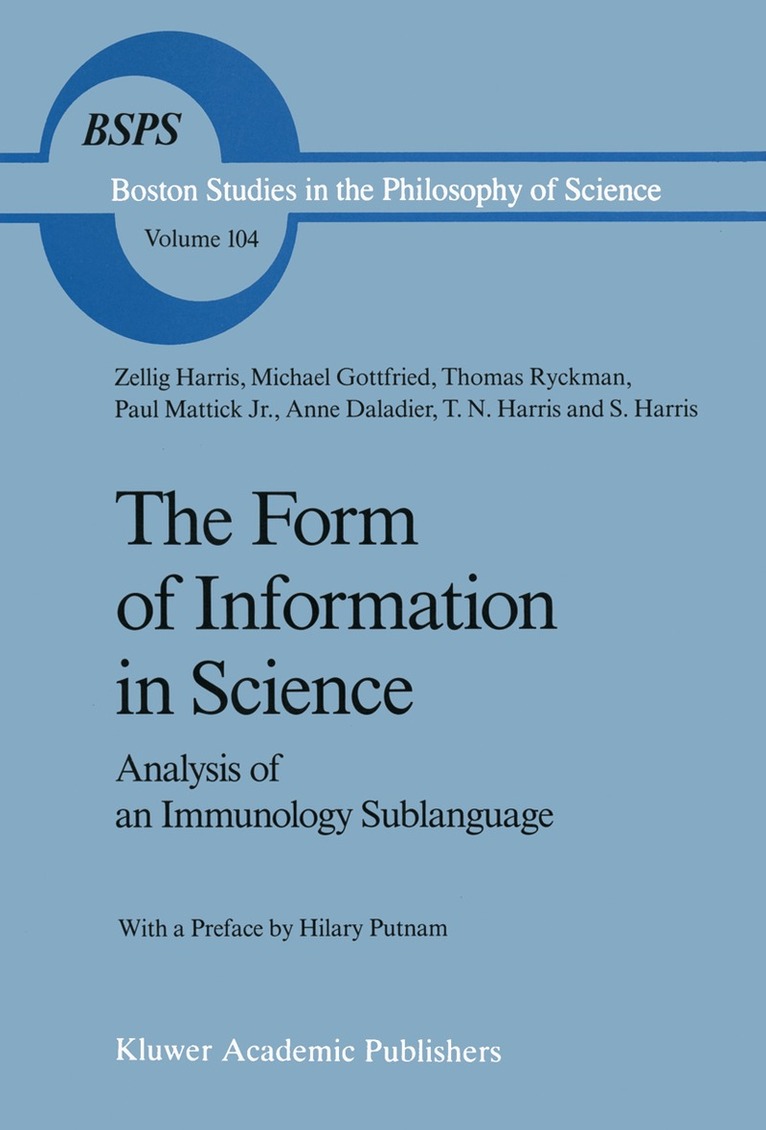
Del 104 - Boston Studies in the Philosophy and History of Science
Form of Information in Science
Analysis of an Immunology Sublanguage
Häftad, Engelska, 2011
2 121 kr
Skickas inom 10-15 vardagar
DOES DISCOURSE HAVE A 'STRUCTURE'? HARRIS'S REVOLUTION IN LINGUISTICS As a freshman back in 1947 I discovered that within the various academic divisions and subdivisions of the University of Pennsylvania there existed a something (it was not a Department, but a piece of the Anthropology Department) called 'Linguistic Analysis'. I was an untalented but enthusiastic student of Greek and a slightly more talented student of German, as well as the son of a translator, so the idea of 'Linguistic Analysis' attracted me, sight unseen, and I signed up for a course. It turned out that 'Linguistic Analysis' was essentially a graduate program - I and another undergraduate called Noam Chomsky were the only two undergraduates who took courses in Linguistic Analysis - and also that it was essentially a one-man show: a professor named Zellig Harris taught all the courses with the aid of graduate Teaching Fellows (and possibly - I am not sure - one Assistant Professor). The technicalities of Linguistic Analysis were formidable, and I never did master them all. But the powerful intellect and personality of Zellig Harris drew me like a lodestone, and, although I majored in Philosophy, I took every course there was to take in Linguistic Analysis from then until my gradua tion. What 'Linguistics' was like before Zellig Harris is something not many people care to remember today.