• Fri frakt över 249 kr
  • •
  • Snabba leveranser
  • •
  • Billiga böcker
Kundservice

Du är på sajten för privatpersoner.

Företag, bibliotek eller offentlig verksamhet?

Du handlar på classic.bokus.com, där alla dina funktioner finns intakta.
Till classic.bokus.com
Bokus logotyp. Gå till startsidan.
  • Erbjudanden
  • Student
  • Topplistor
  • Barn & ungdom
  • Bokus Play
  • E-böcker
  • Ljudböcker
  • Pocketböcker
  • Spel och pussel

Pocketfynda! Hundratals böcker för 49 kr/st →

Sidfot

Mina sidor

    Hjälp

    • Kundservice
    • Vanliga frågor och svar
    • Frakt och leverans
    • Retur vid ångerrätt
    • Reklamera vara
    • Betalning
    • Köpvillkor
    • Allmänna villkor
    • Information om webbplatsens tillgänglighet

    Om Bokus

    • Om oss
    • Pressrum
    • För studenter
    • För företag
    • För bibliotek och offentlig verksamhet
    • För leverantörer
    • Hållbarhet

    Populärt

    • Aktuella erbjudanden
    • Presentkort
    • Studentlitteratur
    • Nya böcker
    • Topplistor
    • Signerade böcker
    • Engelska böcker

    Inspiration

    • Boktips
    • BookTok
    • Barnbokskaraktärer
    • Populära författare
    Logotyp för Bokus
    Följ oss på Facebook (extern länk)Följ oss på Instagram (extern länk)Följ oss på YouTube (extern länk)Följ oss på TikTok (extern länk)
    bokus @ CookiesAnpassa cookiesIntegritetspolicyKöpvillkor
    Till Citymail hemsida (extern länk)Till Budbee hemsida (extern länk)Till Postnord hemsida (extern länk)Till Schenker hemsida (extern länk)Till Early Bird hemsida (extern länk)Till Walleys hemsida (extern länk)
    1. Juridik
    2. Internationell rätt
    3. Folkrätt

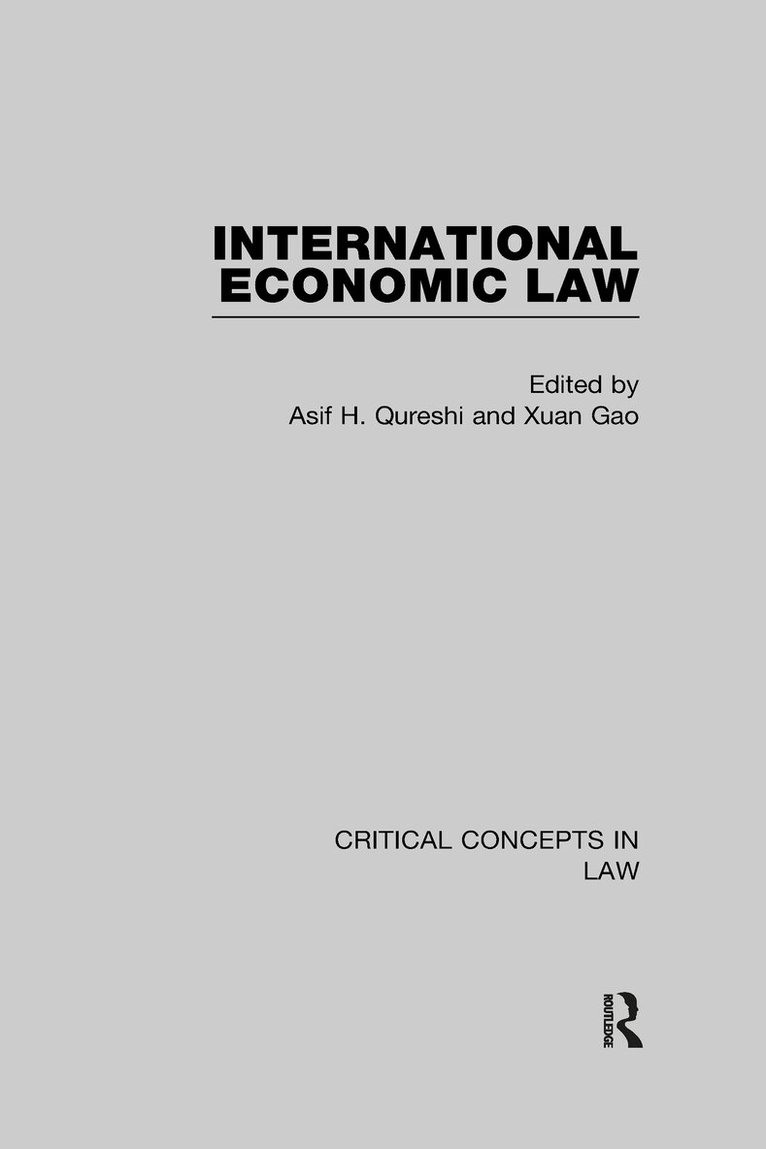
    International Economic Law

    AvAsif H. Qureshi,Xuan Gao

    Taylor & Francis Ltd

    2010

    Del i serien Critical Concepts in Law

    28 661 kr

    Beställningsvara. Skickas inom 5-8 vardagar. Fri frakt över 249 kr.

    Beskrivning

    The legal foundations of the international economy—which underpin both the actions of sovereign states, as well as the conduct of individuals and business entities engaged in cross-border transactions—are now more than ever a crucial site for scholarly exploration.Indeed, with the growing impact of globalization, research in and around the subject flourishes as never before. This new four-volume collection from Routledge meets the need for an authoritative reference work to map a rapidly growing and ever more complex corpus of literature. Edited by a leading scholar, International Economic Law gathers foundational and canonical work, together with more contemporary and cutting-edge scholarship. The collection boldly identifies and elucidates International Economic Law’s critical concepts to make sense of the subdiscipline’s evolution and to garner insights into its likely development.With a full index, together with a comprehensive introduction, newly written by the editor, which places the collected material in its historical and intellectual context, International Economic Law is an essential work of reference. For the novice or advanced student, the collection will be particularly useful as an essential database allowing scattered and often fugitive material to be easily located. And, for the more advanced scholar, as well as practitioners and policy-makers, it will be welcomed as a crucial tool permitting rapid access to less familiar—and sometimes overlooked—texts. For all users, International Economic Law will be valued as a vital one-stop research and pedagogic resource.

    Produktinformation

    • Märke:Taylor & Francis Ltd
    • Utgivningsdatum:2010-07-14
    • Höjd:156 x 234 x 180 mm
    • Vikt:4 888 g
    • Språk:Engelska
    • Serie:Critical Concepts in Law
    • Antal sidor:2 478
    • Förlag:Taylor & Francis Ltd
    • EAN:9780415543262

    Utforska kategorier

    • Folkrätt inom Juridik

    Mer om författaren

    Edited Asif H. Quershi and Xuan Gao

    Innehållsförteckning

    • Volume I Part 1: Theory 1. Conceptualizing International Economic Law 2. The Phenomenon of Globalization 3. The Washington Consensus 4. International Distributive Justice Part 2: Fundamental Concepts 1. Sources Customary International Economic Law International Economic Soft Law 2. Participants State Economic Development Paradigms Non-governmental Organizations 3. Economic Sovereignty 4. Non-discrimination and Differential Treatment 5. Extraterritorial Jurisdiction 6. State Immunity 7. Constitutionalizing International Economic Law 8. Economic Human Rights 9. Economic Sanctions Volume II: International Monetary and Financial Law 1. Monetary Sovereignty 2. Exchange Arrangements 3. Multilateral System of Payments 4. International Capital Transfers 5. International Liquidity: Special Drawing Rights 6. IMF Conditionality 7. Surveillance and IMF Standards and Codes 8. International Financial Architecture 9. Sovereign Debt Volume III: World Trade Law 1. Theory of Comparative Advantage 2. Reciprocity in Trade Negotiations 3. Market Access 4. National Treatment 5. MFN Treatment 6. Unfair Trade Practices 7. Regional Trade Agreements 8. Consensus Decision-Making 9. Enforcement and Transparency. Non-Violation Complaint. Trade Policy Review 10. Development and Trade. Special and Differential Treatment. Aid for Trade. Food Security. Process and Production Methods Volume IV: International Investment Law 1. Key Concepts in General International Law. International Minimum Standard. Expropriation Stabilization Clauses. International Corporate Social Responsibility 2. Key Concepts in Investment Agreements. ‘Investment’ in International Investment Law. Fair and Equitable Treatment. MFN Treatment Volume V: International Development Law 1. Development 2. Permanent Sovereignty over Natural Resources 3. Right to Development 4. Sustainable Development 5. Millennium Development Goals 6. Monterrey Consensus 7. New International Economic Order 8. Good Governance and Global Governance Volume VI: International Fiscal Law 1. International Fiscal Law Defined 2. Worldwide versus Residence Taxation 3. Fiscal Sovereignty and Jurisdiction 4. Key Concepts in Double Taxation Relief and Tax Evasion and Avoidance 5. Non-Discrimination 6. Permanent Establishment 7. Non-Enforcement of Tax Claims 8. Harmful Tax Competition 9. Calculation of Multijurisdictional Company Profits. Unitary Taxation. Transfer Pricing