Critical Concepts in Law - Böcker
Visar alla böcker i serien Critical Concepts in Law. Handla med fri frakt och snabb leverans.
18 produkter
18 produkter
26 663 kr
Skickas inom 10-15 vardagar
This Critical Concepts series (a Routledge Major Work) is an anthology of influential works on international law. The collection covers the principal facets of both classical and contemporary international law. In making their selection, J.H.H. Weiler and Alan T. Nissel consulted with a wide range of experts and chose those pieces that in their view both shaped the field and have illuminated its contours. These articles have, or are expected to have, considerable "staying power."By juxtaposing classical with more contemporary articles, this anthology illustrates the motion of international law—the evolution of doctrine, practice and historiography of the field. The series begins with a consideration of the fundamental systemic (Volume I) and conceptual (Volumes II and III ) features of International Law. It then maps out substantive aspects (Volumes IV and V). The collection concludes (Volume VI) with what the authors call "multi-inter-disciplinary" approaches to the field.
16 041 kr
Skickas inom 7-10 vardagar
Edited and introduced by a leading academic in the field, this is a new Routledge Major Work in the Critical Concepts in Law series. Law and Economics is a five-volume collection of canonical and cutting-edge research on the application of economic theory - primarily microeconomics and the basic concepts of welfare economics—to the examination of the formation, structure, processes and economic impact of law and legal institutions. Economic concepts have been applied to explain and clarify legal issues, not only with respect to competition law, but also in respect of a wide range of non-market activities, ranging from issues of tortuous liability and compensation, to family matters and crime. Law and Economics has influenced legislation and the development of Anglo-American case law and has become a central part of legal and economic education and research at some of the most prestigious universities on both sides of the Atlantic.This collection provides users with a collection of original articles that represent the source materials upon which each of the various Law and Economics schools of thought are founded—including the Chicago approach and the New Haven School; public-choice theory and modern civic republicanism; institutional law and economics and the new institutional economics; social norms and law and economics; and Austrian law and economics. As well as the editor’s selection of foundational texts, his collection also brings together and makes readily accessible the very best of cutting-edge research in Law and Economics.Including a newly written introduction to each school of thought, a comprehensive index, and a chronological table of the articles, Law and Economics is a unique and valuable research resource for both student and scholar.
17 876 kr
Skickas inom 10-15 vardagar
A close engagement with law has long been a core dimension of feminist activism. However, it is only since the late twentieth century that a distinct and vital body of academic literature addressing the nature, effects, and limits of that engagement has emerged. In particular, from the 1980s onwards, a critical mass of scholarship has accumulated, establishing feminist legal studies not just as a recognizable subdiscipline, both of law and of feminist or women’s studies, but also as a terrain of substance and complexity, the exploration and understanding of which requires increasingly sophisticated navigation skills.As research in and around the area flourishes as never before, this new title in the Routledge Major Works series, Critical Concepts in Law, meets the need for an authoritative reference work to make sense of a rapidly growing and ever more complex corpus of literature, and to provide a map of feminist legal studies as it has emerged, developed, and diverged over the last thirty years.There are many ways of classifying feminist thinking within and beyond law. A typical method is to divide work into competing political or theoretical camps (such as liberal feminism, socialist feminism, and radical feminism). Another way, more common in law, is to organize feminist perspectives around issues such as abortion, equal pay, and pornography. A third treatment would be to focus on epistemologies (for example, feminist empiricism, standpoint theory, and postmodernism). However, the editor of this reference work, an internationally renowned scholar, eschews these increasingly sterile approaches and instead offers a view of feminist legal studies as a dynamic process of engagement with law which takes different forms and emphases at different points and contexts. Feminist legal studies does not, she argues, comprise a static set of ideas; it is rather an ongoing conversation.For this reason, the material gathered here in this four-volume collection is, to a considerable extent, organized chronologically, starting with the key feminist issues and interventions of the early 1980s. The collection then progresses thematically to reflect the shifts and turns of feminist legal thought. The content of the material is explicitly inter-jurisdictional, and reflects the global nature of feminist legal scholarship and, in particular, current thematic preoccupations.With a comprehensive introduction, newly written by the editor, which places the material in its historical and intellectual context, Feminist Legal Studies is an essential work of reference and is destined to be valued by scholars and students of feminist law—as well as those working in allied areas—as a vital one-stop research resource.
17 583 kr
Skickas inom 10-15 vardagar
Critical Legal Theory has conventionally been traced to the social, political, and philosophical movements of the 1960s and, before that, to the early-twentieth-century ‘realist’ critique of modern jurisprudence. In truth, however, its origins go back to classical and pre-modern thought, and to their acknowledgement of the centrality of law in attempts to conceive of the good life, or the just polity—a centrality that is, moreover, also discernible in the recent gravitation of a number of contemporary philosophers and theorists (such as Habermas, Derrida, Agamben, Luhmann, Latour) towards law.Against the ‘restricted’ and ‘conservative’ character of modern jurisprudence, Critical Legal Theory constitutes a return to this more general interest in law and legality. Exceeding (if not exploding) the limits of jurisprudence, it has, moreover, drawn upon the most ancient and most contemporary traditions of critical thought in order to pursue new ways of understanding, living, and imagining the law.Critical Legal Theory is now an established—if heterogeneous and controversial—field of study, represented by numerous international journals, regional organizations, and global conferences. As the field continues to flourish as never before, this new title in Routledge’s Major Works series, Critical Concepts in Law, meets the need for an authoritative reference work to make sense of a rapidly growing and ever more complex corpus of literature. Indeed, it is a landmark collection of Critical Legal Theory’s principal sources, orientations, movements, and themes.The first volume in the collection (‘Critical Legal Origins’) illuminates the foundations of Critical Legal Theory in contemporary continental thought, as well as providing an account of its institutional history. Volume II (‘Critical Legal Orientations’), meanwhile, examines the ways in which Critical Legal Theory has addressed and problematized conventional jurisprudential ideas about law, drawing upon the insights of philosophy, as well as other disciplines. Volume III (‘Critical Legal Movements’) assembles the best and most influential research to provide an overview of the movements that characterize the field. The scholarship assembled in the final volume (‘Critical Legal Themes’) brings together the key work to explore a range of substantial themes with which Critical Legal Theorists have engaged.Supplemented with a full index and comprehensive introductions, newly written by the editors, which situate the collected material in the context of more general theoretical traditions, as well as in critical relation to jurisprudence, Critical Legal Theory is destined to be valued by scholars, students, and researchers as a vital resource.
18 228 kr
Skickas inom 7-10 vardagar
Confronting the patriarchal origins and male-dominated institutions of international law, over the last several decades serious thinking about gender and international law has developed into a flourishing discourse within its host discipline. From the lecture theatres and conferences of academia to the corridors of international institutions frequented by non-governmental organizations, diplomats, and the bureaucrats of international institutions, gender issues are now placed firmly on the international-law agenda. Indeed, scholarship on gender and international law is now an important and dynamic area of critique that continues to challenge the failures of the political, legal, and institutional frameworks of international law.As research in gender and international law continues to flourish, this new four-volume collection from Routledge’s Critical Concepts in Law series brings together the most influential scholarship to date, gathering foundational and canonical theoretical work, together with innovative and cutting-edge applications and interventions. It provides an understanding of the development of the field of gender and international law, as well as highlighting areas of thought-provoking research to stimulate future developments in the field.The first volume in the collection (‘Defining Gender and International Law’) assembles key works to illustrate the development of the field and provide users with a clear understanding of the concepts, methods, and theoretical underpinnings of gender and international law. Volume II (‘Doing Gender and International Law: Actors and Institutions’) brings gender and international law to life as an action-orientated field, theoretically sophisticated, but focused on and contributing to changes in how international and national law-makers treat gendered issues. Volume III (‘Key Legal Themes in Gender and International Law’) provides an overview of the different legal themes that have engaged scholars analysing international law from feminist, women-centred, or gendered perspectives. The scholarship assembled in the final volume (‘Critical Movements and Emerging Issues in Gender and International Law’) collects work that encourages critical reflections about gendered analyses of contemporary issues in international law. It also highlights where increased attention is needed, or where current approaches by feminist international legal scholars might require further scrutiny.With a full index, together with a comprehensive introduction, newly written by the learned editors, which places the collected material in its historical and intellectual context, Gender and International Law is an essential work of reference and will be welcomed by researchers, advanced students, practitioners, and policy-makers.
27 557 kr
Skickas inom 7-10 vardagar
The legal foundations of the international economy—which underpin both the actions of sovereign states, as well as the conduct of individuals and business entities engaged in cross-border transactions—are now more than ever a crucial site for scholarly exploration.Indeed, with the growing impact of globalization, research in and around the subject flourishes as never before. This new four-volume collection from Routledge meets the need for an authoritative reference work to map a rapidly growing and ever more complex corpus of literature. Edited by a leading scholar, International Economic Law gathers foundational and canonical work, together with more contemporary and cutting-edge scholarship. The collection boldly identifies and elucidates International Economic Law’s critical concepts to make sense of the subdiscipline’s evolution and to garner insights into its likely development.With a full index, together with a comprehensive introduction, newly written by the editor, which places the collected material in its historical and intellectual context, International Economic Law is an essential work of reference. For the novice or advanced student, the collection will be particularly useful as an essential database allowing scattered and often fugitive material to be easily located. And, for the more advanced scholar, as well as practitioners and policy-makers, it will be welcomed as a crucial tool permitting rapid access to less familiar—and sometimes overlooked—texts. For all users, International Economic Law will be valued as a vital one-stop research and pedagogic resource.
16 850 kr
Skickas inom 10-15 vardagar
In the past three decades, the Chinese legal system has undergone a substantial transformation, reflecting the economic, social, culture, administrative, and political changes taking place in China. Compared with the situation in the early 1950s when the newly established People’s Republic of China started to construct a socialist legal system and with the situation in the early 1980s when post-Cultural Revolution (1966–76) legal reform had just started, the current Chinese legal system has become a relatively comprehensive system, comparable to a certain degree with the jurisdictions in Western developed countries.This new Major Work collection from Routledge brings together the most representative pieces for a comprehensive set covering every aspect of current Chinese law, providing readers with a one-stop reference resource on China’s legal, judicial, and institutional changes in the past decades, as well as current law and institutions in China.
21 580 kr
Skickas inom 7-10 vardagar
Law and Development emerged in the United States in the 1960s and rapidly spread throughout the world. Its intellectual origins can be traced back to the boundless confidence of some American legal academics about the possibilities of achieving democratic change in developing countries through legal means. Financial assistance from the US government and US-based foundations enabled the launch of scores of ambitious research projects and the rapid growth of legal education programmes in the newly independent states of Asia and Africa, as well as in several countries in Latin America. Thus, by the late 1960s and early 1970s, as the number of academic lawyers with direct knowledge of developing countries grew, the Law and Development movement was recognized as an important new trend in American legal education.During the 1960s Law and Development had a crucial impact on lawyers and law schools in a variety of countries, including Ethiopia, Sri Lanka, Chile, Perú, and Colombia. By the early 1970s, however, the movement lost its momentum, as some of its leading figures came to realize that American liberal legalism could not easily be replicated in developing countries. They refocused their attention to domestic legal issues and soon became the precursors of the enormously successful Law and Society and Socio-Legal Studies movements.By the late 1980s, however, Law and Development made a remarkable comeback, as the World Bank and bilateral donors began to acknowledge the crucial role of legal institutions in the process of development. As a consequence, Law and Development today occupies a prominent place on the agenda of all major international and national development agencies. It has also been firmly embraced by most developing countries, as they adapt their institutions and procedures to the demands generated by the process of globalization.The four volumes in this new collection from Routledge’s Major Works series, Critical Concepts in Law, bring together carefully selected materials that trace the evolution of the Law and Development movement; identify the key theoretical texts that have served as inspiration to this movement; provide a representative collection of articles written by specialists from various disciplines; and offer a selection of case studies and policy-based papers on the implementation of Law and Development projects.Edited by a leading scholar in the field, the collection also contains an extensive Introduction that examines the past, present, and future of Law and Development and will enable users to place the collected materials in their historical and intellectual context.
21 244 kr
Skickas inom 10-15 vardagar
In 1993, the United Nations Security Council set up an ad hoc tribunal to bring to trial those accused of the worst breaches of humanitarian law in the war-torn former Yugoslavia, thus setting in motion a process which has significantly raised the profile and importance of international criminal justice. Whether through a proliferation of international criminal courts and tribunals, or by the many pronouncements in domestic courts on international crimes, the patchwork of disparate rules, principles, conventions, and treaties is now taking discernible shape, and a distinct corpus of law operating across diverse cultures and varied legal traditions is rapidly emerging.Responding to these momentous developments, this new title from Routledge’s Major Works series, Critical Concepts in Law, addresses the acute need for an authoritative reference work that traces the evolution of the emerging discipline of international criminal law. The learned editors aver that now is the time to take stock and make some sense of the subject’s dauntingly vast literature, to identify a canon, and to engage with its key concepts. Selected by Antonio Cassese, the first President of the Yugoslavia Tribunal and the author of some of the most influential books on the subject, and a small team of noted scholars, this new four-volume collection assembles the best scholarship from the time of Nuremberg and Tokyo to the present day.The volume editors have realized an ambitious aim. Not only does International Criminal Law bring together ground-breaking material sourced from a wide range of academic journals, edited collections, textbooks, and monographs, many of which are now hard to obtain, the editors also illuminate the much broader—and fundamental—issues related to impunity, guilt, restitution, and social reconciliation.With a full index and a comprehensive introduction, International Criminal Law is an essential, authoritative, and accessible work of reference for scholar, student, and practitioner alike.
20 219 kr
Skickas inom 10-15 vardagar
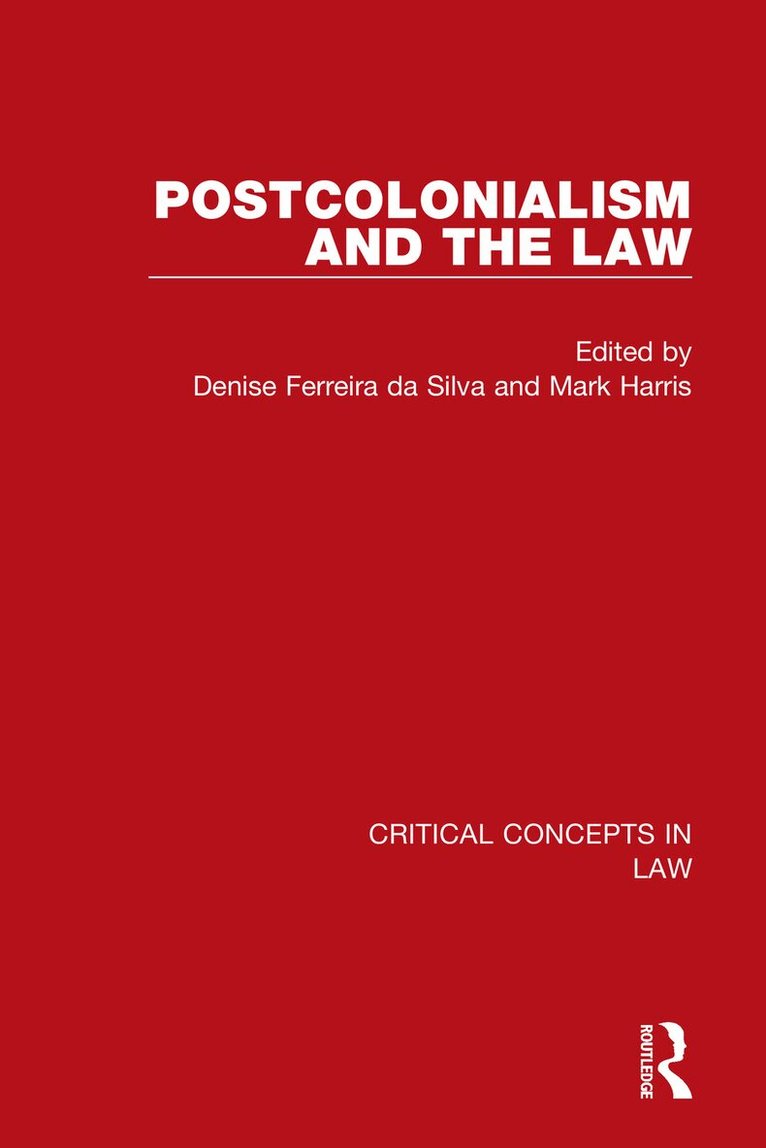
Postcolonialism and the Law provides a long overdue delineation of the field of enquiry that engages with the legal programmes, structures, and procedures which have sustained Euro-North American supremacy on the international political stage for the past fifty years or so. Focusing on the relationship between law and the racial and colonial mechanisms of subjugation at work in the global present, the contributions assembled in this new four-volume collection from Routledge’s Critical Concepts in Law series attend to juridical apparatuses as they operate in concert with economic and ethical frameworks, procedures, and architectures. Instead of approaching law as a self-sufficient instrument of power, the gathered major works expose the complex deployment and operation of legal instruments and how they—along with economic mechanisms and ethical programmes—participate in the constitution of the political space shared by both former colonial powers and colonies.With a full index, together with a comprehensive introduction, newly written by the editors, which places the collected material in its historical and intellectual context, Postcolonialism and the Law is an essential work of reference. The collection will be particularly useful as a database allowing scattered and often fugitive material to be easily located. It will also be welcomed as a crucial tool permitting rapid access to less familiar—and sometimes overlooked—texts. For postcolonial theorists and lawyers, as well as those working in cognate disciplines, such as Critical Legal Studies, Ethics, Cultural Studies, Race and Ethnicity Studies, and Human Rights, it is certain to be valued as a vital one-stop research and pedagogic resource.
16 118 kr
Skickas inom 10-15 vardagar
Despite the fact that the appropriation of land and resources of the so-called New World necessarily involved the dispossession and exploitation (and, sometimes, genocide) of the original inhabitants of colonized nations, it was not until the late twentieth century that Indigenous Peoples attained any meaningful degree of legal recognition in both national and international spheres. Until then Indigenous Peoples (also known as ‘First Nations’ and ‘First Peoples’) were routinely denied any form of juridical identity.Research in and around Indigenous Peoples and the Law is now very wide-ranging and flourishes as never before. But much of the relevant literature remains inaccessible or is highly specialized and compartmentalized, so that it is difficult for many of those who are interested in the subject to obtain an informed, balanced, and comprehensive overview. This new four-volume collection meets the need for an authoritative anthology to make sense of the subject’s vast and dispersed literature and the continuing explosion in research output. Drawing on a wide variety of materials from a broad range of disciplines and theoretical approaches, the collection gathers canonical and cutting-edge major works in a ‘one-stop’ resource to enable users to understand how the law Indigenous Peoples encounter has been transformed from an oppressive, rights-denying system to a site of contestation and for the articulation of claims.The collection includes a full index and is supplemented by introductions to each volume, newly written by the editors, which place the gathered materials in their historical and intellectual context. Indigenous Peoples and the Law is an essential reference work which will be valued as a vital resource by students, scholars, policy-makers, and practitioners.
Law and Society
2013
20 123 kr
Skickas inom 7-10 vardagar
The thriving and well-established field of Law and Society (also referred to as Sociolegal Studies) has diverse methodological influences; it draws on social-scientific and arts-based methods. The approach of scholars researching and teaching in the field often crosses disciplinary borders, but, broadly speaking, Law and Society scholarship goes behind formalism to investigate how and why law operates, or does not operate as intended, in society. By exploring law’s connections with broader social and political forces—both domestic and international—scholars gain valuable perspectives on ideology, culture, identity, and social life. Law and Society scholarship considers both the law in contexts, as well as contexts in law.Law and Society flourishes today, perhaps as never before. Academic thinkers toil both on the mundane and the local, as well as the global, making major advances in the ways in which we think both about law and society. Especially over the last four decades, scholarly output has rapidly burgeoned, and this new title from Routledge’s acclaimed Critical Concepts in Law series answers the need for an authoritative reference collection to help users make sense of the daunting quantity of serious research and thinking.Edited by the leading scholars in the field, Law and Society brings together in four volumes the vital classic and contemporary contributions. Volume I is dedicated to historical antecedents and precursors. The second volume covers methodologies and crucial themes. The third volume assembles key works on legal processes and professional groups, while the final volume of the collection focuses on substantive areas. Together, the volumes provide a one-stop ‘mini library’ enabling all interested researchers, teachers, and students to explore the origins of this thriving subdiscipline, and to gain a thorough understanding of where it is today.
Property
2015
20 219 kr
Skickas inom 10-15 vardagar
The editor of this new Routledge collection reminds us that ‘property is one of the most unassailable concepts of modern Western legal systems’. The need for individuals and companies to be able to control and manipulate property—including, among other things, rights in land, objects, patents, and copyrights—is foundational not only to modern economies, but also to our very identities, our liberties, and our relationships. Indeed, the secure creation and protection of property is regarded as a fundamental part of most civilized legal systems and it is even regarded by many as a necessary and pre-legal facet of human society itself. But the existence and concept of private property has always been subject to critique, from the Diggers to Marx and anarchist movements, to conscientious objectors to intellectual property, modern land reformers, and campaigners for decolonization. The nature, justification, distribution, forms, and meanings of property continue to be hugely controversial, particularly in a context of diminishing resources, environmental stress, and an expanding class of owners across the world. Recent academic theory emphasizes alternatives to mainstream property thinking, as well as a renewed interest in the commons as an alternative—in some spheres—to endless private commodification.Property meets the need for an authoritative reference work to help researchers and students navigate and make sense of a huge—and growing—scholarly literature. The collection is made up of four volumes which bring together the best and most influential canonical and trailblazing research.Fully indexed and with a comprehensive introduction newly written by the editor, which places the collected material in its historical and intellectual context, Property is an essential reference work, destined to be valued by scholars and students as a vital research resource.
20 219 kr
Skickas inom 10-15 vardagar
Law and Sexuality has rapidly developed as a distinct area of critical and socio-legal scholarship over the last two decades. In that time, it has blossomed from a small community into a global field of enquiry, with contributions at the cutting edge of academic legal research around the world. A key reason for its vigorous growth has been the rapid pace of legal change in recent years, with many Western societies providing or enhancing legal recognition of lesbian, gay, bisexual, and transgender (‘LGBT’) individuals, relationships, and lives. Indeed, many jurisdictions have recently passed progressive anti-discrimination legislation enacting formal equality for LGBT individuals in education, the workplace, or in access to goods and services. And more and more states are developing recognition frameworks for same-sex relationships and LGBT families. In other jurisdictions, however, there has been a parallel rise in anti-gay measures, including constitutional amendments banning gay marriage in several US states and the high-profile ‘Kill the Gays’ Bill in Uganda. This evolving legal cartography poses many interesting questions and dilemmas for scholars of law and sexuality, offering rich resources for insightful work.Conceptually, law-and-sexuality research is typified by a dynamic, evolving, and sophisticated conceptual and theoretical base, and this new four-volume collection from Routledge provides an essential work of reference for experts and neophytes alike. Law and Sexuality is prefaced by an introduction, newly written by the editor, which places the gathered materials in context. Each volume also includes a shorter introduction mapping developing themes and trajectories. The collection is sure to be welcomed as a crucial one-stop resource for reference and research.
19 780 kr
Skickas inom 10-15 vardagar
Scholars and practitioners working in ‘transitional justice’ are concerned with remedies of accountability and redress in the aftermath of conflict and state repression. Transitional justice, it is argued, provides recognition of the rights of victims, promotes civic trust, and strengthens the democratic rule of law. As serious scholarship flourishes around this critical concept as never before, this new collection from Routledge meets the need for an authoritative reference work to map a vibrant site of research and reflection. In four volumes, Transitional Justice is an accessible database which brings together foundational and the best and most influential cutting-edge materials, including key works produced before the term ‘transitional justice’ gained wide currency but which anticipate approaches now included under that rubric.The collection covers themes such as: truth and history; acknowledgement, reconciliation, and forgiveness; retribution, restorative justice and reparations; and democracy, state-building, identity, and civil society. Fully indexed and with a comprehensive introduction, newly written by the editors, Transitional Justice is an essential work of reference.
13 921 kr
Skickas inom 10-15 vardagar
Once a mere appendage to constitutional law proper, research in comparative constitutional law has burgeoned in recent decades. Indeed, a growing tendency towards international borrowing and harmonization has been marked in many jurisdictions (even, tentatively, the United States), but it has not been uncontroversial, or uncontested.Now, this new collection from Routledge’s Critical Concepts in Law series meets the need for an authoritative reference work to help researchers and students navigate and make better sense of an abundance of scholarship in comparative constitutional law. The collection is made up of four volumes which bring together the best and most influential canonical and cutting-edge thinking. Topics include constitution-making and amendment; the different structural components of constitutional governance (such as the relationship of legislatures to courts and the effects of different methods of judicial oversight); the interaction of constitutional law with transnational sources of law; and theoretical and practical aspects of constitutional legitimacy.With a full index, and thoughtful introductions, newly written by the learned editor, Comparative Constitutional Law traces the field's development and highlights the challenges for future explorations. The collection will be valued by legal scholars—as well as by political philosophers and theorists—as a vital and enduring resource.
Law and History
2016
22 633 kr
Skickas inom 10-15 vardagar
The historical study of law is among the most important domains of global legal scholarship. Indeed, many of the most distinguished academic works on law are historical. And while much scholarly output has focused on ‘textual’ legal history—exploring how legal doctrines, ideas, concepts, principles, and institutions have developed over time—in recent years there has also been a sharpened focus on ‘contextual’ legal history, exploring the interaction and interplay between legal and socio-political change.Now, to help researchers and students navigate and make better sense of an overabundance of scholarship, Routledge announces a new collection in its Critical Concepts in Law series. Edited by two leading academics, Law and History provides an authoritative ‘mini library’ which explores the development of legal history as an area of study by bringing together major works on the ‘textual’ legal history of English law alongside cutting-edge ‘contextual’ legal history.Volume I, entitled ‘Historiography’, explores the relationship between law and history and the development of legal history. The second and third volumes ('Public Law’and 'Land Law’ ) explicate law’s historical development, while the collection’s final volume, ‘Law of Obligations', underscores the interaction between legal and social and political change.With a full index, and thoughtful introductions, newly written by the learned editors, Law and History is sure to be welcomed as a vital and enduring reference and pedagogical resource.
Law and Religion
2016
21 977 kr
Skickas inom 10-15 vardagar
From the murderous reaction to the publication in a French satirical magazine of ‘blasphemous’ cartoons, to wrangles over the wearing of religious dress and symbols in schools and workplaces, the interaction between law and religion is rarely far from the headlines. Indeed, the editors of this Routledge collection argue that, since the events of 11 September 2001, the short- and long-term implications of multiculturalism, religious resurgence, and extremism have dominated public life both globally and domestically. Consequently, they say, the legal framework concerning the regulation of religion has changed dramatically over the last decade or so. There have been numerous developments at the global, regional, state, and sub-state level, and these changes have been accompanied by an unprecedented number of high-profile cases affecting religious individuals and groups.Now, this new collection from Routledge’s Critical Concepts in Law series, edited by two prolific authors based at the world-leading Centre for Law and Religion at Cardiff University, meets the need for an authoritative reference work to help researchers and students navigate and make better sense of an abundance of scholarship.With a full index, and thoughtful introductions, newly written by the learned editors, Law and Religion traces the field’s development and highlights the challenges for future explorations. The collection will be valued by legal and religious scholars as a vital and enduring resource.