Visar resultat för..."Berättelse Chicago Ernst"
Sökningen "Berättelse från Chicago Ernst Lindblom" gav inga träffar.19 produkter
19 produkter
786 kr
Tillfälligt slut
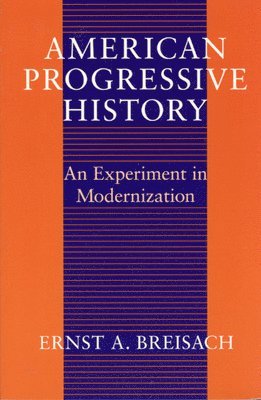
American Progressive History is the first book to relate the story of Progressive history through all its transformations from its emergence in the early 1900s to its demise in the 1940s. Focusing his account on the work of the movement's most important representatives--including Charles Beard, James Harvey Robinson, and Carl Becker--Ernst Breisach demonstrates that Progressive history is distinguished by its unique combination of beliefs in the objective reality of historical facts and its faith in the inevitability of the progress of the human race. And though he discusses at length Frederick Jackson Turner's contributions to the creation of a modern American historiography, Breisach sets him apart from the scholars who shaped Progressive history. While Progressive history is usually treated in isolation from simultanieous movements in European historiography, Breisach shows how it was formulated in the face of the same cultural pressures confronting European historians.Indeed, it becomes clear that until the 1930s the Progressive historians' confidence in the validity of historical investigation and the progress of civilization shielded American historians from the skepticism and cultural pessimism which characterized many of their European contempories. Breisach's exceptionally broad and subtle analysis reveals American Progressive history to be an important and innovative experiment in the international quest for a New History, as well as a coherent school of thought in its own right.
312 kr
Skickas inom 5-8 vardagar
American Progressive History is the first book to relate the story of Progressive history through all its transformations from its emergence in the early 1900s to its demise in the 1940s. Focusing his account on the work of the movement's most important representatives—including Charles Beard, James Harvey Robinson, and Carl Becker—Ernst Breisach demonstrates that Progressive history is distinguished by its unique combination of beliefs in the objective reality of historical facts and its faith in the inevitability of the progress of the human race. And though he discusses at length Frederick Jackson Turner's contributions to the creation of a modern American historiography, Breisach sets him apart from the scholars who shaped Progressive history. While Progressive history is usually treated in isolation from simultanieous movements in European historiography, Breisach shows how it was formulated in the face of the same cultural pressures confronting European historians. Indeed, it becomes clear that until the 1930s the Progressive historians' confidence in the validity of historical investigation and the progress of civilization shielded American historians from the skepticism and cultural pessimism which characterized many of their European contempories.Breisach's exceptionally broad and subtle analysis reveals American Progressive history to be an important and innovative experiment in the international quest for a New History, as well as a coherent school of thought in its own right.
1 536 kr
Skickas inom 3-6 vardagar
In this pioneering work, Ernst Breisach presents an effective, well-organized, and concise account of the development of historiography in Western culture. Neither a handbook nor an encyclopedia, this up-to-date third edition narrates and interprets the development of historiography from its origins in Greek poetry to the present, with compelling sections on postmodernism, deconstructionism, African-American history, women’s history, microhistory, the Historikerstreit, cultural history, and more. The definitive look at the writing of history by a historian, Historiography provides key insights into some of the most important issues, debates and innovations in modern historiography. Praise for the first edition: “Breisach’s comprehensive coverage of the subject and his clear presentation of the issues and the complexity of an evolving discipline easily make his work the best of its kind.”—Lester D. Stephens, American Historical Review
363 kr
In this pioneering work, Ernst Breisach presents an effective, well-organized, and concise account of the development of historiography in Western culture. Neither a handbook nor an encyclopedia, this up-to-date third edition narrates and interprets the development of historiography from its origins in Greek poetry to the present, with compelling sections on postmodernism, deconstructionism, African-American history, women’s history, microhistory, the Historikerstreit, cultural history, and more. The definitive look at the writing of history by a historian, Historiography provides key insights into some of the most important issues, debates and innovations in modern historiography. Praise for the first edition: “Breisach’s comprehensive coverage of the subject and his clear presentation of the issues and the complexity of an evolving discipline easily make his work the best of its kind.”—Lester D. Stephens, American Historical Review
330 kr
Skickas inom 5-8 vardagar
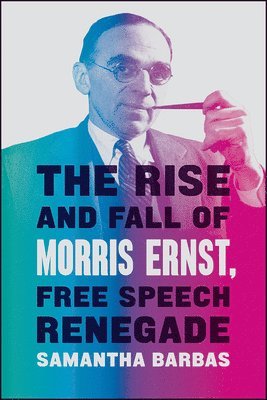
In the 1930s and ’40s, Morris Ernst was one of the best-known liberal lawyers in the United States. An eminent attorney and general counsel of the ACLU for decades, Ernst was renowned for his audacious fights against literary and artistic censorship. He successfully defended Ulysses against obscenity charges, litigated groundbreaking reproductive rights cases, and supported the widespread broadening of protections for sexual expression, union organizing, and public speech. Yet this “human dynamo,” as friends called him, was also a man of stark contradictions, who also waged a personal battle against Communism, defended a foreign autocrat, and aligned himself with J. Edgar Hoover’s inflammatory crusades.Arriving at a moment when issues of privacy, artistic freedom, and personal expression are freshly relevant, The Rise and Fall of Morris Ernst, Free Speech Renegade brings this singularly complex figure into a timely new light. As Samantha Barbas’s eloquent and compelling biography makes ironically clear, Ernst both transformed free speech in America and inflicted damage to the cause of civil liberties. Drawing on Ernst’s voluminous cache of publications and papers, Barbas follows the life of this singular idealist from his pugnacious early career to his legal triumphs of the 1930s and ’40s and later-life turn toward zealous anticommunism. As she shows, today’s challenges to free speech and the exercise of political power make Morris Ernst’s battles as pertinent as ever.
348 kr
Skickas inom 5-8 vardagar
181 kr
Skickas inom 5-8 vardagar
369 kr
Skickas inom 5-8 vardagar
515 kr
Tillfälligt slut
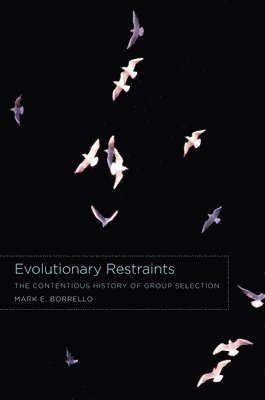
Much of the history of the evolutionary debate since Darwin has focused on the level at which natural selection occurs. Most biologists acknowledge multiple levels of selection - from the gene, the trait, and the organism, to the family, the group, and the species. However, it is the debate about group selection that Mark E. Borrello focuses on in "Evolutionary Restraints". Tracing the history of biological attempts to determine whether selection could lead to the evolution of fitter groups, Borrello takes as his focus the British naturalist V. C. Wynne-Edwards, who proposed that animals could regulate their own population levels and thereby avoid overexploitation of their food and other resources. By the mid-twentieth century, Wynne-Edwards became the primary advocate for group selection theory and precipitated a debate that engaged the most significant evolutionary biologists, including Ernst Mayr, John Maynard Smith, G. C. Williams, and Richard Dawkins. The resultant interpretations and arguments bled out into broader conversations about population regulation, environmental crises, and the evolution of human and animal social behavior."Evolutionary Restraints" illuminates both the process of science and the role of controversy in the process. From its origins in Darwin's own thinking, this debate, Borrello reminds us, remains relevant and alive to this day.
271 kr
Skickas inom 5-8 vardagar
Much of the evolutionary debate since Darwin has focused on the level at which natural selection occurs. Most biologists acknowledge multiple levels of selection - from the gene to the species. The debate about group selection, however, is the focus of Mark E. Borrello's "Evolutionary Restraints". Tracing the history of biological attempts to determine whether selection leads to the evolution of fitter groups, Borrello takes as his focus the British naturalist V. C. Wynne-Edwards, who proposed that animals could regulate their own populations and thus avoid overexploitation of their resources. By the mid-twentieth century, Wynne-Edwards became an advocate for group selection theory and led a debate that engaged the most significant evolutionary biologists of his time, including Ernst Mayr, G. C. Williams, and Richard Dawkins. This important dialogue bled out into broader conversations about population regulation, environmental crises, and the evolution of human social behavior. By examining a single facet of the long debate about evolution, Borrello provides powerful insight into an intellectual quandary that remains relevant and alive to this day.
411 kr
Tillfälligt slut
Earthquakes have taught us much about our planet's hidden structure and the forces that have shaped it. This knowledge rests not only on the recordings of seismographs, but also on the observations of eyewitnesses to destruction. During the nineteenth century, a scientific description of an earthquake was built of stories - stories from as many people in as many situations as possible. Sometimes their stories told of fear and devastation, sometimes of wonder and excitement. In "The Earthquake Observers", Deborah R. Coen acquaints readers not only with the century's most eloquent seismic commentators, including Alexander von Humboldt, Charles Darwin, Mark Twain, Charles Dickens, Karl Kraus, Ernst Mach, John Muir, and William James, but also with countless other citizen-observers, many of whom were women. Coen explains how observing networks transformed an instant of panic and confusion into a field for scientific research, turning earthquakes into natural experiments at the nexus of the physical and human sciences.Seismology abandoned this project of citizen science with the introduction of the Richter Scale in the 1930s, only to revive it in the twenty-first century in the face of new hazards and uncertainties. "The Earthquake Observers" tells the history of this interrupted dialogue between scientists and citizens about living with environmental risk.
247 kr
Skickas inom 5-8 vardagar
Earthquakes have taught us much about our planet's hidden structure and the forces that have shaped it. This knowledge rests not only on the recordings of seismographs but also on the observations of eyewitnesses to destruction. During the nineteenth century, a scientific description of an earthquake was built of stories - stories from as many people in as many situations as possible. Sometimes their stories told of fear and devastation, sometimes of wonder and excitement. In The Earthquake Observers, Deborah R. Coen acquaints readers not only with the century's most eloquent seismic commentators, including Alexander von. Humboldt, Charles Darwitt, Mark Twain, Charles Dickens, Karl Kraus, Ernst Mach, John Muir, and William James, but also with countless other citizen-observers, many of whom were women. Coen explains how observing networks transformed an instant of panic and confusion into a field for scientific research, turning earthquakes into natural experiments at the nexus of the physical and human sciences.Seismology abandoned this project of citizen science with the introduction of the Richter Scale in the 1950s, only to revive it in the twenty-first century in the face of new hazards and uncertainties. The Earthquake Observers tells the history of this interrupted dialogue between scientists and citizens about living with environmental risk.
402 kr
Skickas inom 5-8 vardagar
Our stories of industrial innovation tend to focus on individual initiative and lone breakthroughs. With Making Jet Engines, Hermione Giffard uses the case of the development of jet engines during World War II to offer a different way of understanding technological innovation, revealing the complicated mix of factors that go into any decision to pursue an innovative, and therefore risky technology. Giffard compares the approaches of Germany, Britain, and the United States, showing that each approached jet engines in different ways because of its own particular war aims and industrial expertise. Germany, which produced more jet engines than the others, did so largely as replacements for more expensive piston engines. Britain, on the other hand, produced relatively few engines but, by shifting emphasis to design rather than production, found itself at war's end holding an unrivaled range of designs. The US emphasis on development, meanwhile, built an institutional basis for postwar production.Taken together, Giffard's accounts make a powerful case for a more nuanced understanding of technological innovation, one that takes into account the influence of the many organizational factors that play a part in the journey from idea to finished product.
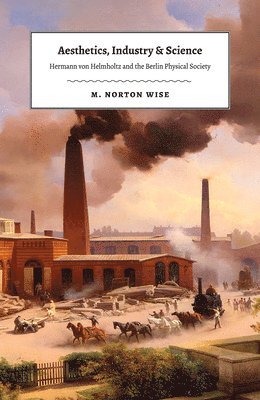
Aesthetics, Industry, and Science
Hermann Von Helmholtz and the Berlin Physical Society
Inbunden, Engelska, 2018
402 kr
Skickas inom 5-8 vardagar
On January 5, 1845, the Prussian Cultural Minister received a request by a group of six young men to form a new Physical Society in Berlin. In fields from thermodynamics, mechanics, and electromagnetism to animal electricity, ophthalmology, and psychophysics, members of this small but growing group--which soon included Emil Du Bois-Reymond, Ernst Brucke, Werner Siemens, and Hermann von Helmholtz--established leading positions in what only thirty years later had become a new landscape of natural science. How was this possible? How could a bunch of twenty-somethings succeed in seizing the future? In Aesthetics, Industry, and Science, M. Norton Wise answers these questions not simply from a technical perspective of theories and practices but with a broader cultural view of what was happening in Berlin at the time. He emphasizes in particular how rapid industrial development, military modernization, and the neoclassical aesthetics of contemporary art informed the ways in which these young men thought. Wise argues that aesthetic sensibility and material aspiration in this period were intimately linked, and he uses these two themes for a final reappraisal of Helmholtz's early work. Anyone interested in modern German cultural history, or the history of nineteenth-century German science, will be drawn to this landmark book.
1 102 kr
Skickas inom 5-8 vardagar
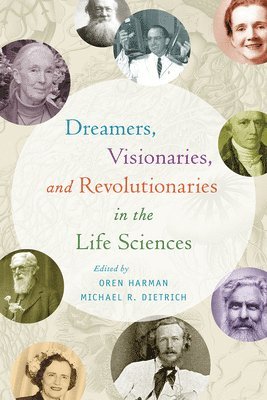
What are the conditions that foster true novelty and allow visionaries to set their eyes on unknown horizons? What have been the challenges that have spawned new innovations, and how have they shaped modern biology? In Dreamers, Visionaries, and Revolutionaries in the Life Sciences, editors Oren Harman and Michael R. Dietrich explore these questions through the lives of eighteen exemplary biologists who had grand and often radical ideas that went far beyond the run-of-the-mill science of their peers. From the Frenchman Jean-Baptiste Lamarck, who coined the word “biology” in the early nineteenth century, to the American James Lovelock, for whom the Earth is a living, breathing organism, these dreamers innovated in ways that forced their contemporaries to reexamine comfortable truths. With this collection readers will follow Jane Goodall into the hidden world of apes in African jungles and Francis Crick as he attacks the problem of consciousness. Join Mary Lasker on her campaign to conquer cancer and follow geneticist George Church as he dreams of bringing back woolly mammoths and Neanderthals. In these lives and the many others featured in these pages, we discover visions that were sometimes fantastical, quixotic, and even threatening and destabilizing, but always a challenge to the status quo.
372 kr
Skickas inom 5-8 vardagar
What are the conditions that foster true novelty and allow visionaries to set their eyes on unknown horizons? What have been the challenges that have spawned new innovations, and how have they shaped modern biology? In Dreamers, Visionaries, and Revolutionaries in the Life Sciences, editors Oren Harman and Michael R. Dietrich explore these questions through the lives of eighteen exemplary biologists who had grand and often radical ideas that went far beyond the run-of-the-mill science of their peers. From the Frenchman Jean-Baptiste Lamarck, who coined the word "biology" in the early nineteenth century, to the American James Lovelock, for whom the Earth is a living, breathing organism, these dreamers innovated in ways that forced their contemporaries to reexamine comfortable truths. With this collection readers will follow Jane Goodall into the hidden world of apes in African jungles and Francis Crick as he attacks the problem of consciousness. Join Mary Lasker on her campaign to conquer cancer and follow geneticist George Church as he dreams of bringing back woolly mammoths and Neanderthals. In these lives and the many others featured in these pages, we discover visions that were sometimes fantastical, quixotic, and even threatening and destabilizing, but always a challenge to the status quo.
312 kr
Skickas inom 5-8 vardagar
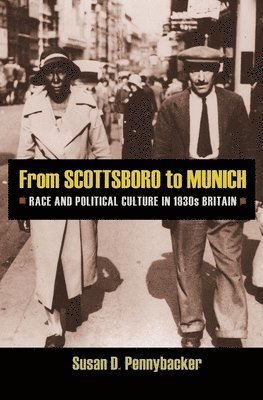
Presenting a portrait of engaged, activist lives in the 1930s, From Scottsboro to Munich follows a global network of individuals and organizations that posed challenges to the racism and colonialism of the era. Susan Pennybacker positions race at the center of the British, imperial, and transatlantic political culture of the 1930s--from Jim Crow, to imperial London, to the events leading to the Munich Crisis--offering a provocative new understanding of the conflicts, politics, and solidarities of the years leading to World War II. Pennybacker examines the British Scottsboro defense campaign, inaugurated after nine young African Americans were unjustly charged with raping two white women in Alabama in 1931. She explores the visit to Britain of Ada Wright, the mother of two of the defendants. Pennybacker also considers British responses to the Meerut Conspiracy Trial in India, the role that antislavery and refugee politics played in attempts to appease Hitler at Munich, and the work of key figures like Trinidadian George Padmore in opposing Jim Crow and anti-Semitism.Pennybacker uses a wide variety of archival materials drawn from Russian Comintern, Dutch, French, British, and American collections. Literary and biographical sources are complemented by rich photographic images. From Scottsboro to Munich sheds new light on the racial debates of the 1930s, the lives and achievements of committed activists and their supporters, and the political challenges that arose in the postwar years.
350 kr
Skickas inom 3-6 vardagar
Der Rothe Doktor Von Chicago - Ein Deutsch-Amerikanisches Auswandererschicksal
Biographie Des Dr. Ernst Schmidt, 1830-1900, Arzt Und Sozialrevolutionaer
Häftad, Tyska, 2003
1 362 kr
Tillfälligt slut
Letar du efter digitala böcker?
E-böcker och ljudböcker handlar du än så länge på vår tidigare sajt.