Race in the Atlantic World, 1700–1900 Series – serie
415 kr
Läs direkt efter köp
This study offers a new and challenging look at Christian institutions and practices in Britain’s Caribbean and southern American colonies. Focusing on the plantation societies of Barbados, Jamaica, and South Carolina, Nicholas M. Beasley finds that the tradition of liturgical worship in these places was more vibrant and more deeply rooted in European Christianity than previously thought. In addition, Beasley argues, white colonists’ attachment to religious continuity was thoroughly racialized. Church customs, sacraments, and ceremonies were a means of regulating slavery and asserting whiteness. Drawing on a mix of historical and anthropological methods, Beasley covers such topics as church architecture, pew seating customs, marriage, baptism, communion, and funerals. Colonists created an environment in sacred time and space that framed their rituals for maximum social impact, and they asserted privilege and power by privatizing some rituals and by meting out access to rituals to people of color. Throughout, Beasley is sensitive to how this culture of worship changed as each colony reacted to its own political, environmental, and demographic circumstances across time. Local factors influencing who partook in Christian rituals and how, when, and where these rituals took place could include the structure of the Anglican Church, which tended to be less hierarchical and centralized than at home in England; the level of tensions between Anglicans and Protestants; the persistence of African religious beliefs; and colonists’ attitudes toward free persons of color and elite slaves.This book enriches an existing historiography that neglects the cultural power of liturgical Christianity in the early South and the British Caribbean and offers a new account of the translation of early modern English Christianity to early America.
486 kr
Läs direkt efter köp
In 1834 Virgil Stewart rode from western Tennessee to a territory known as the “Arkansas morass” in pursuit of John Murrell, a thief accused of stealing two slaves. Stewart’s adventure led to a sensational trial and a wildly popular published account that would ultimately help trigger widespread violence during the summer of 1835, when five men accused of being professional gamblers were hanged in Vicksburg, nearly a score of others implicated with a gang of supposed slave thieves were executed in plantation districts, and even those who tried to stop the bloodshed found themselves targeted as dangerous and subversive. Using Stewart’s story as his point of entry, Joshua D. Rothman details why these events, which engulfed much of central and western Mississippi, came to pass. He also explains how the events revealed the fears, insecurities, and anxieties underpinning the cotton boom that made Mississippi the most seductive and exciting frontier in the Age of Jackson.As investors, settlers, slaves, brigands, and fortune-hunters converged in what was then America’s Southwest, they created a tumultuous landscape that promised boundless opportunity and spectacular wealth. Predicated on ruthless competition, unsustainable debt, brutal exploitation, and speculative financial practices that looked a lot like gambling, this landscape also produced such profound disillusionment and conflict that it contained the seeds of its own potential destruction. Rothman sheds light on the intertwining of slavery and capitalism in the period leading up to the Panic of 1837, highlighting the deeply American impulses underpinning the evolution of the slave South and the dizzying yet unstable frenzy wrought by economic flush times. It is a story with lessons for our own day.Published in association with the Library Company of Philadelphia’s Program in African American History. A Sarah Mills Hodge Fund Publication.
1 297 kr
Läs direkt efter köp
In the Caribbean colony of Grenada in 1797, Dorothy Thomas signed the manumission documents for her elderly slave Betty. Thomas owned dozens of slaves and was well on her way to amassing the fortune that would make her the richest black resident in the nearby colony of Demerara. What made the transaction notable was that Betty was Dorothy Thomas’s mother and that fifteen years earlier Dorothy had purchased her own freedom and that of her children. Although she was just one remove from bondage, Dorothy Thomas managed to become so rich and powerful that she was known as the Queen of Demerara.Dorothy Thomas’s story is but one of the remarkable acounts of pluck and courage recovered in Enterprising Women. As the microbiographies in this book reveal, free women of color in Britain’s Caribbean colonies were not merely the dependent concubines of the white male elite, as is commonly assumed. In the capricious world of the slave colonies during the age of revolutions, some of them were able to rise to dizzying heights of success. These highly entrepreneurial women exercised remarkable mobility and developed extensive commercial and kinship connections in the metropolitan heart of empire while raising well-educated children who were able to penetrate deep into British life.
575 kr
Läs direkt efter köp
Why did it take so long to end slavery in the United States, and what did it mean that the nation existed eighty-eight years as a “house divided against itself,” as Abraham Lincoln put it? The decline of slavery throughout the Atlantic world was a protracted affair, says Patrick Rael, but no other nation endured anything like the United States. Here the process took from 1777, when Vermont wrote slavery out of its state constitution, to 1865, when the Thirteenth Amendment abolished slavery nationwide.Rael immerses readers in the mix of social, geographic, economic, and political factors that shaped this unique American experience. He not only takes a far longer view of slavery’s demise than do those who date it to the rise of abolitionism in 1831, he also places it in a broader Atlantic context. We see how slavery ended variously by consent or force across time and place and how views on slavery evolved differently between the centers of European power and their colonial peripheries—some of which would become power centers themselves.Rael shows how African Americans played the central role in ending slavery in the United States. Fueled by new Revolutionary ideals of self-rule and universal equality—and on their own or alongside abolitionists—both slaves and free blacks slowly turned American opinion against the slave interests in the South. Secession followed, and then began the national bloodbath that would demand slavery’s complete destruction.
440 kr
Läs direkt efter köp
Finding Charity’s Folk highlights the experiences of enslaved Maryland women who negotiated for their own freedom, many of whom have been largely lost to historical records. Based on more than fifteen hundred manumission records and numerous manuscript documents from a diversity of archives, Jessica Millward skillfully brings together African American social and gender history to provide a new means of using biography as a historical genre.Millward opens with a striking discussion about how researching the life of a single enslaved woman, Charity Folks, transforms our understanding of slavery and freedom in Revolutionary America. For African American women such as Folks, freedom, like enslavement, was tied to a bondwoman’s reproductive capacities. Their offspring were used to perpetuate the slave economy. Finding loopholes in the law meant that enslaved women could give birth to and raise free children. For Millward, Folks demonstrates the fluidity of the boundaries between slavery and freedom, which was due largely to the gendered space occupied by enslaved women. The gendering of freedom influenced notions of liberty, equality, and race in what became the new nation and had profound implications for African American women’s future interactions with the state.
796 kr
Läs direkt efter köp
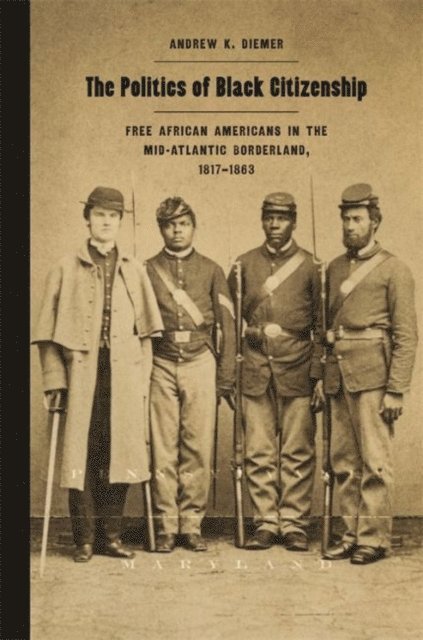
Considering Baltimore and Philadelphia as part of a larger, Mid-Atlantic borderland, The Politics of Black Citizenship shows that the antebellum effort to secure the rights of American citizenship was central to black politics—it was an effort that sought to exploit the ambiguities of citizenship and negotiate the complex national, state, and local politics in which that concept was determined.In the early nineteenth century, Baltimore and Philadelphia contained the largest two free black populations in the country, separated by a mere hundred miles. The counties that lie between them also contained large and vibrant freeblack populations in this period. In 1780, Pennsylvania had begun the process of outlawing slavery, while Maryland would cling desperately to the institution until the Civil War, and so these were also cities separated by the legal boundary between freedom and slavery. Despite the fact that slavery thrived in parts of the state of Maryland, in Baltimore the free black population outnumbered the enslaved so that on the eve of the Civil War there were ten times as many free blacks in the city of Baltimore as there were slaves.In this book Andrew Diemer examines the diverse tactics that free blacks employed in defense of their liberties—including violence and the building of autonomous black institutions—as well as African Americans'' familiarity with the public policy and political struggles that helped shape those freedoms in the first place.
973 kr
Läs direkt efter köp
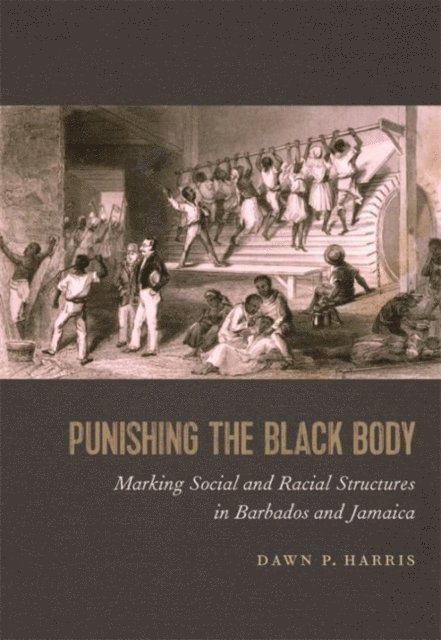
Punishing the Black Body examines the punitive and disciplinary technologies and ideologies embraced by ruling white elites in nineteenth-century Barbados and Jamaica. Among studies of the Caribbean on similar topics, this is the first to look at the meanings inscribed on the raced, gendered, and classed bodies on the receiving end of punishment. Dawn P. Harris uses theories of the body to detail the ways colonial states and their agents appropriated physicality to debase the black body, assert the inviolability of the white body, and demarcate the social boundaries between them.Noting marked demographic and geographic differences between Jamaica and Barbados, as well as any number of changes within the separate economic, political, and social trajectories of each island, Harris still finds that societal infractions by the subaltern populations of both islands brought on draconian forms of punishments aimed at maintaining the socio-racial hierarchy. Her investigation ranges across such topics as hair-cropping, the 1836 Emigration Act of Barbados and other punitive legislation, the state reprisals following the 1865 Morant Bay Rebellion in Jamaica, the use of the whip and the treadmill in jails and houses of correction, and methods of surveillance, policing, and limiting free movement. By focusing on meanings ascribed to the disciplined and punished body, Harris reminds us that the transitions between slavery, apprenticeship, and post-emancipation were not just a series of abstract phenomena signaling shifts in the prevailing order of things. For a large part of these islands’ populations, these times of dramatic change were physically felt.
1 415 kr
Läs direkt efter köp
Over the long nineteenth century, African-descended peoples used the uncertainties and possibilities of emancipation to stake claims to freedom, equality, and citizenship. In the process, people of color transformed the contours of communities, nations, and the Atlantic World. Although emancipation was an Atlantic event, it has been studied most often in geographically isolated ways. The justification for such local investigations rests in the notion that imperial and national contexts are essential to understanding slaving regimes. Just as the experience of slavery differed throughout the Atlantic World, so too did the experience of emancipation, as enslaved people’s paths to freedom varied depending on time and place.With the essays in this volume, historians contend that emancipation was not something that simply happened to enslaved peoples but rather something in which they actively participated. By viewing local experiences through an Atlantic framework, the contributors reveal how emancipation was both a shared experience across national lines and one shaped by the particularities of a specific nation. Their examination uncovers, in detail, the various techniques employed by people of African descent across the Atlantic World, allowing a broader picture of their paths to freedom.Contributors: Ikuko Asaka, Caree A. Banton, Celso Thomas Castilho, Gad Heuman, Martha S. Jones, Philip Kaisary, John Garrison Marks, Paul J. Polgar, James E. Sanders, Julie Saville, Matthew Spooner, Whitney Nell Stewart, and Andrew N. Wegmann.
575 kr
Läs direkt efter köp
427 kr
Läs direkt efter köp
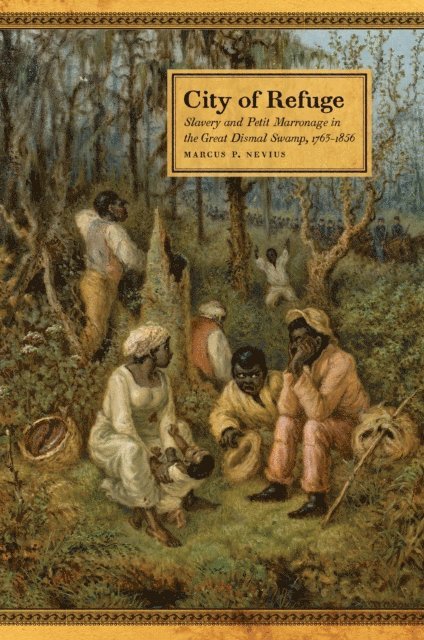
City of Refuge is a story of petit marronage, an informal slave’s economy, and the construction of internal improvements in the Great Dismal Swamp of Virginia and North Carolina. The vast wetland was tough terrain that most white Virginians and North Carolinians considered uninhabitable. Perceived desolation notwithstanding, black slaves fled into the swamp’s remote sectors and engaged in petit marronage, a type of escape and fugitivity prevalent throughout the Atlantic world. An alternative to the dangers of flight by way of the Underground Railroad, maroon communities often neighbored slave-labor camps, the latter located on the swamp’s periphery and operated by the Dismal Swamp Land Company and other companies that employed slave labor to facilitate the extraction of the Dismal’s natural resources. Often with the tacit acceptance of white company agents, company slaves engaged in various exchanges of goods and provisions with maroons—networks that padded company accounts even as they helped to sustain maroon colonies and communities.In his examination of life, commerce, and social activity in the Great Dismal Swamp, Marcus P. Nevius engages the historiographies of slave resistance and abolitionism in the early American republic. City of Refuge uses a wide variety of primary sources—including runaway advertisements; planters’ and merchants’ records, inventories, letterbooks, and correspondence; abolitionist pamphlets and broadsides; county free black registries; and the records and inventories of private companies—to examine how American maroons, enslaved canal laborers, white company agents, and commission merchants shaped, and were shaped by, race and slavery in an important region in the history of the late Atlantic world.