Advances in Inclusion Science - Böcker
Visar alla böcker i serien Advances in Inclusion Science. Handla med fri frakt och snabb leverans.
9 produkter
9 produkter
Proceedings of the Fourth International Symposium on Cyclodextrins
Munich, West Germany, April 20–22, 1988
Inbunden, Engelska, 1988
3 266 kr
Skickas inom 10-15 vardagar
The rapidly growing number of papers and patents on Cyclodextrins and their potential or actual industrial uses raised the idea to organize a Symposium on Cyclodextrins. This Symposium - held in September 1981 in Budapest, with more than 200 participants from 17 countries - proved to be very succesfull in every respect, therefore it has been accepted unanimously to organize the lInd CD-Symposium in 1984, in Tokyo. (The Budapest-Symposium got posteriorly the "First" adjective). The IInd Symposium was held together with the III. Int. Symposium on Chlatrate Compounds and Molecular Inclusion Phenomena. The IIIrd CD-Symposium also was held as a Joint Symposium, with the IVth. Chlatrate Symposium in Lancaster, U. K. ,1986. The limited time however showed, that such a broad field - from calixarenes to zeolites - can not be managed efficiently. Therefore the International Organizing Committee voted for separation of two Symposia in the future. The IVth Int. CD-Symposium was held in the Munich, in April 1988, and the Vth Chlatrate Symposium (called already Vth Int. Symposium on Inclusion Phenomena and Molecular Recognition) was held in Alabama, Sept. 1988. In Munich 220 participants from 21 countries attended 32 verbal lectures and 54 posters. This volume contains the submitted 71 manuscripts of the IVth Cyclodextrin Symposium.
850 kr
Skickas inom 10-15 vardagar
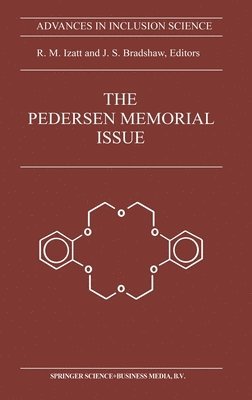
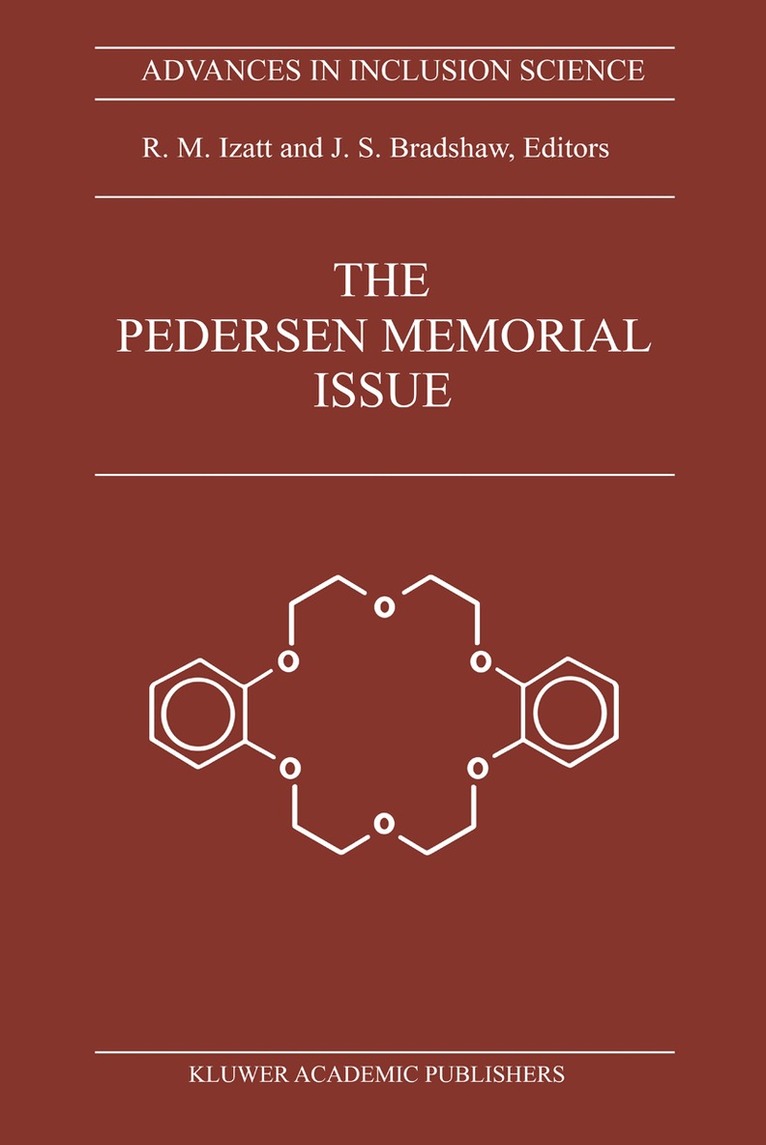
This volume is dedicated to the memory of the late Charles J. Pedersen in recognition of his contribution to scientific research, culminating in his discovery of crown ethers and their cation complexing properties and his receipt of the 1987 Nobel Prize for Chemistry. This collection of papers acknowledges the impact of his work. The field of macrocyclic chemistry, to a large degree, had its beginnings with Professor Pedersen's discovery. A first-person account of this discovery is given as the first paper in this volume. the growth of the field since the first publication on the subject in 1967 has been enormous. Charles Pedersen lived to see much of this growth. He saw many of his own predictions of possible uses of crown ethers and related macrocycles realized. His work illustrates how one individual can make an enormous difference in science. The effect of his life and work on those who contributed papers for this volume and on many others is appreciated and is acknowledged by several of the authors in their individual papers.
Proceedings of the First International Symposium on Cyclodextrins
Budapest, Hungary, 30 September–2 October, 1981
Häftad, Engelska, 2013
1 062 kr
Skickas inom 10-15 vardagar
Cyclodextrins are galnlng industrial interest owing to their particu- lar structure. These cyclic amyloses are commonly composed of 6, 7 or 8 (named a-, 8-, y-CD) glucose units. They undergo complexation with quite a large number of substances by molecular inclusion. Their potential for in- dustrial application is substantiated by their ability to protect fragile substances from oxygen and UV, to delay the evolution of volatiles and to aid the ancillary processing of dangerous or volatile substances in powder- ed form. Though a-, 8- and y-CD exhibit different inclusion specificity, 8-CD has found more attention than the others. This is due to the fact that most of the cyclodextrin producing enzymes known produce predominantly 8-CD. Fur- thermore 8-CD is by far the least soluble form, leading to a relatively sim- ple production and purification. Consequently 8-CD is already in production on an industrial scale [~] while a- and 8-CD are still more or less re- garded as specialities. A further CD-producing enzyme has been found in the medium of K. pneu- moniae [l], Since this CGT appeared to produce predominantly a-CD [~], it has been chosen to develop a process for the production of a-CD.MATERIALS AND METHODS Analysis of cyclodextrins: HPLC on Lichrosorb-NH . 10 ~m, with acetonitrile 2 water 65/35 per volume. Test for CGT activity: as described by Landert elsewhere in this Volume. Starch: potato starch as obtained from Blattmann, Wadenswil, Switzerland.
534 kr
Skickas inom 10-15 vardagar
Foreword: Charles J. Pedersen (1904-1989), Nobel Laureate in Chemistry (1987) This issue is dedicated to the memory of the late Charles J. Pedersen in recognition of his outstanding contribution to scientific research, culminating in his discovery of crown ethers and their remarkable cation complexing properties and his receipt of the 1987 Nobel Prize in Chemistry. Charlie's origin and early years in Korea did not portend the creative work in chemistry which would characterize his later life. However, we can see in his early years the influence of his Norwegian father and Japanese mother who considered his formal education to be of utmost importance. At the age of eight, he was sent abroad to Japan for schooling, first at a convent school in Nagasaki, and two years later at a French-American preparatory school in Yokohama run by a Marianist order of Catholic priests and brothers. The latter group encouraged him to attend the order's University of Dayton in Ohio where he received a bachelors degree in chemical engineering. Charlie's academic experiences, his employment with du Pont, and the creative spark which he manifested at an early stage of his scientific career are detailed in the paper in this issue by Herman Schroeder. Schroeder had a long-time association with Charlie at du Pont as a co-worker, supervisor, and friend. His recollections provide insight into Charlie's creative mind. In addition, they make it clear that a long period of creative work preceded the accidental discovery of the first synthetic crown ether. It is important to note that Charlie's mind was well prepared to recognize the importance of his discovery. The field of macrocyclic chemistry, to a large degree, had its beginnings with Charlie's discovery. A first-person account of his discovery is given as the first paper in this issue. This account was prepared by him and was read at the 12th Symposium on Macrocyclic Chemistry in Hiroshima, Japan in 1987 by Herman Schroeder. The growth of this field since Charlie's first publication on the subject in 1967 has been enormous. This growth is evidenced in one segment of the field by the three-fold increase in the number of references in two Chemical Reviews articles on thermodynamic quantities associated with cation-macrocycle interaction authored by us in 1985 and 1991. Charlie lived to see much of this growth. He saw many of his own predictions of possible uses of crown ethers and related macrocycles realized. Recognition for Charlie came late in his career. He found it satisfying to see so many capable scientists go in so many directions as they applied his discovery to a wide range of chemical and other fields. He made seminal contributions to the broad area known today as molecular recognition. His work illustrates how one individual can make an enormous difference in science. The effectof his life and work on those of us who contributed papers for this issue and on many others is appreciated and is acknowledged by several of the authors in their individual papers. It is entirely appropriate to honor his memory with this special issue. R.M. Izatt, J.S. BradshawDepartment of Chemistry, Brigham Young University, Provo, UT 84602, U.S.A. Reprinted from Journal of Inclusion Phenomena and Molecular Recognition in Chemistry, Volume 12, Nos. 1-4 (1992)
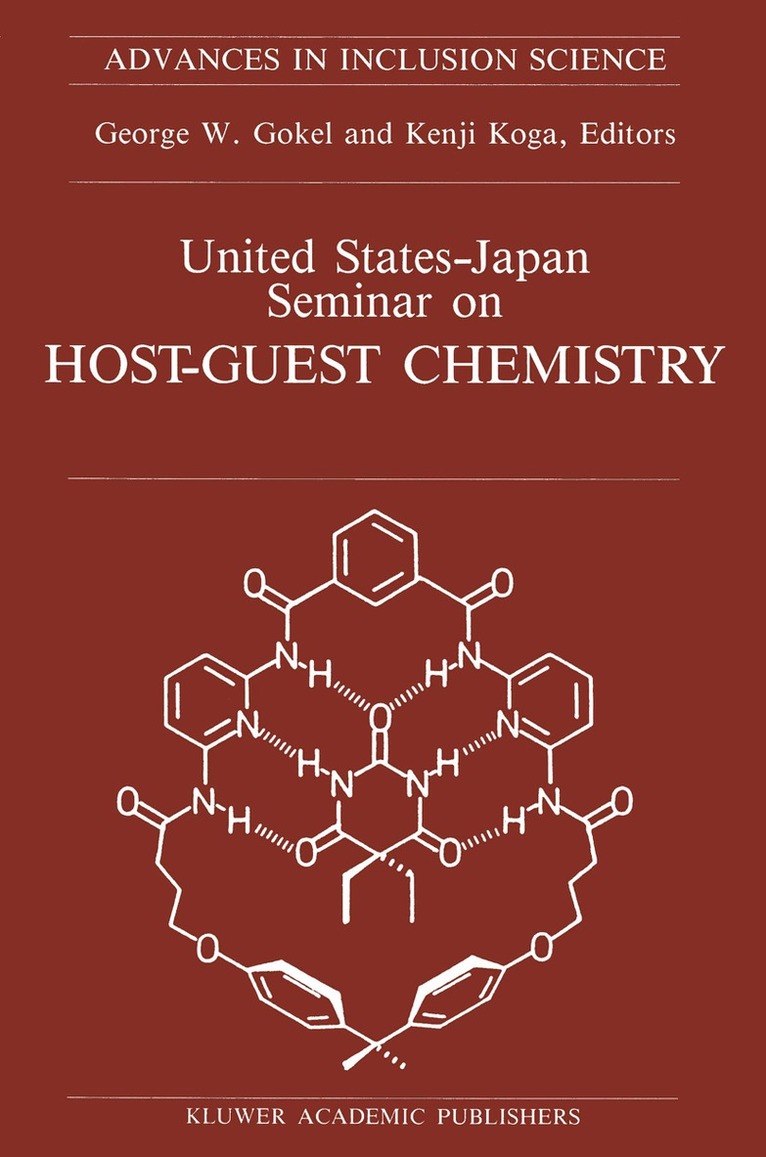
United States-Japan Seminar on Host-Guest Chemistry
Proceedings of the U.S.-Japan Seminar on Host-Guest Chemistry, Miami, Florida, U.S.A, 2–6 November 1987
Häftad, Engelska, 2011
534 kr
Skickas inom 10-15 vardagar
Proceedings of the Fourth International Symposium on Cyclodextrins
Munich, West Germany, April 20–22, 1988
Häftad, Engelska, 2011
3 266 kr
Skickas inom 10-15 vardagar
The rapidly growing number of papers and patents on Cyclodextrins and their potential or actual industrial uses raised the idea to organize a Symposium on Cyclodextrins. This Symposium - held in September 1981 in Budapest, with more than 200 participants from 17 countries - proved to be very succesfull in every respect, therefore it has been accepted unanimously to organize the lInd CD-Symposium in 1984, in Tokyo. (The Budapest-Symposium got posteriorly the "First" adjective). The IInd Symposium was held together with the III. Int. Symposium on Chlatrate Compounds and Molecular Inclusion Phenomena. The IIIrd CD-Symposium also was held as a Joint Symposium, with the IVth. Chlatrate Symposium in Lancaster, U. K. ,1986. The limited time however showed, that such a broad field - from calixarenes to zeolites - can not be managed efficiently. Therefore the International Organizing Committee voted for separation of two Symposia in the future. The IVth Int. CD-Symposium was held in the Munich, in April 1988, and the Vth Chlatrate Symposium (called already Vth Int. Symposium on Inclusion Phenomena and Molecular Recognition) was held in Alabama, Sept. 1988. In Munich 220 participants from 21 countries attended 32 verbal lectures and 54 posters. This volume contains the submitted 71 manuscripts of the IVth Cyclodextrin Symposium.
534 kr
Skickas inom 10-15 vardagar
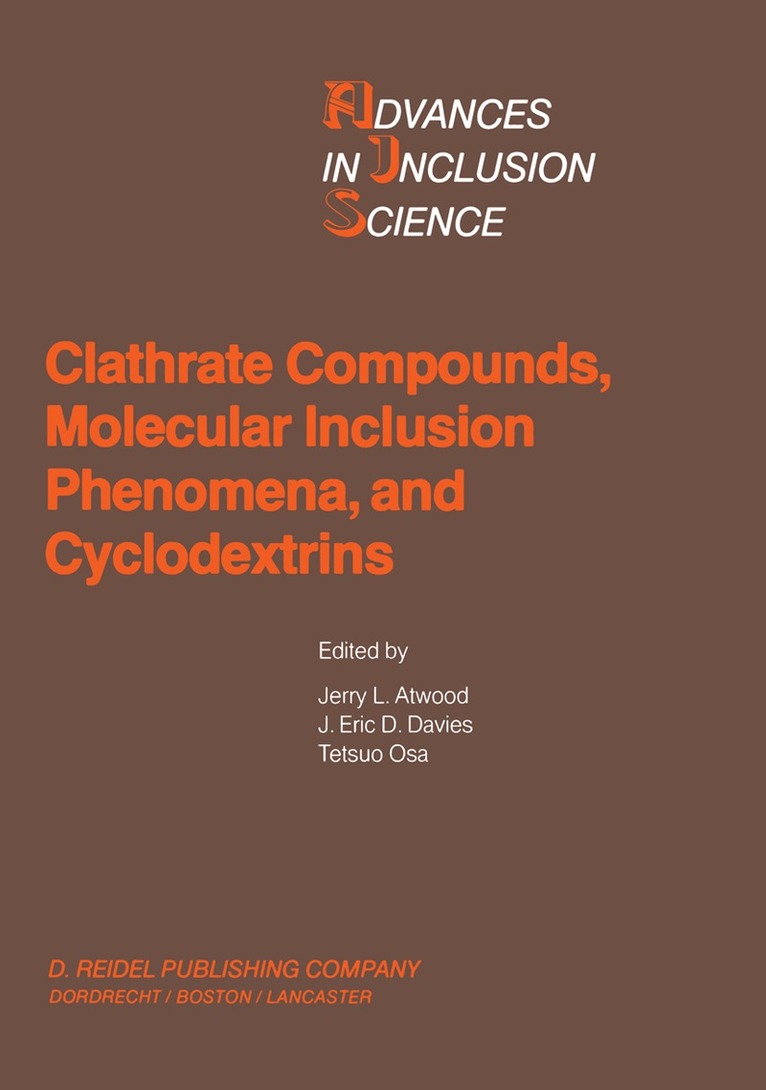
The contents of this volume originate from the joint Inclusion Phenomenal Cyclodextrins Symposium held at Lancaster in July 1986. Consisting of 50 extended ab stracts and 21 original contributions, the reader will find an up-to-date survey of the current state of research into, and applications of, inclusion compounds. Topics covered range from cyclodextrin complexes and their use as media for selective chemical reagents and their applications in chromatography and in the pharmaceutical and agricultural areas; the synthesis of new hosts, particularly those containing hydrophobic cavities; the characterisation of inclusion compounds using crystallographic and spectroscopic techniques; the use of inclusion com pounds as enzyme models; macrocyclic complexes and ionophores; to intercalates and zeolites. The Symposium was extremely successful, being attended by some 250 delegates drawn from 23 nations. It is hoped that the reader will recapture the flavour of the meeting from reading this volume. xi Journal of Inclusion Phenomena 5 (1987), 1-2. 1 © 1987 by D. Reidel Publishing Company. Preface The joint meeting comprlslng the 4th International Symposium on Inclusion Phenomena and the 3rd International Symposium on Cyclodextrins was held on 20 - 25 July, 1986 at the University of Lancaster, Great Britain, and followed on from the previous joint meeting held in Tokyo in July, 1984. The meeting was sponsored by the Royal Society of Chemistry.
Del 2 - Advances in Inclusion Science
Solvent-Dependent Flexibility of Proteins and Principles of Their Function
Häftad, Engelska, 2011
534 kr
Skickas inom 10-15 vardagar
Molecular biology has now advanced to the point where it is no longer possible to give a complete review of the available data on the conformational features of proteins. New data keep streaming in, and there is obviously an urgent need for some sort of general treatment of the subject. A systematic treatment of the large amount of data obtained by a great variety of methods on a great variety of objects must be based on the use of models; these should be as simple as possible, should conform to well-established scien tific laws, and at the same time be sufficiently flexible. The validity of the models finally arrived at is then confirmed or otherwise by testing the conclusions arrived at with their aid by means of experiment. After a suitable model has been adopted, it can be used in analyzing the experimental data. Such an analysis may result in one of three possible situations: neither the experi mental results nor their interpretation contradict the proposed model; the experimental results do not contradict the proposed model but their interpretation by the authors does; finally, both the experimental results and their interpretation may be found to be incompatible with the fundamental principles underlying the proposed model. The first situation is clearly the most desirable, and presents no difficulties.
1 589 kr
Skickas inom 10-15 vardagar
The Joint Meeting comprisIng the 3rd International Symposium on Clathrate Compounds and Molecular Inclusion Phenomena and the 2nd International Symposium on Cyclodextrins was held on 23-27 July, 1984, in Tokyo, Japan. It was organized by the Japan Association for Inclusion Chemistry together with the International Organization Committee, with the auspices of sixteen societies and associations in Japan. This event was the first joint meeting with the hope of unifying the above two symposia. The program of the symposium consisted of 142 papers, including 14 invited papers. The invited papers and some selected topics were presented verbally, and all the other 118 papers were displayed in poster sessions. The symposium was held at Hoshi University in Tokyo. Due to the multidisciplinary nature of the subjects treated, the scope and subjects were grouped into two parts. In the first group, the chemistry of cyclodextrins, synthetic organic hosts, inorganic and metal complex hosts and layered hosts were treated. In the second group applications in various fields, biomimetic aspects, physicochemical aspects, selectivity, stereo-specificity and other aspects were discussed. The scientific sessions were carried out in a really vivid atmosphere. The number of participants viz 50 from 19 overseas countries and 253 domestic partici pants exceeded our expectation.