SUNY series in the History of Books, Publishing, and the Book Trades – serie
Visar alla böcker i serien SUNY series in the History of Books, Publishing, and the Book Trades. Handla med fri frakt och snabb leverans.
4 produkter
4 produkter
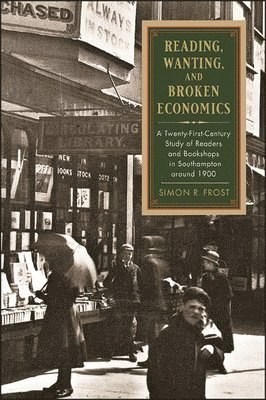
Reading, Wanting, and Broken Economics
A Twenty-First-Century Study of Readers and Bookshops in Southampton around 1900
Inbunden, Engelska, 2021
1 499 kr
Skickas inom 3-6 vardagar
Uses a historical study of bookselling and readers as a way to question and rethink our understanding of the market for symbolic goods.Combining historical study, theorization, and experimental fiction, this book takes commodity culture and book retail around 1900 as the prime example of a market of symbolic goods. With the port of Southampton, England, as his case study, Simon R. Frost reveals how the city's bookshops, with their combinations of libraries, haberdashery, stationery, and books, sustained and were sustained by the dreams of ordinary readers, and how together they created the values powering this market. The goods in this market were symbolic and were not "consumed" but read. Their readings were created between other readers and texts, in happy disobedience to the neoliberal laws of the free market. Today such reader-created social markets comprise much of the world's branded economies, which is why Frost calls for a new understanding of both literary and market values.
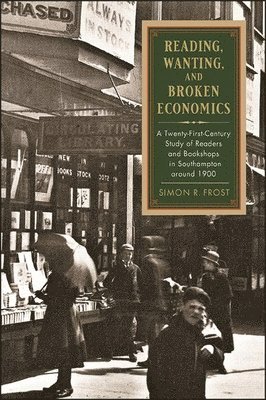
Reading, Wanting, and Broken Economics
A Twenty-First-Century Study of Readers and Bookshops in Southampton around 1900
Häftad, Engelska, 2022
611 kr
Skickas inom 3-6 vardagar
Uses a historical study of bookselling and readers as a way to question and rethink our understanding of the market for symbolic goods.Combining historical study, theorization, and experimental fiction, this book takes commodity culture and book retail around 1900 as the prime example of a market of symbolic goods. With the port of Southampton, England, as his case study, Simon R. Frost reveals how the city's bookshops, with their combinations of libraries, haberdashery, stationery, and books, sustained and were sustained by the dreams of ordinary readers, and how together they created the values powering this market. The goods in this market were symbolic and were not "consumed" but read. Their readings were created between other readers and texts, in happy disobedience to the neoliberal laws of the free market. Today such reader-created social markets comprise much of the world's branded economies, which is why Frost calls for a new understanding of both literary and market values.
583 kr
Skickas inom 3-6 vardagar
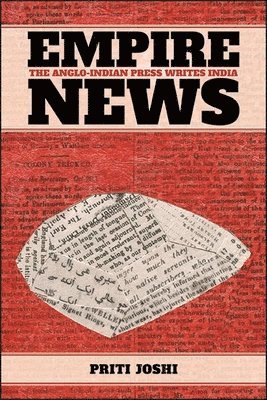
Examines English-language Indian newspapers from the mid-nineteenth century and their role in simultaneously sustaining and probing British colonial governance.Shortlisted for the 2022 George A. and Jeanne S. DeLong Book History Book Prize presented by the Society for the History of Authorship, Reading and Publishing Winner of the 2021 Robert and Vineta Colby Scholarly Book Prize presented by the Research Society for Victorian Periodicals In Empire News, Priti Joshi examines the neglected archive of English-language newspapers from India to unpack the maintenance and tensions of empire. Focusing on the period between 1845 and 1860, she analyzes circulation-of newspapers and news, of peoples and ideas-and newspapers' coverage and management of crises. The book explores three moments of colonial crisis. The sensational trial of East India Company vs. Jyoti Prasad in Agra in 1851 as the Kohinoor diamond is exhibited in London's Hyde Park is a case lost but for colonial newspapers. In these accounts, the trial raises the specter of Warren Hastings and the costs of empire. The Uprising of 1857 was a geopolitical crisis, but for the Indian news media it was a story simultaneously of circulation and blockage, of contraction and expansion, of colonial media confronting its limits and innovating. Finally, Joshi traces circuits of exchange between Britain and India and across media platforms, including Dickens's Household Words, where the empire's mofussil (margin) appears in an unrecognized guise during and after the Uprising. By attending to these fascinating accounts in the Anglo-Indian press, Joshi illuminates the circulation and reproduction of colonial narratives and informs our understanding of the functioning of empire.
1 499 kr
Skickas inom 3-6 vardagar
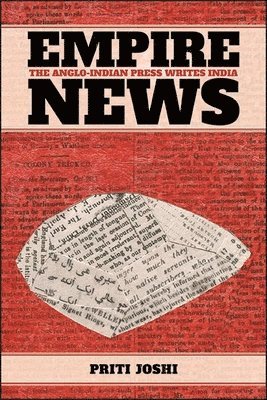
Examines English-language Indian newspapers from the mid-nineteenth century and their role in simultaneously sustaining and probing British colonial governance.Shortlisted for the 2022 George A. and Jeanne S. DeLong Book History Book Prize presented by the Society for the History of Authorship, Reading and Publishing Winner of the 2021 Robert and Vineta Colby Scholarly Book Prize presented by the Research Society for Victorian Periodicals In Empire News, Priti Joshi examines the neglected archive of English-language newspapers from India to unpack the maintenance and tensions of empire. Focusing on the period between 1845 and 1860, she analyzes circulation-of newspapers and news, of peoples and ideas-and newspapers' coverage and management of crises. The book explores three moments of colonial crisis. The sensational trial of East India Company vs. Jyoti Prasad in Agra in 1851 as the Kohinoor diamond is exhibited in London's Hyde Park is a case lost but for colonial newspapers. In these accounts, the trial raises the specter of Warren Hastings and the costs of empire. The Uprising of 1857 was a geopolitical crisis, but for the Indian news media it was a story simultaneously of circulation and blockage, of contraction and expansion, of colonial media confronting its limits and innovating. Finally, Joshi traces circuits of exchange between Britain and India and across media platforms, including Dickens's Household Words, where the empire's mofussil (margin) appears in an unrecognized guise during and after the Uprising. By attending to these fascinating accounts in the Anglo-Indian press, Joshi illuminates the circulation and reproduction of colonial narratives and informs our understanding of the functioning of empire.