Studies in Modern Science, Technology, and the Environment - Böcker
Visar alla böcker i serien Studies in Modern Science, Technology, and the Environment. Handla med fri frakt och snabb leverans.
8 produkter
8 produkter
294 kr
Skickas inom 5-8 vardagar
Trees are the grandest and most beautiful plant creations on earth. From their shade-giving, arching branches and strikingly diverse bark to their complex root systems, trees represent shelter, stability, place, and community as few other living objects can.Enduring Roots tells the stories of historic American trees, including the oak, the apple, the cherry, and the oldest of the world’s trees, the bristlecone pine. These stories speak of our attachment to the land, of our universal and eternal need to leave a legacy, and demonstrate that the landscape is a gift, to be both received and, sometimes, tragically, to be destroyed.Each chapter of this book focuses on a specific tree or group of trees and its relationship to both natural and human history, while exploring themes of community, memory, time, and place. Readers learn that colonial farmers planted marker trees near their homes to commemorate auspicious events like the birth of a child, a marriage, or the building of a house. They discover that Benjamin Franklin’s Newtown Pippin apples were made into a pie aboard Captain Cook’s Endeavour while the ship was sailing between Tahiti and New Zealand. They are told the little-known story of how the Japanese flowering cherry became the official tree of our nation’s capital-a tale spanning many decades and involving an international cast of characters. Taken together, these and many other stories provide us with a new ways to interpret the American landscape.“It is my hope,” the author writes, “that this collection will be seen for what it is, a few trees selected from a great forest, and that readers will explore both-the trees and the forest-and find pieces of their own stories in each.”

Gender and the Science of Difference
Cultural Politics of Contemporary Science and Medicine
Inbunden, Engelska, 2011
1 432 kr
Skickas inom 5-8 vardagar
How does contemporary science contribute to our understanding about what it means to be women or men? What are the social implications of scientific claims about differences between "male" and "female" brains, hormones, and genes? How does culture influence scientific and medical research and its findings about human sexuality, especially so-called normal and deviant desires and behaviors? Gender and the Science of Difference examines how contemporary science shapes and is shaped by gender ideals and images. Prior scholarship has illustrated how past cultures of science were infused with patriarchal norms and values that influenced the kinds of research that was conducted and the interpretation of findings about differences between men and women. This interdisciplinary volume presents empirical inquiries into today's science, including examples of gendered scientific inquiry and medical interventions and research. It analyzes how scientific and medical knowledge produces gender norms through an emphasis on sex differences, and includes both U.S. and non-U.S. cases and examples.
Gender and the Science of Difference
Cultural Politics of Contemporary Science and Medicine
Häftad, Engelska, 2011
406 kr
Skickas inom 5-8 vardagar
How does contemporary science contribute to our understanding about what it means to be women or men? What are the social implications of scientific claims about differences between "male" and "female" brains, hormones, and genes? How does culture influence scientific and medical research and its findings about human sexuality, especially so-called normal and deviant desires and behaviors? Gender and the Science of Difference examines how contemporary science shapes and is shaped by gender ideals and images. Prior scholarship has illustrated how past cultures of science were infused with patriarchal norms and values that influenced the kinds of research that was conducted and the interpretation of findings about differences between men and women. This interdisciplinary volume presents empirical inquiries into today's science, including examples of gendered scientific inquiry and medical interventions and research. It analyzes how scientific and medical knowledge produces gender norms through an emphasis on sex differences, and includes both U.S. and non-U.S. cases and examples.
739 kr
Skickas inom 7-10 vardagar
It sounds so simple. Just combine oxygen and hydrogen in an electrochemical reaction that produces water and electricity, and you’ll have a clean, efficient power source. But scientists have spent decades-and billions of dollars in government and industry funding-developing the fuel cell. There have been successes and serendipitous discoveries along the way, but engineering a fuel cell that is both durable and affordable has proved extraordinarily difficult.Overpotential charts the twists and turns in the ongoing quest to create the perfect fuel cell. By exploring the gap between the theory and practice of fuel cell power, Matthew N. Eisler opens a window into broader issues in the history of science, technology, and society after the Second World War, including the sociology of laboratory life, the relationship between academe, industry, and government in developing advanced technologies, the role of technology in environmental and pollution politics, and the rise of utopian discourse in science and engineering.
Malthusian Moment
Global Population Growth and the Birth of American Environmentalism
Inbunden, Engelska, 2012
1 432 kr
Skickas inom 5-8 vardagar
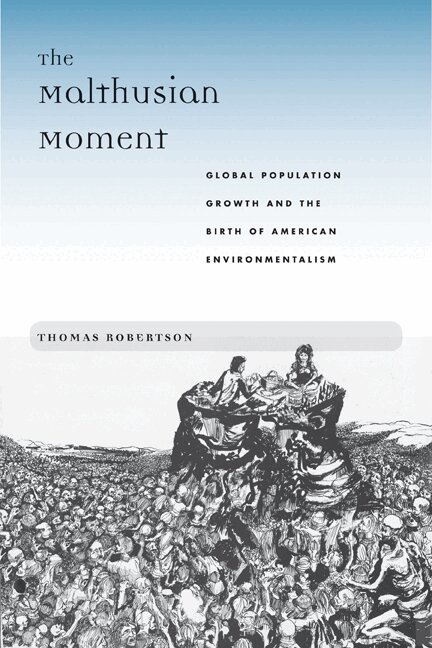
Although Rachel Carson’s Silent Spring (1962) is often cited as the founding text of the U.S. environmental movement, in The Malthusian Moment Thomas Robertson locates the origins of modern American environmentalism in twentieth-century adaptations of Thomas Malthus’s concerns about population growth. For many environmentalists, managing population growth became the key to unlocking the most intractable problems facing Americans after World War II-everything from war and the spread of communism overseas to poverty, race riots, and suburban sprawl at home.Weaving together the international and the domestic in creative new ways, The Malthusian Moment charts the explosion of Malthusian thinking in the United States from World War I to Earth Day 1970, then traces the just-as-surprising decline in concern beginning in the mid-1970s. In addition to offering an unconventional look at World War II and the Cold War through a balanced study of the environmental movement’s most contentious theory, the book sheds new light on some of the big stories of postwar American life: the rise of consumption, the growth of the federal government, urban and suburban problems, the civil rights and women’s movements, the role of scientists in a democracy, new attitudes about sex and sexuality, and the emergence of the “New Right.”
Malthusian Moment
Global Population Growth and the Birth of American Environmentalism
Häftad, Engelska, 2012
397 kr
Skickas inom 5-8 vardagar
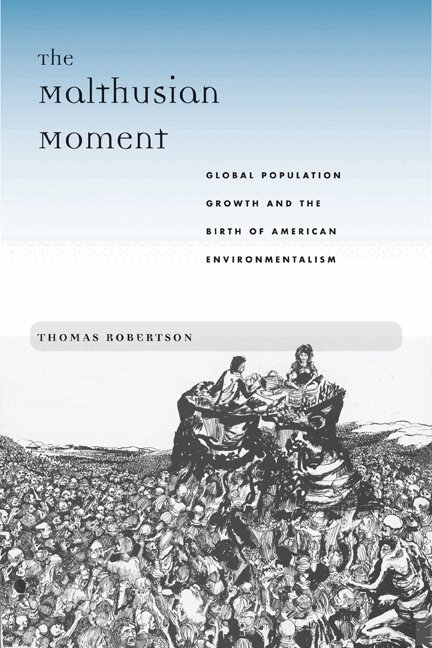
Although Rachel Carson’s Silent Spring (1962) is often cited as the founding text of the U.S. environmental movement, in The Malthusian Moment Thomas Robertson locates the origins of modern American environmentalism in twentieth-century adaptations of Thomas Malthus’s concerns about population growth. For many environmentalists, managing population growth became the key to unlocking the most intractable problems facing Americans after World War II-everything from war and the spread of communism overseas to poverty, race riots, and suburban sprawl at home.Weaving together the international and the domestic in creative new ways, The Malthusian Moment charts the explosion of Malthusian thinking in the United States from World War I to Earth Day 1970, then traces the just-as-surprising decline in concern beginning in the mid-1970s. In addition to offering an unconventional look at World War II and the Cold War through a balanced study of the environmental movement’s most contentious theory, the book sheds new light on some of the big stories of postwar American life: the rise of consumption, the growth of the federal government, urban and suburban problems, the civil rights and women’s movements, the role of scientists in a democracy, new attitudes about sex and sexuality, and the emergence of the “New Right.”
902 kr
Skickas inom 11-20 vardagar
Early in the twentieth century, arguments about “nature” and “nurture” pitted a rigid genetic determinism against the idea that genes were flexible and open to environmental change. This book tells the story of three Viennese biologists-Paul Kammerer, Julius Tandler, and Eugen Steinach-who sought to show how the environment could shape heredity through the impact of hormones. It also explores the dynamic of failure through both scientific and social lenses. During World War I, the three men were well respected scientists; by 1934, one was dead by his own hand, another was in exile, and the third was subject to ridicule.Paul Kammerer had spent years gathering zoological evidence on whether environmental change could alter heredity, using his research as the scientific foundation for a new kind of eugenics-one that challenged the racism growing in mainstream eugenics. By 1918, he drew on the pioneering research of two colleagues who studied how secretions shaped sexual attributes to argue that hormones could alter genes. After 1920, Julius Tandler employed a similar concept to restore the health and well-being of Vienna's war-weary citizens. Both men rejected the rigidly acting genes of the new genetics and instead crafted a biology of flexible heredity to justify eugenic reforms that respected human rights. But the interplay of science and personality with the social and political rise of fascism and with antisemitism undermined their ideas, leading to their spectacular failure.
Shaky Foundations
The Politics-Patronage-Social Science Nexus in Cold War America
Häftad, Engelska, 2015
422 kr
Skickas inom 5-8 vardagar
“Solovey’s social scientists are neither naÏve researchers exploited by the military-industrial complex nor greedy masterminds eagerly anticipating their patrons’ needs. Instead, he presents us with a series of encounters between program managers, disciplinary spokesmen, and political partisans, each of which demonstrates its participants’ unexpectedly complex positions. In what feels like a prelude to contemporary partisan investigations of the social sciences, Shaky Foundations recounts numerous instances of McCarthy-era attacks on social scientists as leftist agitators.” -Science “Shaky Foundations offers an important new argument about how the American social sciences interacted with wider social and political forces during the Cold War era. Solovey has done very important work in establishing the bitterly contested character of postwar epistemological and institutional shifts.” -Isis “This is an important book. The brilliance of this book lies in pinpointing the origins of the terms that are still used in contemporary debates on the role of social science in the United States. This book is a critical tool in approaching the most essential question -what’s next for American social science?” -LSE Review of Books “Solovey leaves readers with a sharpened understanding of the travails of social science research during the first two decades of the Cold War.” -Journal of American History “Solovey makes a valuable contribution to the growing literature on the development of social sciences in the U.S. during the 20th century. A major achievement is the author’s presentation of this often complicated and complex story in a clearly written and well-documented manner. Highly recommended.” -Choice “Shaky Foundations impressively pulls back the curtain on American social scientists and their complex relationships with funding agencies, offering crucial insights into the past-and the future-of social science.” -David C. Engerman, author of Know Your Enemy: The Rise and Fall of America’s Soviet Experts “In this clearly written and thoroughly researched book, Mark Solovey takes a new approach to writing the history of the social sciences in America by ‘following the money’ and examining how patrons and their agendas shaped the development of the field.” -Nadine Weidman, author of Constructing Scientific Psychology: Karl Lashley’s Mind-Brain Debates