Archaeological Exploration of Sardis Reports - Böcker
Visar alla böcker i serien Archaeological Exploration of Sardis Reports. Handla med fri frakt och snabb leverans.
7 produkter
7 produkter
Del 4 - Archaeological Exploration of Sardis Reports
Love for Lydia
A Sardis Anniversary Volume Presented to Crawford H. Greenewalt, Jr.
Inbunden, Engelska, 2009
414 kr
Skickas inom 7-10 vardagar
This generously illustrated volume, honoring Crawford H. Greenewalt, Jr., field director of the Sardis Expedition for over thirty years, and commemorating the fiftieth anniversary of the Harvard–Cornell archaeological excavation, presents new studies by scholars closely involved with Professor Greenewalt’s excavations at this site in western Turkey. The essays span the Archaic to the Late Antique periods, focusing primarily on Sardis itself but also touching on other archaeological sites in the eastern Mediterranean. Three papers publish for the first time an Archaic painted tomb near Sardis with lavish interior furnishings. Papers on Sardis in late antiquity focus on domestic wall paintings, spolia used in the late Roman Synagogue, and late fifth-century coin hoards. Other Sardis papers examine the layout of the city from the Lydian to the Roman periods, the transformation of Sardis from an imperial capital to a Hellenistic polis, the reuse of pottery in the Lydian period, and the history and achievements of the conservation program at the site. Studies of an Archaic seal from Gordion, queenly patronage of Hellenistic rotundas, and ancient and modern approaches to architectural ornament round out the volume.
Del 5 - Archaeological Exploration of Sardis Reports
Lydian Architecture
Ashlar Masonry Structures at Sardis
Inbunden, Engelska, 2011
700 kr
Skickas inom 7-10 vardagar
From the sixth to the fourth century B.C., the western Anatolian region of Lydia was home to a distinctive local tradition of ashlar masonry construction. The earliest datable example of fine stone masonry in the environs of Sardis, the capital of the Lydian empire, is the tomb of King Alyattes, who died in ca. 560 B.C. Contemporary monuments include a city gate and monumental terraces. Alyattes’ son Croesus was overthrown by the Persians in 547 B.C., but the Lydian building tradition survived in chamber tombs at Sardis and throughout Lydia.This richly illustrated volume examines the monuments of Sardis and environs in the context of contemporary developments in Lydia and throughout the ancient Mediterranean and Near East. The study of Lydian architecture illuminates traditions of Anatolian kingship, technological exchange between Lydia and Greece and the Near East, and the origins of Persian imperial architecture.
Del 3 - Archaeological Exploration of Sardis Reports
Bath-Gymnasium Complex at Sardis
Inbunden, Engelska, 1986
691 kr
Skickas inom 7-10 vardagar
The Bath-Gymnasium at Sardis is the most important known example of a complex that combines the gymnasium, a Greek institution, with the Roman bath, a unique architectural and cultural embodiment comparable in size and organization to the great Imperial thermae of Rome. The restoration by the Harvard-Cornell Expedition of the “Marble Court” or Imperial cult hall provides a rare opportunity to appreciate firsthand the scale and elegance of the major Imperial monuments.In this fully illustrated volume Fikret Yegül describes the complex from the palaestra of the east through the richly decorated Marble Court to the vast swimming pool, lofty halls, and hot baths, including analysis of the excavation, evidence for structural systems, roofing, vaulting, and decoration, and the significance of building inscriptions. The author traces the building history from its completion in the second century through five centuries of renovation and redecoration. Mehmet Bolgil, a practicing architect who was in charge of the restoration at Sardis, contributes a clear description of the reconstruction process.
Del 8 - Archaeological Exploration of Sardis Reports
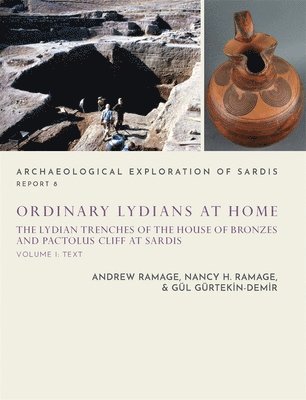
Ordinary Lydians at Home
The Lydian Trenches of the House of Bronzes and Pactolus Cliff at Sardis
2021
969 kr
Skickas inom 7-10 vardagar
This much-anticipated publication of two major Lydian excavation sectors at Sardis is the first in-depth presentation of the architecture and associated pottery and other artifacts found in the houses of inhabitants of this legendary city. It traces continuous occupation outside the city walls from the Late Bronze Age to the middle of the sixth century BC, when the Persians under Cyrus the Great captured the capital city of King Croesus.This book represents a remarkable synthesis of a vast quantity of everyday materials into a vivid picture of daily life in early Sardis in the period when the Lydians were conquering most of western Turkey. The authors describe many small structures and a wealth of artifacts that collectively document the lives of ordinary Lydians, in what appear to be both domestic and craft contexts.Because the Lydians maintained cultural and economic contacts throughout the eastern Mediterranean and the Near East, scholars working in Greece, Anatolia, and the Near East will find this first presentation of Lydian pottery and other objects, as well as vernacular architecture, of great interest and value. The two-volume book discusses the chronology, history, and evidence of everyday life, and catalogues nearly 800 objects, illustrated by more than 300 color plates of photos and detailed drawings.
1 449 kr
Skickas inom 7-10 vardagar
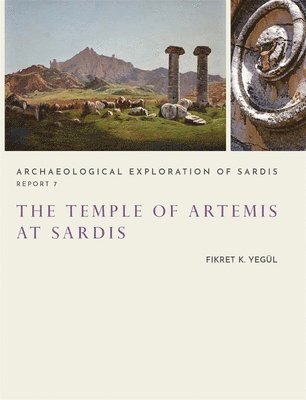
The Temple of Artemis at Sardis, one of the largest Greek temples in the world, is documented in detail in this lavishly illustrated two-volume boxed set by architectural historian Fikret K. Yegül. Begun in the century after the death of Alexander the Great, this delightful and complex building has been admired by travelers, depicted by artists and architects, and studied by scholars for hundreds of years. Yegül provides a wide-ranging overview of the building, treating such topics as early travelers, excavation history, inscriptions, construction techniques, the colossal Roman imperial portraits from the temple cella, religion and cult, and comparisons to other temples and buildings throughout Asia Minor.Yegül’s block-by-block description of the extant elements of the building, accompanied by hundreds of drawings and photographs, elucidates the two primary phases in the temple’s design and construction, which date to the Hellenistic and the Roman imperial periods. All elements of the building are illustrated in their recently conserved state, with centuries-old discoloration now removed to reveal the original marble.The text volume is accompanied by a series of twenty-four foldout plates with detailed state plans and elevations of the temple.
1 028 kr
Kommande
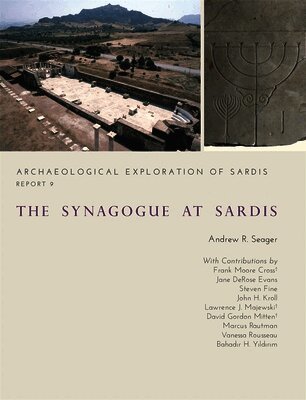
The Synagogue at Sardis, discovered by the Harvard-Cornell expedition in 1962, is the largest synagogue known in the ancient world. Its great size, its location within a bath-gymnasium complex, its elaborate and expensive interior decorations, and the high status of many of the donors caused significant revision of previous assumptions about Judaism in the Roman Empire.This long-awaited volume discusses in detail the history of the building, its decoration, and the place of the Jewish community in the larger society. Copiously illustrated with plans and photos, the book also includes catalogs of the decorative elements, coins, and other objects associated with this monumental religious space.
Del 6 - Archaeological Exploration of Sardis Reports
Churches EA and E at Sardis
Inbunden, Engelska, 2015
719 kr
Skickas inom 7-10 vardagar
Sardis was home to one of the earliest known Christian communities, appearing among the Seven Churches of Asia in the mid-first century AD. Between 1962 and 1973, the Archaeological Exploration of Sardis excavated two superimposed churches at the ancient site, one early Christian, one Byzantine. This richly illustrated volume documents the architecture and history of these buildings from the fourth to the sixteenth century.The early Christian church, an aisled basilica with narthex and atrium, both decorated with floor mosaics, had a long and complicated history, starting in the fourth century and continuing into the ninth century. Built over its remains is a Byzantine church dating to the little-known Lascarid period, when Constantinople had fallen to the Fourth Crusade and western Asia Minor was home to an independent Christian empire. This building’s standing remains, scattered domes, and vaulting fragments support the reconstruction of an inscribed-cross church with six columns and five domes, enriched on the exterior by a variety of brick and terracotta decoration. Together, these buildings cast new light on a millennium of Christian worship at Sardis, from the first official recognition of Christianity until the end of the Byzantine era.