Battleground Books: WWI – serie
Visar alla böcker i serien Battleground Books: WWI. Handla med fri frakt och snabb leverans.
5 produkter
5 produkter
177 kr
Skickas
Unlike the popular view, the French army did not cease offensive operations after the disastrous Nivelle Offensive of spring 1917 and the subsequent mutinies. Nor did the fighting at Verdun come to an end in 1916.The successful French counter offensives at the end of that year led to preliminary planning for a two Army operation in 1917 to break out of the Verdun salient and recapture the strategically very significant Briey coal basin. The French Army mutinies of May and June 1917 led to a more limited version of the plan being implemented, with the aim of establishing new lines for a break out in 1918.The need to rebuild morale in the French army meant that nothing was left to chance. The immense logistical effort of this late summer 1917 campaign and the detailed planning and careful training at all levels brought success to an army weary of war but determined to win. The industrial nature of the preparations, the spectacular numbers of guns and the first appearance of the Americans at Verdun presage the campaigns of 1918 and the final Allied victory.Once more Christina Holstein, the premier expert in Britain of the battlefields around Verdun, leads the reader around the various vital points of this largely unknown battle of 1917, one which was vital for the rebuilding of a French army that played such a notable part in the victorious allied campaign of 1918.As for all the books in the Battleground Europe series, it is profusely illustrated and mapped using contemporary and modern material, supported by clear maps to support each of the tours.
American Expeditionary Forces in the Great War
The St. Mihiel Offensive 12 to 16 September 1918
Häftad, Engelska, 2019
173 kr
Skickas
The St Mihiel Offensive, which took place between the 12th and 16th September 1918, was the first full scale attack that was under the direct command of the Americans, in the person of General J Pershing. He combined his command of the First (at the time the only) American Army with that of Commander in Chief of the AEF, a tremendous burden.The St Mihiel Salient had its origins in the early fighting of the war and had been stabilised by the end of 1914, although there was fierce fighting there in the first half of 1915 as both sides jostled for position; the high ground of Les Eparges became notorious for the intensity of the mine warfare that took place below it, extensive remains of which can be seen today.The American attack (with the assistance of a French Corps) was an outstanding success and the Germans were forced into a rapid withdrawal to the Michel Line, a strongly defended position that formed the Hindenburg Line in this area. On the other hand, the success was in part assisted by the fact that the Germans intended to withdraw from the exposed position of the Salient back to this line, the only question being the timing of such a move. Historians argue about whether the move had actually begun or not; but the reality is that senior German officers knew that it was imminent and certainly some heavier artillery had already been pulled back.Pershing's original hope had been to continue the offensive to seize Metz, crucial rail links and economically vital areas to the German war effort. In fact any such attempt would have taken weeks of preparation, as even a casual examination of the Michel Line defences still existing today would show.It is probable that relatively easy success here led to overconfidence amongst some that the next offensive, the Meuse-Argonne - to the north and scheduled to begin on the 26th, would have a similar outcome. If so they were in for a rude awakening.This book is profusely illustrated with contemporary photographs and numerous maps, the narrative supplemented by a number of first hand accounts; the whole is supported by several walking and car tours.This is the latest in a series of Battleground books by Maarten Otte on the American Expeditionary Forces, with several more in preparation.
173 kr
Skickas
The sector north of Ypres is best known for the inundation of much of the ground to the east of the Yser that acted as a block to the German advance in the autumn of 1914\. From that time on military activities were extremely limited. Much of this line was manned by Belgian troops, with some assistance from the French army at its southern end and of the British army on the Channel coast. The role of the Belgian army in the Great War is little known, apart from the opening months, when 'brave little Belgium' held on to its important fortified cities, notably Liege and Antwerp, for longer than German planning had anticipated. It was not until mid October 1914 that the Belgian army was forced back to the area of the Yser, when its defences were bolstered by French troops whilst Haig's I Corps came up on its southern flank.At this crucial phase of the campaign, the harsh decision was taken to open the dykes at the end of October 1914 and thereby flooding much of the low lying ground east of the Yser and so effectively halting major German offensive operations. For almost four years the Belgian army rested reasonably secure behind this sodden landscape, although certain key points were the scene of frequent, if limited, tussles. 'Free' Belgium was reduced to two significant towns that could be regarded as secure and out of the range of most German artillery - the coastal resort of La Panne (De Panne) and the much bigger settlement of Furnes (Veurne),Over these years the Belgian army was rebuilt under the dynamic leadership of the king, Albert I, and by the time of the general allied advance in September 1918, the Belgian army was able to take its place in the Advance to Victory, in an allied Army that was commanded by King Albert. Although this phase of the war is outside the scope of the book, it is important to realise that the Belgian army was a very active player in these last few months. Amongst the achievements of Belgian troops at this stage of the war was the final capture of Passchendaele.This book concerns itself with the years of defence and the reconstruction of the army behind the Yser. Relatively little of Belgium's efforts in the Great War remained, but recent years have seen action to preserve what does. Most significant of these, perhaps, is the so called Trench of Death near Diksmuide. Although always preserved, it has recently been very successfully refurbished and is now most effectively and informatively presented. Other remains from the war have also been developed so as to be more informative and the result is that touring this area provides a fascinating insight into one of the most unusual sectors of the Western Front and which is conveniently close to the much visited Ypres Salient.In this book Chris Baker brings his extensive knowledge of the Belgian army (helped by his ability to read French and Dutch) and of the Flanders region to produce a much needed insight into Belgium's army role for most of the war as the protector of the northern flank of the whole of the Allied line.
173 kr
Skickas
The Americans had considerable initial success when they launched their huge offensive against the Germans in the Meuse-Argonne in the last days of September 1918. However, not everything went smoothly and the attack became bogged down, held up by the several lines of the Hindenburg System and logistical challenges. A major additional obstacle was the presence of batteries of German artillery on the high ground on the right bank of the Meuse, almost untroubled by any significant assaults by the allied forces. These guns created severe problems for the American commanders and their troops.Eventually sufficient resources were allocated for an American-French attack on the right bank, with the aim of removing the German artillery and pushing the Germans off the Meuse Heights, part of the renewed offensive on the Left Bank and the Argonne Forest.The action often took place over ground that had already seen ferocious fighting during the Battle of Verdun in 1916 and the French offensive of late summer 1917. It also involved the very difficult achievement of getting large bodies of troops over the River Meuse and its associated canal.The terrain is rugged and, even then, quite heavily wooded. The American and French troops often had to fight uphill and in the face of German defences that had been developed over the previous twelve months. On the other hand, the quality of the defending troops was not high, as Germany faced so much pressure in other sectors, and included a significant number of Austro-Hungarian troops. Popular opinion tends to be dismissive of the fighting quality of these Austrian troops who, in fact, performed well.The tours take the visitor over some beautiful countryside, with stunning views over the Meuse and the Woevre Plain. There are significant vestiges of the war still to be seen, including numerous observation bunkers and shelters as well as trenches. An unusual feature of the area are the traces of part of the Maginot Line, notably bunkers (some of which are very large) and the rail infrastructure to support it, sometimes making use of lines that the Germans built during the First World War.One of these tours follows the fate of Henry Gunther, officially the last American soldier to be killed in action in the Great War. There is substantial myth about Gunther; the facts surrounding his death are examined, as well as placing his last action on the ground. There is a tour dedicated just to him.
170 kr
Skickas
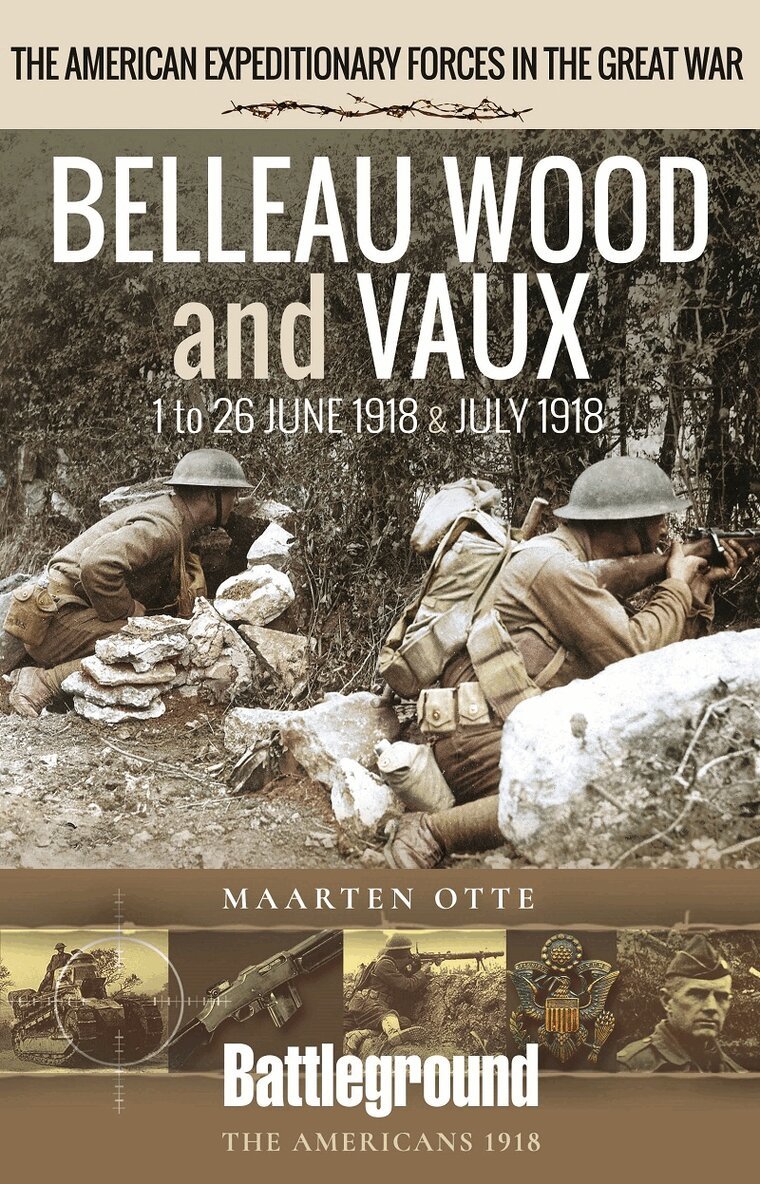
BELLEAU WOODThe Battle of Belleau Wood has a prominent place in the history of the United States Marine Corps; it took place between 6 and 27 June 1918 (sometimes considered to be 1-26 June). However, when on 6 June 1918 the marines launched their attack on the wood, the biggest German threat here was nearly over.Its significance to the Corps is underlined by the presence not only of a monument to the 4th (Marine) Brigade of the US 2nd Division but also by a preserved part of the wood, which is situated to the rear of the Aisne-Marne American Cemetery. The fighting here marks the first major battle by the USMC in Europe.The battle came - although the participants were unaware of this - at the end of the the third great German offensive of Spring 1918, the Blucher-York Offensive, also known as the 3rd Battle of the Aisne, which was launched on 27 May and officially ended on 4 June. Like its predecessors that Spring, an offensive which had started with startling territorial gains had almost ground to a halt by the time that the 2nd Division, and thus the marines, were called in to assist the French Sixth Army in holding the line and in retaking, where possible, crucial positions.What started out as preventing the Germans from breaking through the French lines and pushing on to Paris ended in a three-weeks long slogging match in and around Belleau Wood. It was on French General Duch ne's instigation that the woods were attacked; but in reality the marines could have just held the line and been satisfied with that. As it was, they were flung into action with little time to prepare. The fighting in Belleau Wood was extremely brutal and involved several attacks and counter-attacks; neither side was willing to yield an inch of the terrain of a feature that had local strategic significance, particularly to the Germans. Although the offensive locally here came to an end and the initial German threat in the area was nearly overcome, the focal point of the fighting moved to Villers Cotter ts, twenty-five kilometres north-east of Belleau. The Americans were not quite finished when Belleau Wood was finally captured, as the nearby village of Vaux was taken by an army brigade of the 2nd Division in a text book attack on 1 July.The USMC has always had a good publicity machine' and Belleau Wood was certainly well known to the wider American public in the war years, particularly as it was an early action by a formation of the AEF. Although largely forgotten since the Second World War - the memory perhaps kept alive by the unusual preserved remnant of the battlefield, Belleau Wood's reputation has been enhanced by increased interest in the war since the turn of the century. Nowadays, the battle is sometimes called a pivotal event in the First World War and an iconic battle in US Marine Corps history' by several American authors, which some of their European counterparts might regard as somewhat exaggerated.Although there have been several guide books on Belleau Wood published in recent years (a clear indication of American interest in the battle today), what differs in this book is the number of points to visit as well as the clear narrative that precedes the tours section. Not only are many new points of interest explored in Belleau itself, but the surrounding countryside is not forgotten. Headquarters, temporary burial sites and other features are included. The book is profusely illustrated by contemporary photographs and numerous maps, the narrative supplemented by a number of first hand accounts; the whole is supported by several walking and car tours.This is the latest in a series of Battleground books by Maarten Otte on the American Expeditionary Forces, with several more in preparation. The AEF's performance in the war is relatively little known, not least in the USA; Belleau Wood is one of the few engagements that still carries some resonance. It is fortunate that so many of the AEF's actions took place in parts of France that have seen little development and are in agricultural or wooded country, which means that traces of their fighting are relatively plentiful.