Baylor-Mohr Siebeck Studies in Early Christianity - Böcker
Visar alla böcker i serien Baylor-Mohr Siebeck Studies in Early Christianity. Handla med fri frakt och snabb leverans.
14 produkter
14 produkter
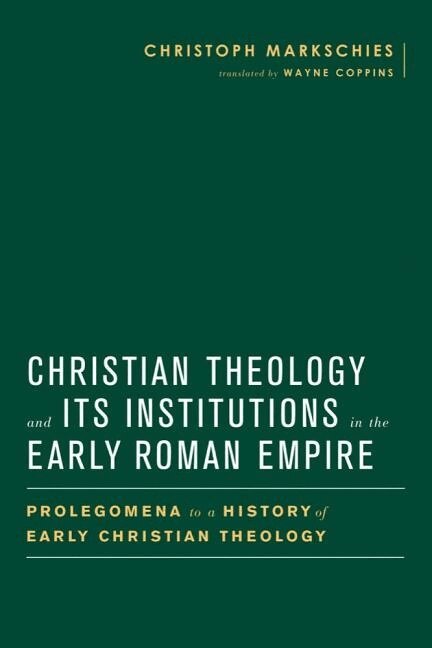
Christian Theology and Its Institutions in the Early Roman Empire
Prolegomena to a History of Early Christian Theology
Inbunden, Engelska, 2015
983 kr
Skickas
Tension between unity and diversity plagues any attempt to recount the development of earliest Christianity. Explanations run the gamut - from asserting the presence of a fully formed and accepted unity at the beginning of Christianity to the hypothesis that understands orthodox unity as a later imposition upon Christianity by Rome. In Christian Theology and Its Institutions in the Early Roman Empire, Christoph Markschies seeks to unravel the complex problem of unity and diversity by carefully examining the institutional settings for the development of Christian theology. Specifically, Markschies contends that theological diversity is closely bound up with institutional diversity.Markschies clears the ground by tracing how previous studies fail to appreciate the critical role that diverse Christian institutions played in creating and establishing the very theological ideas that later came to define them. He next examines three distinct forms of institutional life - the Christian institutions of (higher) learning, prophecy, and worship - and their respective contributions to Christianity's development. Markschies then focuses his attention on the development of the New Testament canon, demonstrating how different institutions developed their own respective "canons", while challenging views that assign a decisive role to Athanasius, Marcion, or the Gnostics. Markschies concludes by arguing that the complementary model of the "identity" and "plurality" of early Christianity is better equipped to address the question of unity and diversity than Walter Bauer's cultural Protestant model of "orthodoxy and heresy" or the Jesuit model of the "inculturation" of Christianity.Not for sale in Europe.
769 kr
Skickas inom 10-15 vardagar
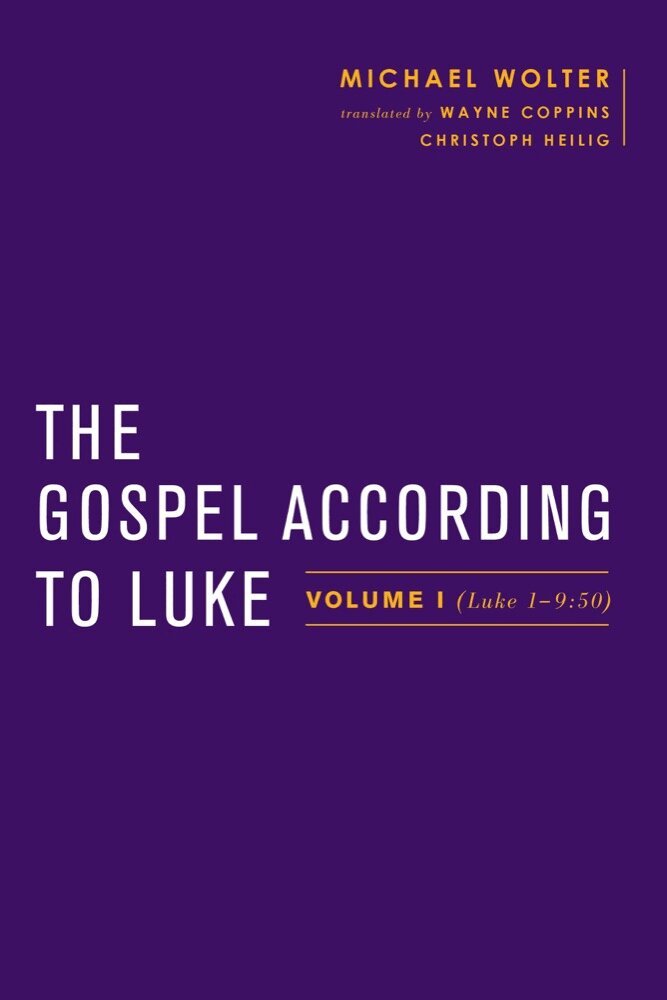
In this fourth volume of the Baylor-Mohr Siebeck Studies in Early Christianity, Michael Wolter provides a detailed, verse-by-verse interpretation of the Third Evangelist. Wolter's commentary fully complements the great tradition of "Handbooks of the New Testament" published by Mohr Siebeck. Replacing the third edition of Erich Klostermann's commentary on Luke, Wolter's volume rightly joins those by Conzelmann (Acts), K?ñsemann (Romans), and Lietzmann (1 Corinthians) in this venerable series.Wolter's approach to a sustained reading of Luke's Gospel is comprehensive. He carefully places Luke's narrative of Jesus in its cultural context, paying close attention to the relationship of the Gospel with its Jewish and Greco-Roman environment. Wolter performs form-critical and narrative analysis of the specific stories; however, Wolter also emphasizes Luke as a theologian and his Gospel as a work of theology.Wolter recognizes how Luke's narrative of Jesus forms the first part of a unified work - the Acts of Apostles being the second - that represents a new moment in Israel's history. But in surprising new ways, Wolter makes clear that it is God alone who works in and through the words and deeds of Jesus to bring salvation to Israel. His commentary shows that Luke succeeds in preserving the history of Jesus and its theological impact and that this history stands on equal footing with the history of early Christianity. Wolter's thorough, careful reading follows Luke as the Evangelist seeks to explain how the fulfillment of the Old Testament promises of God for Israel results in a parting of the ways between the Christian church on the one side and Judaism on the other. Scholars and students alike will benefit from access to new German scholarship now available to English-language audiences.Not for sale in Europe.
1 396 kr
Skickas inom 3-6 vardagar
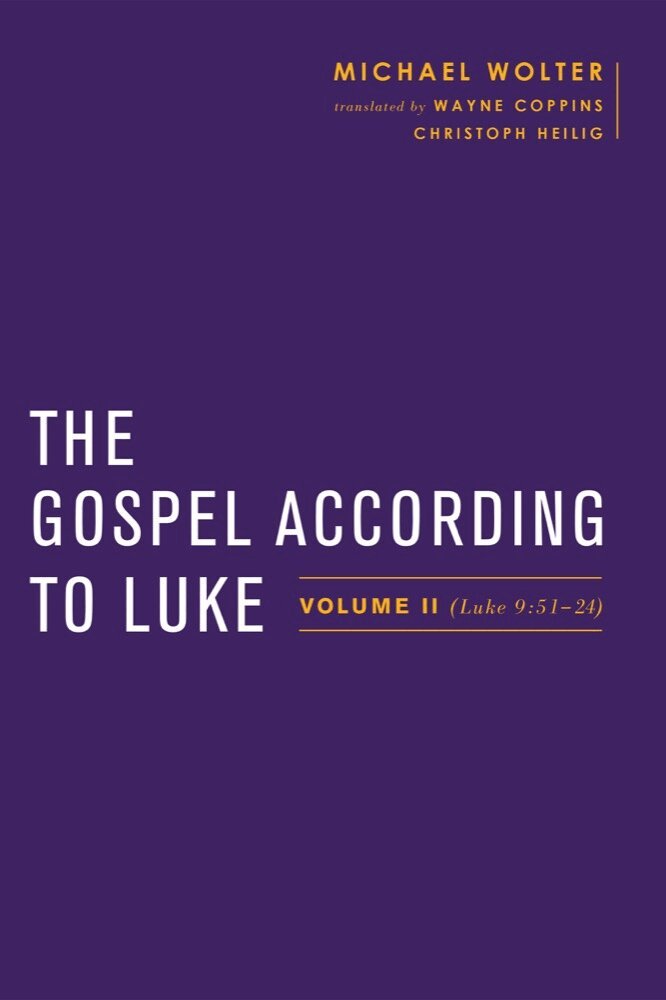
In this fifth volume of the Baylor–Mohr Siebeck Studies in Early Christianity series, Michael Wolter provides a detailed, verse-by-verse interpretation of the Third Evangelist's Gospel (Luke 9:51–24). Wolter's commentary fully complements the great tradition of "Handbooks of the New Testament" published by Mohr Siebeck. Replacing the third edition of Erich Klostermann's commentary on Luke, Wolter's volume rightly joins those by Conzelmann (Acts), Käsemann (Romans), and Lietzmann (1 Corinthians) in this venerable series.Wolter's approach to a sustained reading of Luke's Gospel is comprehensive. He carefully places Luke's narrative of Jesus in its cultural context, paying close attention to the relationship of the Gospel with its Jewish and Greco-Roman environment. Wolter performs form-critical and narrative analysis of the specific stories; however, Wolter also emphasizes Luke as a theologian and his Gospel as a work of theology.Centrally, Wolter recognizes how Luke's narrative of Jesus forms the first part of a unified work—the Acts of Apostles being the second—that represents a new moment in Israel's history. But in surprising new ways, Wolter makes clear that it is God alone who works in and through the words and deeds of Jesus to bring salvation to Israel. His commentary shows that Luke succeeds in preserving the history of Jesus and its theological impact and that this history stands on equal footing with the history of early Christianity. Wolter's thorough, careful reading follows Luke as the Evangelist seeks to explain how the fulfillment of the Old Testament promises of God for Israel results in a parting of the ways between the Christian church on the one side and Judaism on the other. Scholars and students alike will benefit from access to new German scholarship now available to English-language audiences.
1 091 kr
Skickas inom 11-20 vardagar
The debate over the extent of Jewish influence upon early Christianity rages on. At the heart of this argument lies the question of Jesus: how does the fate of a first-century Galilean Jew inspire and determine the nature, shape, and practices of a distinct religious movement? Vital to this first question is another equally challenging one: can the four Gospels be used to reconstruct the historical Jesus? In Jesus and Judaism, Martin Hengel and Anna Maria Schwemer seek to untangle the complex relationships among Jesus, Judaism, and the Gospels in the earliest Christian movement.Jesus and Judaism, the first in a four-volume series, focuses on the person of Jesus in the context of Judaism. Beginning with his Galilean origin, the volume analyzes Jesus' relationship with John the Baptist and the Jewish context of Jesus' life and work. Hengel and Schwemer argue that there never was a nonmessianic Jesus. Rather, his messianic claim finds expression in his relationship to the Baptist, his preaching in authority, his deeds of power, and his crucifixion as king of the Jews, and in the emergence of the earliest Christology. As Hengel and Schwemer reveal, Jesus was not only a devout Jew, nor merely a miracle worker, but the essential part of the earliest form of Christianity.Hengel and Schwemer insist that Jesus belongs within the history of early Christianity, rather than as its presupposition. Christianity did not begin after Jesus' death; Christianity began as soon as a Jew from Galilee started to preach the word of God.Not for sale in Europe.
884 kr
Skickas inom 3-6 vardagar
Humility in the modern world is neither well understood nor well received. Many see it as a sign of weakness; others decry it as a Western construct whose imposition onto marginalized persons only perpetuates oppression. This skepticism has a long pedigree: Aristotle, for instance, pointed to humility as a shameless front. What then are we to make of the New Testament's valorization of this trait?Translated from German into English for the first time, Paul on Humility seeks to reclaim the original sense of humility as an ethical frame of mind that shapes community, securing its centrality in the Christian faith. This exploration of humility begins with a consideration of how the concept plays into current cultural crises before considering its linguistic and philosophical history in Western culture. In turning to the roots of Christian humility, Eve-Marie Becker focuses on Philippians 2, a passage in which Paul appeals to the lowliness of Christ to encourage his fellow Christians to persevere. Becker shows that humility both formed the basis of the ethic Paul instilled in churches and acted as a mimetic device centered on Jesus' example that was molded into the earliest Christian identity and community.Becker resists the urge to cheapen humility with mere moralism. In the vision of Paul, the humble individual is one immersed in a complex, transformative way of being. The path of humility does not constrain the self; rather, it guides the self to true freedom in fellowship with others. Humility is thus a potent concept that speaks to our contemporary anxieties and discomforts.Not for sale in Europe.
884 kr
Skickas inom 3-6 vardagar
Christology, Torah, and Ethics in the Gospel of Matthew, the tenth and final volume in the Baylor–Mohr Siebeck Studies in Early Christianity series, brings together seven of Matthias Konradt's most important essays on the Gospel of Matthew. Together they highlight key themes of this major early Christian text and demonstrate its formative role in shaping both the identity and theology of the growing Christian movement.The first chapter on the context of Matthew is foundational. It presents the main points of controversy in recent scholarship on the relationship of the Matthean community to Judaism, identifies the interpretive problems that underlie the disagreements, and sketches out perspectives for subsequent scholarship. The next two chapters deal with central aspects of Matthean Christology: chapter 2 with the Davidic-messianic aspects of Matthean Christology and chapter 3 with the character of the Son of God concept in Matthew alongside the controversial question of the meaning of righteousness in Matthew. With chapters 4 and 5, Konradt works out his sophisticated understanding of Matthew's Torah hermeneutic, giving special attention to the interpretation of the antitheses in the Sermon on the Mount and to Matthew's reception and interpretation of the decalogue.Finally, with the analysis of mercy in chapter 6 and the detailed interpretation of the invitation of Jesus in Matthew 11:28–30 in chapter 7, the last two chapters show that Matthean ethics are not exhausted in the interpretation of the Torah. Rather, in the way the Gospel of Matthew brings together Old Testament and early Jewish heritage with an orientation toward the ethical potential of the Christ event, it proves to be one of the main testimonies of New Testament ethics.
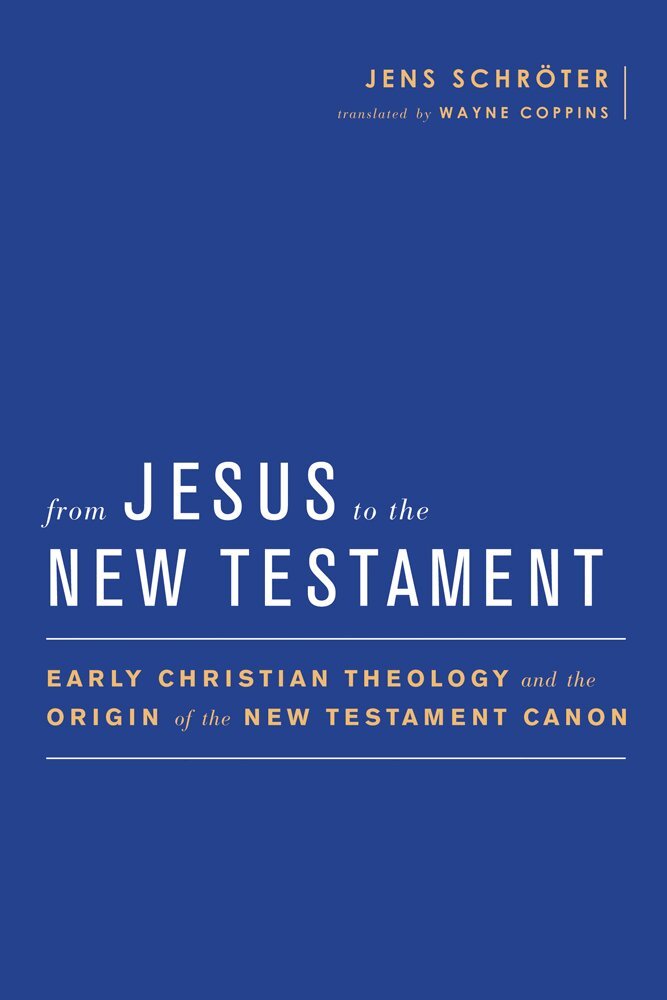
From Jesus to the New Testament
Early Christian Theology and the Origin of the New Testament Canon
Häftad, Engelska, 2021
1 031 kr
Skickas inom 3-6 vardagar
As the inaugural volume in the Baylor-Mohr Siebeck Studies in Early Christianity series, Jens Schröter's celebrated From Jesus to the New Testament is now available for the first time in English. Schröter provides a rich narrative to Christian history by looking back upon the theological forces that created the New Testament canon. Through his textual, historical, and hermeneutical examination of early Christianity, Schröter reveals how various writings that form the New Testament's building blocks are all held together. Jesus not only bound the New Testament, but launched a theological project that resulted in the canon. Schröter's study will undoubtedly spark new discussion about the formation of the canon.
930 kr
Skickas inom 11-20 vardagar
Matthias Konradt explores a problem central to the theological conception of the Gospel of Matthew: What is the cause for the transition from the Israel-centered activities of Jesus and his disciples previous to Easter to the universal mission after Easter, and how is the formation of the church related to Israel's role as God's chosen nation in Matthew's concept? In conjunction with a detailed scrutiny of the traditional interpretation that Matthew propagates the replacement of Israel by the church and - in keeping with this - of the mission to Israel by the universal mission, the author maintains that the Israel-centered and the universal dimension of salvation are positively interconnected in the narrative conception, in which Matthew develops Jesus' messianic identity as the Son of David and the Son of God. Published in North America by Baylor University Press, Waco.
1 092 kr
Skickas inom 5-8 vardagar
In this fourth volume of the Baylor-Mohr Siebeck Studies in Early Christianity, Michael Wolter provides a detailed, verse-by-verse interpretation of the Third Evangelist. His commentary shows that Luke succeeds in preserving the history of Jesus and its theological impact and that this history stands on equal footing with the history of early Christianity. Wolter's thorough, careful reading follows Luke as the Evangelist seeks to explain how the fulfillment of the Old Testament promises of God for Israel results in a parting of the ways between the Christian church on the one side and Judaism on the other. Scholars and students alike will benefit from access to new German scholarship now available to English-language audiences. Published in the US by Baylor University Press, Waco.
1 106 kr
Skickas inom 5-8 vardagar
In this fifth volume of the Baylor-Mohr Siebeck Studies in Early Christianity series, Michael Wolter provides a detailed, verse-by-verse interpretation of the Third Evangelist's Gospel (Luke 9:51--24). His approach to a sustained reading of Luke's Gospel is comprehensive. He carefully places Luke's narrative of Jesus in its cultural context, paying close attention to the relationship of the Gospel with its Jewish and Greco-Roman environment and performs form-critical and narrative analysis of the specific stories; however, he also emphasizes Luke as a theologian and his Gospel as a work of theology. Michael Wolter's commentary shows that Luke succeeds in preserving the history of Jesus and its theological impact and that this history stands on equal footing with the history of early Christianity. Published in the US by Baylor University Press, Waco.
1 524 kr
Skickas inom 5-8 vardagar
The debate over the extent of Jewish influence upon early Christianity rages on. At the heart of this argument lies the question of Jesus: how does the fate of a first-century Galilean Jew inspire and determine the nature, shape, and practices of a distinct religious movement? Vital to this first question is another equally challenging one: can the four Gospels be used to reconstruct the historical Jesus? In this work, Martin Hengel and Anna Maria Schwemer seek to untangle the complex relationships among Jesus, Judaism, and the Gospels in the earliest Christian movement. Jesus and Judaism, the first in a four-volume series, focuses on the person of Jesus in the context of Judaism. Beginning with his Galilean origin, the volume analyzes Jesus' relationship with John the Baptist and the Jewish context of Jesus' life and work. The authors argue that there never was a nonmessianic Jesus. Rather, his messianic claim finds expression in his relationship to the Baptist, his preaching in authority, his deeds of power, and his crucifixion as king of the Jews, and in the emergence of the earliest Christology. As Martin Hengel and Anna Maria Schwemer reveal, Jesus was not only a devout Jew, nor merely a miracle worker, but the essential part of the earliest form of Christianity. The authors insist that Jesus belongs within the history of early Christianity, rather than as its presupposition. Christianity did not begin after Jesus' death; Christianity began as soon as a Jew from Galilee started to preach the word of God.
807 kr
Skickas inom 5-8 vardagar
Translated from German into English for the first time, this monograph seeks to reclaim the original sense of humility as an ethical mindset that is of community-building value. This exploration of humility begins with a consideration of how the concept plays into current cultural crises before considering its linguistic and philosophical history in Western culture. In turning to the roots of Christian humility, Eve-Marie Becker focuses on Philippians 2, a passage in which Paul appeals to the lowliness of Christ to encourage his fellow Christians to persevere. She shows that humility both formed the basis of the ethic Paul instilled in Christ-believing communities and acted as a mimetic device centered on Jesus' example that was molded into the earliest Christian identity and community.
1 064 kr
Tillfälligt slut
In our fraught global environment, when political and ideological lines are drawn ever sharper and old allegiances are increasingly strained, love for neighbor as both individual and societal obligation needs to be thematized and justified anew. At the same time, the New Testament call to love one's enemies forms a sharp point of contrast to the current non-culture of hatred for all things different and foreign. Oda Wischmeyer aims to bring the New Testament concept of love into conversation with the current discussion about love. She investigates the commandment tradition of love for God and for neighbor, the ways in which the Septuagint and Plutarch speak of love, and the innovative concepts of love developed by Paul and John. She also presents an exegetically informed construction of the New Testament concept of love that is sharpened through a penetrating comparison with counter-, parallel, and alternative concepts from the ancient world. The book brings this holistic biblical vision forward into critical and constructive dialogue with key contemporary visions of love, including those of Julia Kristeva, Martha Nussbaum, Pope Benedict XVI, and Simon May. The tension that emerges stresses the need for fresh conceptualizations of ancient Jewish-Christian understandings, giving rise to the concluding question of the profile, limits, and impulses of the agape ἀγάπη concept for present challenges. Through this academically rigorous and pastorally sensitive exploration, Oda Wischmeyer points to the great love story between God and humanity, which realizes itself in the figure of Jesus Christ. This divine romance places love as the most intense, affirming, and life-creating relationship in God's own self, a relationship into which human beings are drawn and by which they obtain special dignity when God's love becomes their life.
901 kr
Skickas inom 5-8 vardagar
Der zehnte und letzte Band der Reihe Baylor-Mohr Siebeck Studies in Early Christianity versammelt sieben der wichtigsten Aufsätze von Matthias Konradt zum Matthäusevangelium. Gemeinsam beleuchten sie Schlüsselthemen dieses wichtigen frühchristlichen Textes und zeigen seine prägende Rolle für die Identität und Theologie der wachsenden christlichen Bewegung.Matthias Konradt stellt die Hauptstreitpunkte der neueren Forschung zum Verhältnis der matthäischen Gemeinde zum Judentum dar, benennt die Interpretationsprobleme, die den Positionsdifferenzen in der Forschung zugrunde liegen, und behandelt zentrale Aspekte der matthäischen Christologie. Der Autor arbeitet sein ausgefeiltes Verständnis von Matthäus' Torah-Hermeneutik heraus, wobei er der Auslegung der Antithesen in der Bergpredigt und Matthäus' Rezeption und Interpretation des Dekalogs besondere Aufmerksamkeit widmet..Erscheint in Nordamerika bei Baylor University Press, Waco.