Bristol Phoenix Press Classic Editions - Böcker
Visar alla böcker i serien Bristol Phoenix Press Classic Editions. Handla med fri frakt och snabb leverans.
13 produkter
13 produkter
Ovid: Heroides I
Introduction and Latin Text, with Greek Translation by Maximus Planudes
Häftad, Engelska, 2005
576 kr
Skickas inom 7-10 vardagar
The Heroides, a collection of elegiac poems written as letters, fused Ovid’s interests in erotics and myth into a new and unique genre, in which experiments with epistolary form and the psychology of first-person narrative would go on to have a profound influence on European literature. This two-volume edition of 1898 remains an essential resource for the poems; but it has long been difficult to obtain. It contains what is still the only detailed commentary in English on the whole collection, as well as extensive discussion of the text and its transmission. It also offers the full text of the translation of Heroides into Greek prose by the Byzantine scholar Maximus Planudes.
543 kr
Skickas inom 7-10 vardagar
The Heroides, a collection of elegiac poems written as letters, fused Ovid’s interests in erotics and myth into a new and unique genre, in which experiments with epistolary form and the psychology of first-person narrative would go on to have a profound influence on European literature. This two-volume edition of 1898 remains an essential resource for the poems; but it has long been difficult to obtain. It contains what is still the only detailed commentary in English on the whole collection, as well as extensive discussion of the text and its transmission. It also offers the full text of the translation of Heroides into Greek prose by the Byzantine scholar Maximus Planudes.
Selections from the Attic Orators
Antiphon, Andocides, Lysias, Isocrates, Isaeus
Häftad, Engelska, 2005
657 kr
Skickas inom 7-10 vardagar
This edition was designed by R.C. Jebb – one of the greatest classical scholars Britain has ever produced – as a companion to his two-volume monograph Attic Orators from Antiphon to Isaeus (1876). The selection was meticulously made to illustrate the ‘successive steps in the process by which a language of most elastic resource was gradually adapted to a certain set of purposes’. The authors represented, with their varied styles, serve to bridge the gap that lies between the prose of Gorgias and Thucydides and that of Demosthenes. At the same time the passages are specifically selected for their intrinsic social and historical interest to readers. That the edition was still in regular use almost a hundred years later, says much for its quality. This reissue carries a substantial new introduction in which Pat Easterling assesses Jebb’s scholarship in general and the place of the Attic orators within it, while Michael Edwards writes more specifically about the edition’s strengths and influences.
446 kr
Skickas inom 7-10 vardagar
Statius' Achilleid is perhaps the most remarkable of all Latin epic poems. Its project - to tell the whole life of Achilles - was cut short by the poet's untimely death. Yet the completed first book and the earliest part of the second have a charm and freshness matched only in some of Ovid's most lively and engaging work. The poem tells how the sea-nymph Thetis, in a vain attempt to save her son from his destined end in the Trojan war, hid him on the island of Scyros, disguised as a girl. There he fell in love with the beautiful Deidamia, but at the same time, with the idea of glory in war. His feminine disguise was eventually penetrated by Ulysses and Diomedes, who tricked him into exposure of his truly warlike aspirations. In relating this story Statius explores the nature of gender and the limits of the epic genre, while playfully and wittily positioning himself in the epic - and wider - poetic tradition. These themes are explored in a new introduction by Robert Cowan, which surveys the latest research on the poem. Its assessment, very much in the modern critical manner, contrasts with and complements the traditional textual and philological commentary by O.A.W. Dilke. The combination of these two distinct approaches will assist undergraduates and postgraduates in reading the text, and, at the same time, it will provide a valuable resource for the more advanced scholar.
430 kr
Skickas inom 7-10 vardagar
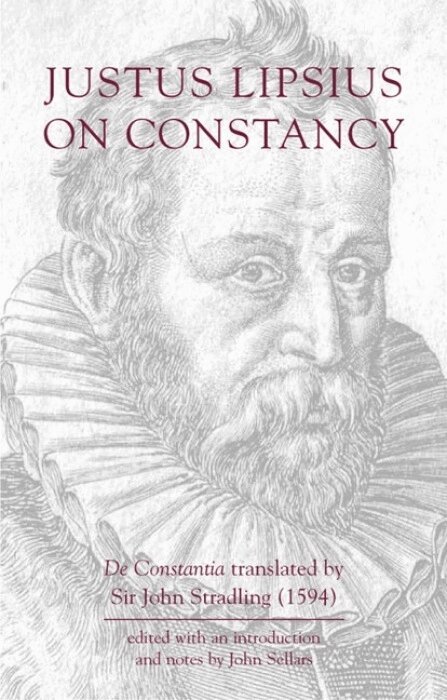
Justus Lipsius' De Constantia (1584) is one of the most important and interesting of sixteenth century Humanist texts. A dialogue in two books, conceived as a philosophical consolation for those suffering through contemporary religious wars, De Constantia proved immensely popular in its day and formed the inspiration for what has become known as 'Neo-stoicism'. This movement advocated the revival of Stoic ethics in a form that would be palatable to a Christian audience. In De Constantia Lipsius deploys Stoic arguments concerning appropriate attitudes towards emotions and external events. He also makes clear which parts of stoic philosophy must be rejected, including its materialism and its determinism. De Constantia was translated into a number of vernacular languages soon after its original publication in Latin. Of the English translations that were made, that by Sir John Stradling (1595) became a classic; it was last reprinted in 1939. The present edition offers a lightly revised version of Stradling’s translation, updated for modern readers, along with a new introduction, notes and bibliography.
535 kr
Skickas inom 7-10 vardagar
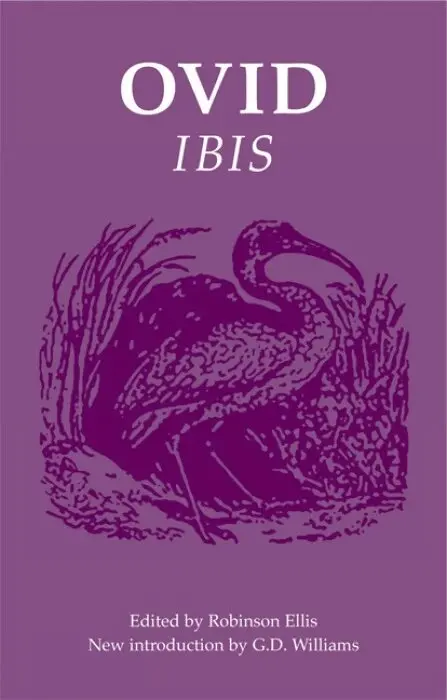
Ovid’s rarely studied Ibis is an elegiac companion-piece to the Tristia and Ex Ponto written after his banishment to the Black Sea in AD 8. Modelled on a poem of the same name by the Hellenistic poet Callimachus, Ibis stands out as an artistically contrived explosion of vitriol against an unnamed enemy who is characterised in terms of the Egyptian bird with its unprepossessing habits. Based in a tradition of curse-ritual, it is the most difficult of Ovid’s poems to penetrate. Robinson Ellis’s edition remains an indispensable – if typically eccentric – platform for the study of the poem’s obscurities. Indeed Ellis deserves the primary credit for bringing Ibis back from obscurity into the light of day.This reissue of Ellis’s 1881 edition includes a new introduction by Gareth Williams setting the edition in the context of earlier and later developments in scholarship. Ellis’s edition not only made a significant contribution to research into the Ibis, it is an important representative of a particular vein of scholarship prevalent in nineteenth-century Latin study.
1 100 kr
Skickas inom 3-6 vardagar
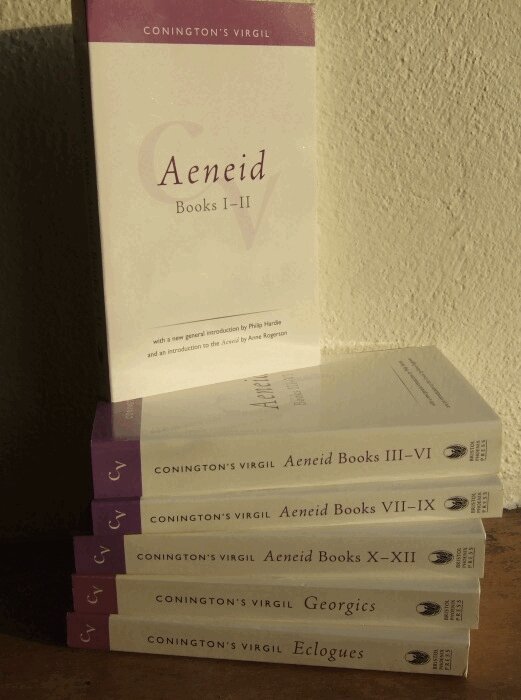
John Conington’s three-volume edition of The Works of Virgil, begun in 1852, has long been unavailable except in rare second-hand sets. The whole work is now being reissued in six affordable paperbacks, with new introductions setting the commentary in its context. Well into the twentieth century Conington’s Virgil remained the sine qua non for school and undergraduate students and their teachers; Conington’s commentary is remarkably close and uncompromising in its engagement with the detail of Virgil’s Latin, as well as its literary sensitivity; it still has much to offer the modern reader.This volume includes Conington’s general introduction to Virgil and his introduction to the Eclogues, with Virgil’s text and Conington’s commentary on the text, and with index. In addition, Philip Hardie introduces the work of Conington as a whole (and of his pupil Nettleship, who completed the Works in 1871), while Brian W. Breed assesses their approaches to the Eclogues in particular, outlining the directions in which scholarship has subsequently led, and may lead. The new introductions also include substantial bibliographies.
580 kr
Skickas inom 7-10 vardagar
John Conington’s three-volume edition of The Works of Virgil, begun in 1852, has long been unavailable except in rare second-hand sets. The whole work is now being reissued in six affordable paperbacks, with new introductions setting the commentary in its context. Well into the twentieth century Conington’s Virgil remained the sine qua non for school and undergraduate students and their teachers; Conington’s commentary is remarkably close and uncompromising in its engagement with the detail of Virgil’s Latin, as well as its literary sensitivity; it still has much to offer the modern reader.This volume contains Virgil’s text of the Georgics; Conington’s introduction to and commentary on the Georgics; Philip Hardie’s general assessment of Conington; Monica Gale’s introduction to the Georgics, and also includes Conington’s index.
1 101 kr
Skickas inom 3-6 vardagar
John Conington’s three-volume edition of The Works of Virgil, begun in 1852, has long been unavailable except in rare second-hand sets. The whole work is now being reissued in six affordable paperbacks, with new introductions setting the commentary in its context. Well into the twentieth century Conington’s Virgil remained the sine qua non for school and undergraduate students and their teachers; Conington’s commentary is remarkably close and uncompromising in its engagement with the detail of Virgil’s Latin, as well as its literary sensitivity; it still has much to offer the modern reader.This volume includes Conington’s general introduction to Virgil, his introduction to the Aeneid, his introduction to Books I –VI, Virgil’s text and Conington’s commentary to Books I–II. It also includes Philip Hardie’s general assessment of Conington, along with Anne Rogerson’s introduction to Conington’s Aeneid.
580 kr
Skickas inom 7-10 vardagar
John Conington’s three-volume edition of The Works of Virgil, begun in 1852, has long been unavailable except in rare second-hand sets. The whole work is now being reissued in six affordable paperbacks, with new introductions setting the commentary in its context. Well into the twentieth century Conington’s Virgil remained the sine qua non for school and undergraduate students and their teachers; Conington’s commentary is remarkably close and uncompromising in its engagement with the detail of Virgil’s Latin, as well as its literary sensitivity; it still has much to offer the modern reader.This volume includes Virgil’s text and Conington’s commentary on Books III–VI, along with Conington’s index to Books I–VI. It also includes Philip Hardie’s general assessment of Conington and Anne Rogerson’s introduction to Conington’s Aeneid.
657 kr
Skickas inom 7-10 vardagar
John Conington’s three-volume edition of The Works of Virgil, begun in 1852, has long been unavailable except in rare second-hand sets. The whole work is now being reissued in six affordable paperbacks, with new introductions setting the commentary in its context. Well into the twentieth century Conington’s Virgil remained the sine qua non for school and undergraduate students and their teachers; Conington’s commentary is remarkably close and uncompromising in its engagement with the detail of Virgil’s Latin, as well as its literary sensitivity; it still has much to offer the modern reader.This volume includes Virgil’s text of the Aeneid Books VII–IX and Conington’s commentary on Books VII–IX; Conington’s introduction to Books VII–XII. It also includes Philip Hardie’s general assessment of Conington and Anne Rogerson’s introduction to Conington’s Aeneid.
580 kr
Skickas inom 7-10 vardagar
John Conington’s three-volume edition of The Works of Virgil, begun in 1852, has long been unavailable except in rare second-hand sets. The whole work is now being reissued in six affordable paperbacks, with new introductions setting the commentary in its context. Well into the twentieth century Conington’s Virgil remained the sine qua non for school and undergraduate students and their teachers; Conington’s commentary is remarkably close and uncompromising in its engagement with the detail of Virgil’s Latin, as well as its literary sensitivity; it still has much to offer the modern reader.This volume includes Virgil’s text and Conington’s commentary on Books X–XII, along with Conington’s index to Books VII–XII. It also includes Philip Hardie’s general assessment of Conington and Anne Rogerson’s introduction to Conington’s Aeneid.
624 kr
Skickas inom 7-10 vardagar
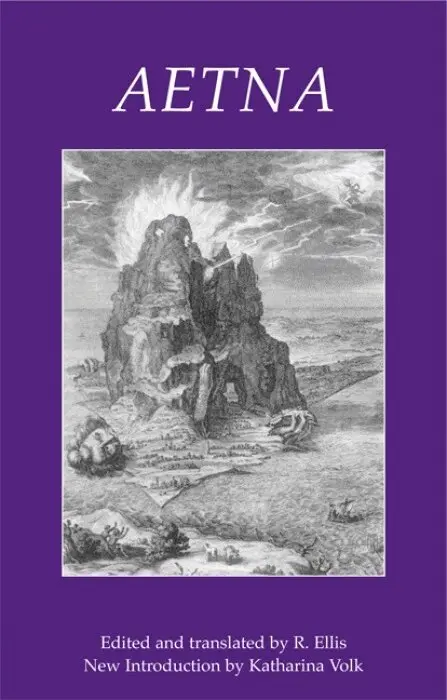
The pseudo-Virgilian Aetna poem has fascinated textual critics for centuries on account of its badly corrupted state. But it is fascinating for its content as well. It appears to date from the first half of the first century AD sometime prior to 79, for it describes Vesuvius as extinct. The highly original account of a volcano with scientific, if eccentric, views of volcanic activity, is enlivened by vivid imagery and digressions such as a section in praise of physical science and the tale of two brothers who rescued their parents from an eruption. A vigorous and enthusiastic poem, it repays further study within the didactic tradition. Robinson Ellis, according to The Times the 'greatest English Latinist' of his age, worked on the poem for decades, and his 1901 edition, which includes a translation and full commentary, constitutes a significant contribution to the study of the poem. His work remains of interest today, both to scholars working on the poem and to historians of classical scholarship.In her new introduction to this reissue of the complete Latin text and translation of the poem with Ellis's commentary, Katharina Volk discusses Ellis’s achievement in the context of his career and as part of the history of critical engagement with the Aetna. She also provides an overview of work on the poem since Ellis's edition, and a bibliography.