Building Social Work Research Capacity - Böcker
Visar alla böcker i serien Building Social Work Research Capacity. Handla med fri frakt och snabb leverans.
4 produkter
4 produkter
641 kr
Skickas inom 5-8 vardagar
Doctoral education in social work is said to be in crisis. While there is a glut of available programs, there is a shortage of doctoral graduates for faculty positions in social work education requiring that the field prepare more high-quality graduates for these positions. There is also an increasing need for doctoral-level social workers in leadership roles outside of schools of social work, such as in think tanks, professional associations, public and organizational administration, and practice.Based on findings from a national survey of doctoral students in social work, this volume discusses the purpose of doctoral education in a practice profession, as well as past and current controversies about what that should be. Survey findings about student demographics and their reasons for seeking the doctoral degree are discussed in comparison to national data from related fields. In addition, their program experiences are considered and parsed, including specifics on what they like and do not like, such as the dissertation research and writing experience and preparation for the PhD job market. While most programs are designed to prepare stewards of the discipline, it turns out that the resources available in social work doctoral programs, including student aid, are quite variable. The book identifies a variety of recommendations that can enhance the profession's ability to prepare the next generation of intellectual leadership.This is essential reading for anyone interested in or already working towards a social work doctorate, and for faculty and directors of schools of social work determined to understand and shape the future of doctoral education in social work.
564 kr
Skickas inom 5-8 vardagar
As the social work profession increasingly emphasizes scholarship and research, the education and training of faculty and students in the responsible conduct of research (RCR) becomes imperative. Research Integrity and Responsible Conduct of Research provides specific guidelines regarding the practical considerations, recommendations, and tools in the ethical and responsible practice of social work research.Using core instructional areas identified by the U.S. Office of Research Integrity, this essential guide covers data acquisition, management, sharing and ownership; conflict of interest and commitment; subjects' protection; research misconduct; publication practices and responsible authorship; mentor and mentee responsibilities; peer review; and collaborative science. For each core area, the book identifies specific issues that are relevant for social work researchers. For example, the chapter on collaborative science discusses issues related to community-based research, and the chapter on subjects' protection covers common institutional review board issues with social behavioral protocols, such as doing research "on" students. Case studies designed to enhance critical thinking about ethical dilemmas confronted by social scientists in the practice of research are also included. Drawing on research, curriculum models, and identified best practices that have been primarily developed for biomedical researchers, the book presents practical strategies for educating and promoting RCR among social scientists.With useful case studies, sample protocols, and take-home points, this is a succinct yet valuable guide to the ethical practice of research for social work students, faculty, and agency-based staff.
598 kr
Skickas inom 5-8 vardagar
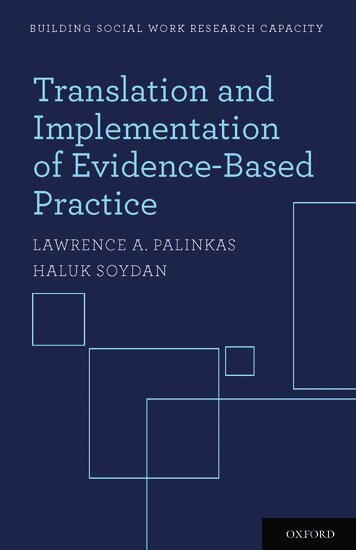
It is one thing to do social work research, but quite another to disseminate the results and ensure their effective utilization by practitioners out in the field working with clients. Just as important is ensuring that the research is relevant and usable by the social and health service community. Implementation research and translational research are designed to develop effective methods for narrowing the gap between research and practice.Using the National Institutes of Health Roadmap as a guide, this book fills a gap in social work writing by describing the challenges of investigating the process and outcomes of efforts to translate and implement evidence-based practices in social work. A general introduction discusses the history of such efforts and a picture of where we are now. Subsequent chapters offer in-depth examinations of the methods for studying the effectiveness, dissemination, and implementation of evidence-based practices; discuss the organizational context in which these activities occur in social work practice; investigate the use of mixed-method designs and community-based participatory methods to address these challenges; provide case studies of research on translation and implementation; identify potential barriers and offer recommendations and guidelines for addressing them.The resulting strategy is founded on the principle and practice of cultural exchange between members of social worker-led interdisciplinary research teams, and between researchers and practitioners. Decision-makers in social service agencies and policy settings, in addition to professors and master's and doctoral-level students, will all want to read this vital and informative book that brings core issues of research and practice to life.
712 kr
Skickas inom 5-8 vardagar
Social work education programs, at all levels, are challenged to enhance their research culture and infrastructure. Since the 1991 NIMH-supported Task Force on Social Work Research report called for increasing research development in social work education programs, schools of social work have worked to develop research-supportive climates. This has helped social work scholars contribute to the knowledge base through the publication of original research, the expansion of the quantity and quality of faculty and student research endeavors, and the development of more empirically validated treatment approaches.Drawing on the extensive experience of the authors, this book provides a roadmap to building research capacity. It outlines specific leadership strategies that deans and directors can use to access federal research funds; incentivize interdisciplinary research; enhance mentorship relationships between senior and junior researchers; and make strategic hires. The book also identifies specific strategies to promote research by junior faculty and graduate students; forge partnerships between the university and local community and state agencies; identify potential grant funders; and write successful grants.Deans, directors, faculty, research administrators, and doctoral students will find this book a valuable step-by-step guide for fostering a research climate and increasing the likelihood of developing successful research initiatives.