
Buildings of the United States S. – serie
Visar alla böcker i serien Buildings of the United States S.. Handla med fri frakt och snabb leverans.
5 produkter
5 produkter
Häftad, Engelska, 1995
499 kr
Tillfälligt slut
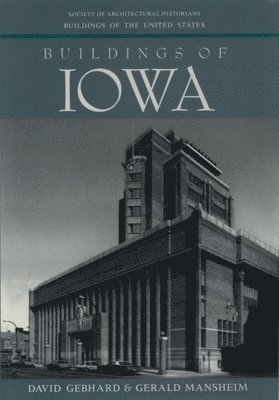
From the first years of European settlement down to the present moment, Iowa has symbolized the heart of America. In Buildings of Iowa we are offered a wide-ranging survey of this state's architecture from the earliest Native American influences to the present. The image of Iowa as the breadbasket and agricultural centre of the nation often overlooks the unity of urban and rural that is reflected in Iowa's buildings and landscape. Surveying the full array of Iowa's architectural styles on a town-by-town basis, this volume examines such structures as octagonal houses, log cabins, Beaux-Arts courthouses, water towers, grain elevators, the Iowa Soldiers' Orphans Home at Cedar Falls, the bright blue "glass fused to steel" silos built by A.O. Harvestore Products Inc., Art Deco service stations, post office buildings, churches, bank buildings, public high schools, American Prairie houses, and motion picture theatres. Beautifully illustrated with over 400 photographs, linocuts, and maps, Buildings of Iowa shows both general readers and travellers how a unity of rural and urban is effectively mirrored in Iowa's buildings.
Häftad, Engelska, 1995
499 kr
Tillfälligt slut
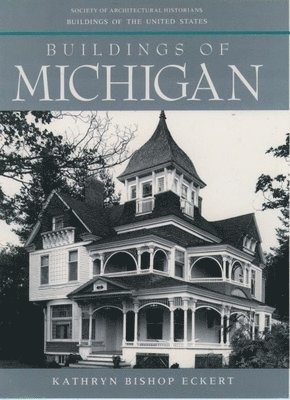
Buildings of Michigan presents a pictorial survey of Michigan architecture from 1831 to the present. From Romantic Michigan, before the Civil War, with its Greek, Gothic, and Italian villas to the internationally renowned buildings of modern Michigan, this informative book explores Michigan's history, covering the full spectrum of architectural styles particular to the state. Surveying the architecture of Detroit and many other cities, towns, and villages, this volume examines such structures as the mine locations in the Copper Range, early inns and houses along the Sauk Trail, the sandstone architecture of the Lake Superior region, lighthouses and lifesaving stations of the Upper Great Lakes, the great houses of automobile industrialists in Grosse Pointe, the factories of Albert Kahn, and the contributions of numerous local architects whose work has added to Michigan's architectural heritage.Offering a fascinating look at buildings of each period, style, type, and material in Michigan's history, with over 400 exceptional photographs, drawings, and maps, Buildings of Michigan is an extraordinary guide to architecture shaped by the changing attitude of people toward their rich and splendid land.
Häftad, Engelska, 1995
295 kr
Tillfälligt slut
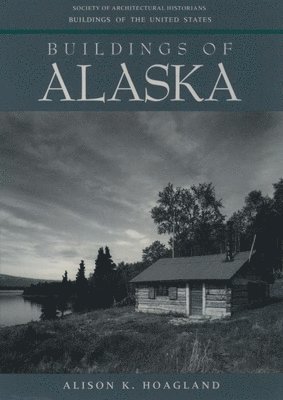
This illustrated study traces Alaska's architecture from the earliest dwellings made of sod, whalebone and driftwood, to the glass and metal skyscrapers of modern day Anchorage.
Häftad, Engelska, 1995
499 kr
Tillfälligt slut
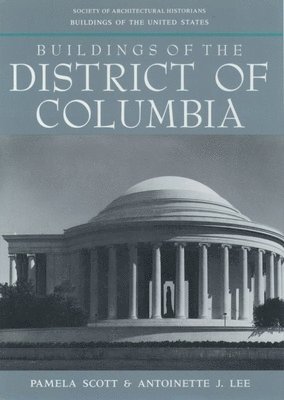
Series copy: America's architectural heritage is incredibly rich-from Alaska's log cabins and Iowa's silos, to Michigan's automobile plants and the District of Columbia's monuments. Now, in Buildings of the United States, a monumental project commissioned by the Society of Architecural Historians, we have the first state-by-state survey American architecture reflecting the geographic, climatic, and ethnic diversity of the country. It records the works of national and international masters of American architecture, as well as works by unknown hands. From pre-Columbian ruins to modern skyscrapers, from churches, courthouses, and theatres, to factories, barns, and gas stations, the volumes balance coverage of urban, suburban, and rural architecture. The authors of the volumes are architectural historians with a distinct and thorough knowledge of the states about which they have written. Each volume is profusely illustrated with photographs and line drawings, many of which were commissioned for the work.Destined to become a national treasure, Buildings of the United States is the authoritative reference on our architectural heritage and will become delight to the general reader and traveler as well as an indispensable source book for scholars and students of architectural history, preservation, and urban planning. The public architecture of Washington D.C. is well-known throughout the world. The Capitol, the White House, and other major monuments are familiar to millions of people who have never visited the city. Less familiar are many notable public and private buildings located in the central city and scattered throughout Washington's residential neighborhoods, ranging from the eighteenth-century port city of Georgetown to the mid-twentieth-century urban renewal area known as the Southwest Quadrant. Tracing the evolution of the district's architectrual character from the Revolutionary War to the present, Pamela Scott and Antoinette J. Lee survey major public and government buildings, monuments and memorials, residential buildings and neighborhoods, parks and recreational areas, and commercial and industrial centres.From the Vietnam Memorial, the Smithsonian Institution, and the United States Patent Office to Howard and Georgetown universities, nineteenth-century row houses, and elegant Beaux-Arts mansions, this volume captures the full array of Washington's architecural styles. Containing over 360 magnificent photographs, drawings, and maps, Buildings of the District of Columbia is a compelling source of information for the general reader, and a splendid guidebook for the traveler.
Häftad, Engelska, 2002
337 kr
Tillfälligt slut
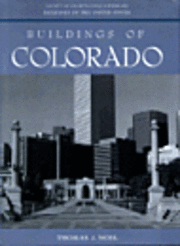
A monumental, state-by-state survey of American architecture, the Buildings of the United States series Commissioned by the Society of Architectural Historians celebrates the rich geographic, cultural, and economic diversity of the country. This fifth volume in the Buildings of the United States series charts the architectural history of Colorado-the nation's highest state-from the eastern High Plains to the Rocky Mountain backbone that melts into the canyons of the west. Both a quick-reference guidebook and a historical resource, this volume reflects the remarkable topographical diversity of the state, a full one-third of which is designated as federal land. In over 450 photographs and maps, it explores the structures humankind has created to tame Colorado's dramatically variant climate and terrain-crossed by barbed wire, roads, power lines, and railroads. Tracing Colorado's architectural development from its Native American origins, the work covers the villages of Mexican settlers and mining camps set up during the Pikes Peak gold rush of 1858-59.It features the forts and farms of pioneers; homes, churches, and schools of early towns; and modern industrial centers and vacation spots. Prehistoric pueblos of the Anasazi Indians at Mesa Verde, the U.S. Air Force Academy north of Colorado Springs, and contemporary ski resorts such as Aspen and Telluride exemplify the dramatically disparate structures of Colorado's built environment.