Cambridge Papers in Social Anthropology - Böcker
Visar alla böcker i serien Cambridge Papers in Social Anthropology. Handla med fri frakt och snabb leverans.
10 produkter
10 produkter
Del 1 - Cambridge Papers in Social Anthropology
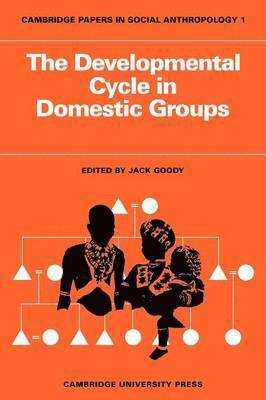
The Developmental Cycle in Domestic Groups
Häftad, Engelska, 1971
428 kr
Skickas inom 7-10 vardagar
Social scientists, when making their studies of the structure of family groups, have often observed the current situation of a particular group of families and drawn conclusions from that static picture. Valuable as many of these conclusions may be, they are incomplete because they overlook the important fact that the structure of the family changes. These changes can be fitted into a developmental cycle in which the family or group changes in composition from its original two members to a larger group and finally two again. This book, originally published in 1958, is introduced by a substantial essay and reviews the papers collected here and discusses the theoretical background and implications of the use of the concept of the developmental cycle. The papers each demonstrate how the changing structure of the domestic group may be seen to explain otherwise obscure elements of the particular society.
Del 2 - Cambridge Papers in Social Anthropology
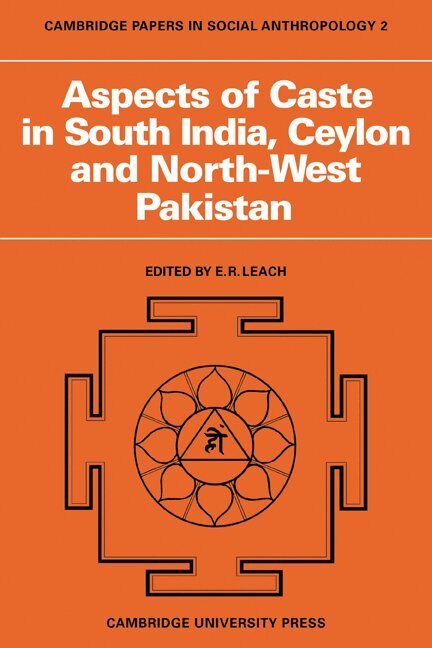
Aspects of Caste in South India, Ceylon and North-West Pakistan
Häftad, Engelska, 1971
428 kr
Skickas inom 7-10 vardagar
When this book was originally published in paperback in 1971, one of the most hotly debated themes in Indian sociology was the meaning of the term caste. At one extreme Professor Dumont argued caste is an aspect of Hinduism that cannot be isolated from its religious matrix; on the other, certain American-trained sociologists represented the caste order as a specially rigid form of social class hierarchy. Aspects of Caste endeavoured to test these two hypotheses against the data. The first paper, by E. Kathleen Gough, describes the caste order of a village in Tanjore that corresponds closely to Dumont's ideal type. The second paper, by Michael Banks, relates to a Jaffna Tamil community in Northern Ceylon. Nur Yalman's paper describes a Buddhist Sinhalese community in Central Ceylon. Fredrik Barth's study of Swat in Northwestern Pakistan exhibits an even more divergent case. Edmund Leach's introductory essay discusses the general theoretical issues raised by these examples and their importance for an understanding of social issues in South Asia.
284 kr
Skickas inom 7-10 vardagar
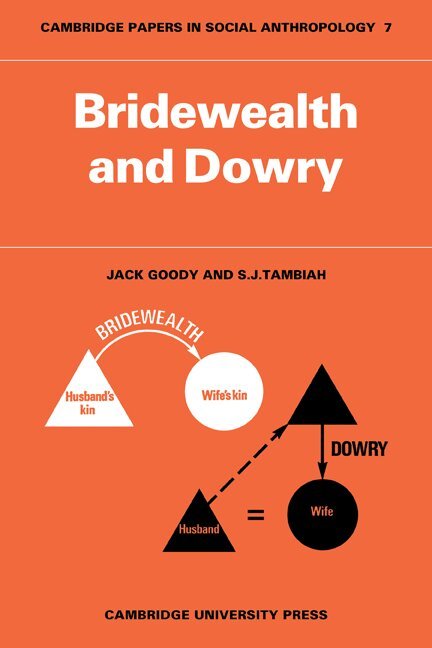
Bridewealth and dowry have certain obvious similarities in that they both involve the transmission of property at marriage, the usual interpretation suggesting that what distinguishes them is the direction in which the property travels - in the case of bridewealth, from the husband and his kin to the wife and her kin, and in the case of dowry, vice versa. The authors of these 1973 papers criticise this interpretation as oversimplified, and analyse the two institutions in the contexts of Africa, with its preponderance of bridewealth, and South Asia, where dowry is the commoner institution. Dr Goody seeks to explain these geographical differences in terms of the basic structure of the societies and the rules governing the inheritance of property. Dr Tambiah considers these institutions in India, Ceylon and Burma as two kinds of property transfer, examining Indian juridical concepts, and relating these to the concepts and practices of Ceylon and Burma.
Del 10 - Cambridge Papers in Social Anthropology
From Craft to Industry
The Ethnography of Proto-Industrial Cloth Production
Häftad, Engelska, 2009
428 kr
Skickas inom 7-10 vardagar
The essays in this volume focus on two themes: the centrality of the production of and trade in cloth in the emergence of market activity; and the nature of the industrialization process. The core of the book is formed by four detailed ethnographic studies of the development and current organization of cloth production for the market, in different parts of the world: tailoring in Kano City, northern Nigeria (Pokrant); dyeing and weaving in Daboya, northern Ghana (Goody); 'fashion'- shirt production in Bombay, India (Swallow); and the manufacture of 'handmade' Harris tweed in the Hebrides (Ennew). Each study examines access to raw materials and to the market, relations of production, the investment of capital and the reproduction of the system. Individually, they raise such questions as the role of fashion, the effects of national economic policies and legislation, and factors related to the modification of traditional technologies.
428 kr
Skickas inom 7-10 vardagar
Following the publication of the book by E. R. Leach, ed., Aspects of Caste in South India, Ceylon and North-West Pakistan (1960), much additional information was gathered on caste hierarchies in South Asia, and two major attempts were made to identify the underlying unity of this material - a structuralist one by Louis Dumont and a ethnosocialogical one by McKim Marriott et al. This quest for unity seemed attractive, yet at the same time, as the contributions to the present volume indicate, premature. The four papers collected here and published in 1982 are all concerned with caste ideology and caste interaction in different locales of South Asia.
Del 11 - Cambridge Papers in Social Anthropology
Inequality in New Guinea Highlands Societies
Häftad, Engelska, 2009
428 kr
Skickas inom 7-10 vardagar
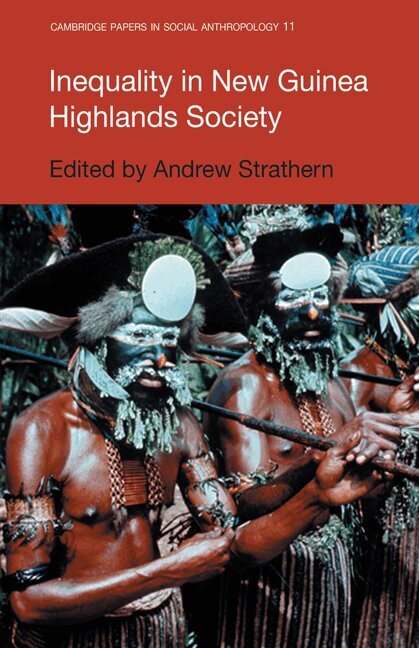
Now reissued in paperback with a new preface. The Highlands societies of Papua New Guinea, which have been studied intensively by numerous anthropologists since the 1950s, have been widely described as egalitarian and as characterised by achieved leadership. The Melanesian 'big-man' system, in which men achieve social status largely by their manipulation of wealth in elaborate structures of ceremonial exchange, has become an established anthropological model. However research has suggested that this interpretation has underestimated the elements of structured inequality within these societies, and that the classic picture should be modified and supplemented. The five papers in this volume seek to illuminate patterns of inequality in Highlands societies, which revolve around the categories of elders/juniors, big-men/workers and men/women. In setting these into a context of long-term and recent social changes, they also aim to develop schemes of analysis which will permit discussion of the societies over extended periods of time.
415 kr
Skickas inom 7-10 vardagar
Continuing a policy of devoting a whole issue to a single topic, the third volume of the series deals with aspects of marriage in tribal societies. Three papers by Esther Goody, Grace Harris and Jean La Fontaine give accounts of observations in African tribal societies; the fourth, by Marguerite Robinson, is a reassessment of Malinowski's data on the Trobrian islanders. Marriage in tribal societies is a transaction: it is also an institution with a place in the social structure. Status in marriage is seen as a crucial issue. The movement from filial to conjugal status in a first marriage is fundamental and irreversible; it is not diminished by subsequent divorce and remarriage. The partners may change, the status remains. Nevertheless, the rights and obligations of marriage, once authorised, are meant to be respected by all others. Hence the jural penalties for adultery. These are some of the themes which initiate important theoretical discussions in these papers. In his introductory essay Professor Fortes unifies the material, notes the important generalizations which emerge, and points the way to further research.
428 kr
Skickas inom 7-10 vardagar
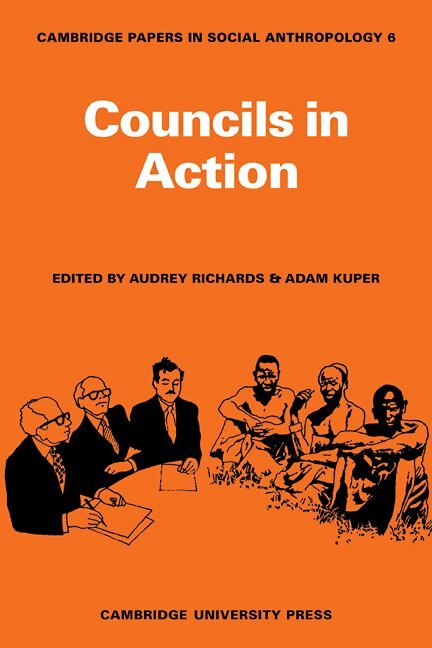
A collection of seven papers by social anthropologists on the processes of decision-making in councils. Types of council described are one community-in-council, two arena councils, an elite council, two modern local government councils and a non-council, a temporary negotiating group which nevertheless displays certain features of the council proper. Most of the examples come from Africa (including Madagascar), but there is also an account of politics and decision-making in an English town council. The editors discuss the papers in a comparative framework, considering also other accounts of conciliar structure and decision-making. They review the ways in which decisions are reached and implemented in societies with very different structures and activities and discuss the impact of written records, colonial overrule and political independence. They attempt to outline some general principles of conciliar structure and process.
Del 8 - Cambridge Papers in Social Anthropology
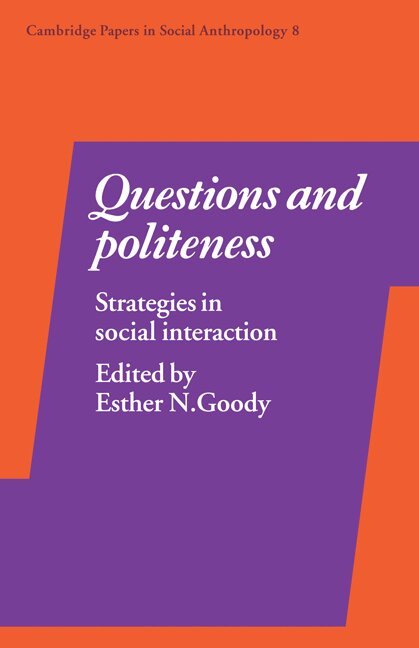
Questions and Politeness
Strategies in Social Interaction
Häftad, Engelska, 1978
428 kr
Skickas inom 7-10 vardagar
These essays, by anthropologists and anthropological linguists, draw on material from speech communities in three continents to raise fundamental questions about the ways in which interrogative and politeness forms are used in day-to-day social interaction. The authors suggest that interrogative and politeness forms have universal features which make them efficient for certain strategies of interaction. Why should these strategies constantly recur? Here the focus shifts to the consideration of status and power, social roles and social distance. Esther Goody looks at the way in whichy the institutionalization of questioning allows only for speech acts consistent with status differences. Brown and Levinson claim that speech acts are potentially threatening to those being addressed, and that politeness forms have evolved as a mechanism for reducing such threats. They analyse the conditions under which politeness forms will be used and show that their findings are consistent with data drawn from India, Mexico and the US.
428 kr
Skickas inom 7-10 vardagar
Positions of authority in any society are limited in number, and therefore rules of selection must operate in their recruitment. There must also be limitations upon the range of authority exercised. These problems are particularly acute in the case of high office, where the questions of recruitment and succession are of central importance. This 1979 volume provides a general and theoretical analysis of succession in different traditional African societies. Jack Goody's introduction spells out the main ways in which systems of succession to office differ, and assesses the problem each system solves and the dilemmas it creates. He also analyses the tensions to which succession gives rise, and relates these to specific methods of transferring office from one generation to the next, The four case studies, all based on extensive fieldwork, consider succession among the Bausto, the Baganda, the Nyamwezi and the Gonja.