Chapman and Hall/CRC Series on Statistics in Business and Economics – serie
Visar alla böcker i serien Chapman and Hall/CRC Series on Statistics in Business and Economics. Handla med fri frakt och snabb leverans.
10 produkter
10 produkter
3 056 kr
Kommande
Introduction to Bayesian Econometrics: A GUIded Toolkit Using R offers a practical, conceptually clear, and computationally accessible pathway into Bayesian data analysis. Designed for readers who wish to apply Bayesian methods without necessarily investing years in programming, the book combines rigorous treatment of foundational ideas with a graphical user interface (GUI) that allows users to run Bayesian regression models in a user-friendly environment.The first part develops the mathematical foundations of Bayesian inference by presenting all derivations step-by-step. This transparent treatment of conjugate models, including posterior analysis, marginal likelihoods, and posterior predictive distributions, provides readers with a strong theoretical base for the more advanced material that follows.The second part focuses on implementation. It introduces the custom GUI for readers with little or no programming experience, demonstrates how to fit Bayesian models using established R packages, and guides more advanced users through programming key components of Bayesian samplers from scratch. This integrated approach enables readers with different backgrounds to engage with Bayesian methods at their preferred level of computational depth.The third part extends the framework to modern Bayesian econometrics. It covers Bayesian machine learning, causal inference, and approximate methods, illustrating how Bayesian ideas can be applied to contemporary empirical challenges. By combining theory, software, and hands-on computation, the book provides a comprehensive entry point into both classical and modern Bayesian analysis.Across all parts, the book is designed to support a wide range of users -beginners, intermediate programmers, and advanced learners-. To the best of the author’s knowledge, no existing text combines mathematical transparency, software accessibility, and modern Bayesian topics in a single, integrated resource.
1 096 kr
Kommande
Introduction to Bayesian Econometrics: A GUIded Toolkit Using R offers a practical, conceptually clear, and computationally accessible pathway into Bayesian data analysis. Designed for readers who wish to apply Bayesian methods without necessarily investing years in programming, the book combines rigorous treatment of foundational ideas with a graphical user interface (GUI) that allows users to run Bayesian regression models in a user-friendly environment.The first part develops the mathematical foundations of Bayesian inference by presenting all derivations step-by-step. This transparent treatment of conjugate models, including posterior analysis, marginal likelihoods, and posterior predictive distributions, provides readers with a strong theoretical base for the more advanced material that follows.The second part focuses on implementation. It introduces the custom GUI for readers with little or no programming experience, demonstrates how to fit Bayesian models using established R packages, and guides more advanced users through programming key components of Bayesian samplers from scratch. This integrated approach enables readers with different backgrounds to engage with Bayesian methods at their preferred level of computational depth.The third part extends the framework to modern Bayesian econometrics. It covers Bayesian machine learning, causal inference, and approximate methods, illustrating how Bayesian ideas can be applied to contemporary empirical challenges. By combining theory, software, and hands-on computation, the book provides a comprehensive entry point into both classical and modern Bayesian analysis.Across all parts, the book is designed to support a wide range of users -beginners, intermediate programmers, and advanced learners-. To the best of the author’s knowledge, no existing text combines mathematical transparency, software accessibility, and modern Bayesian topics in a single, integrated resource.
1 298 kr
Skickas inom 10-15 vardagar
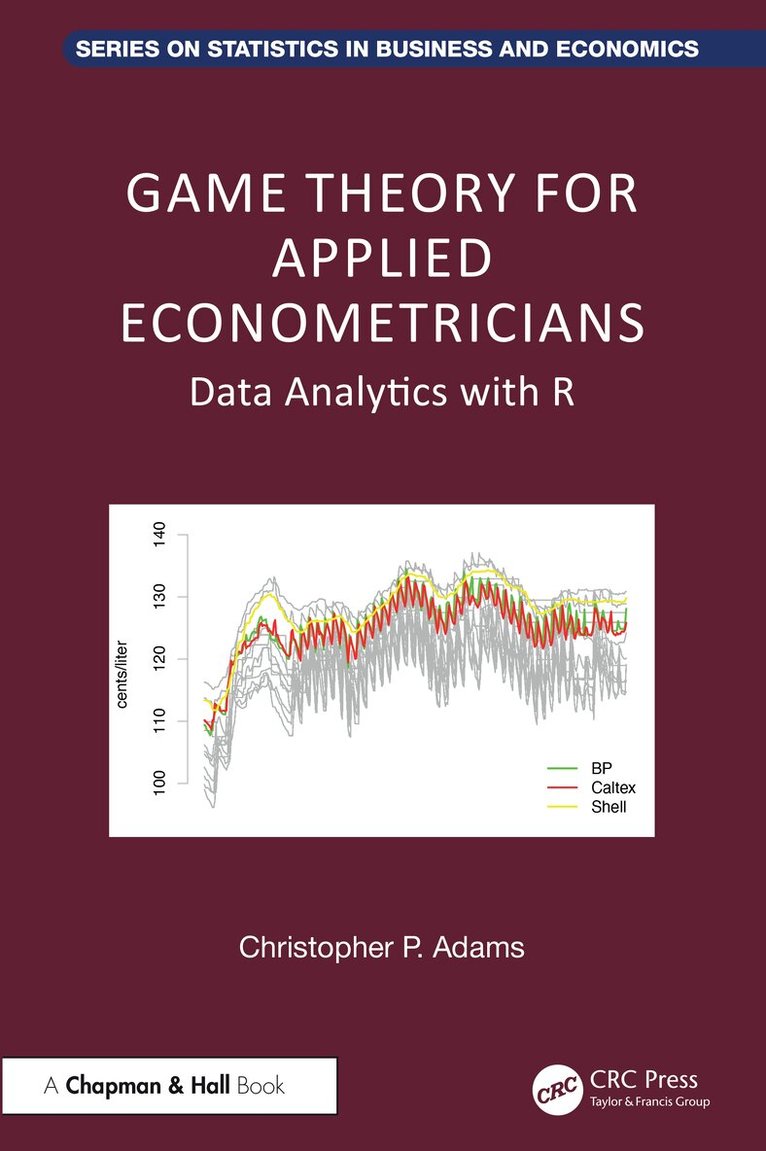
Over the last 30 years the practice and use of game theory has changed dramatically, yet textbooks continue to present game theory with algebraic formalism and toy models. This book, on the other hand, illustrates game theory concepts using real-world data and analyses problems with real policy implications. The focus is on applying current learning to real world problems by providing an introduction to game theory and econometric analysis based on game theoretic principles using the computer language R.The book covers the standard topics of an introductory game theory course including dominant strategies, Nash equilibrium and Bayes Nash equilibrium. It layers on top of this an approach to statistics and econometrics called Structural Modeling. In this approach, key parameter estimates rely upon game theoretic analysis. The real-world examples used to illustrate these concepts vary in scope and include an analysis of bargaining between hospitals and insurers, equilibrium entry of retail tire stores, bid rigging in timber auctions and contracts in 19th century whaling.This book is aimed at the general reader with the equivalent of a bachelor’s degree in economics, statistics or some more technical field. The book could be used as a text for an upper level undergraduate course or a lower level graduate course in economics or business.
1 434 kr
Skickas inom 10-15 vardagar
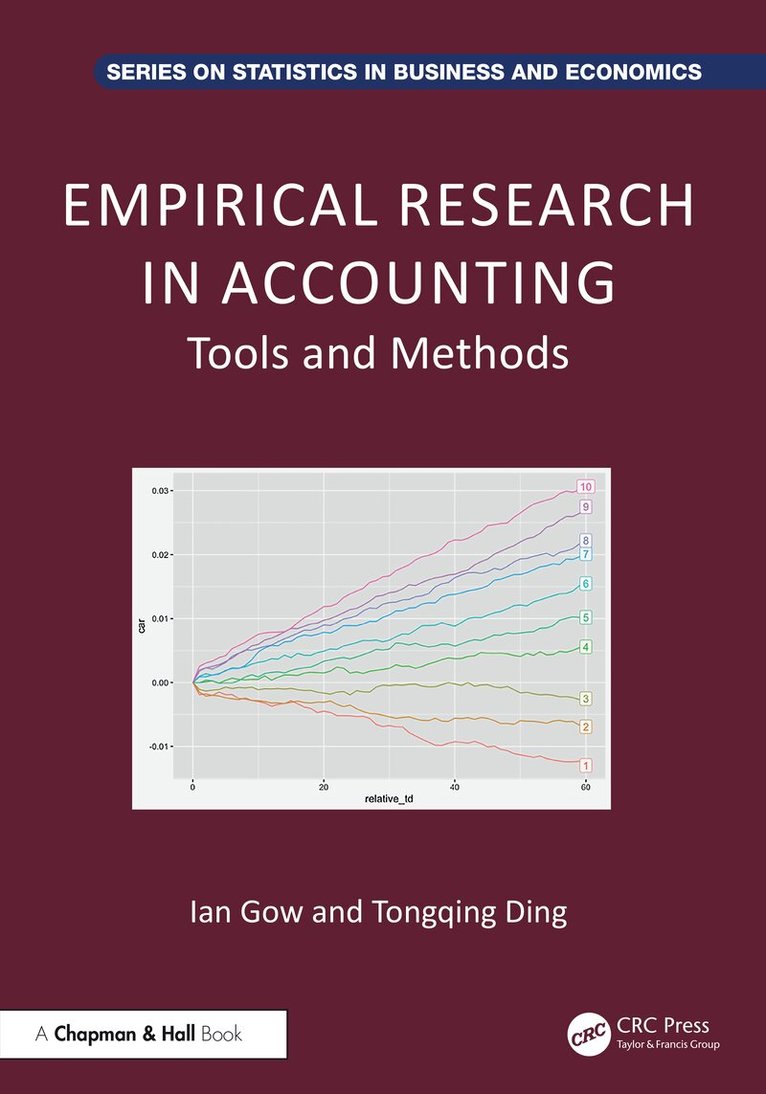
This textbook provides the foundation for a course that takes PhD students in empirical accounting research from the very basics of statistics, data analysis, and causal inference up to the point at which they conduct their own research. Starting with foundations in statistics, econometrics, causal inference, and institutional knowledge of accounting and finance, the book moves on to an in-depth coverage of the core papers in capital market research. The latter half of the book examines contemporary approaches to research design and empirical analysis, including natural experiments, instrumental variables, fixed effects, difference-in-differences, regression discontinuity design, propensity-score matching, and machine learning. Readers of the book will develop deep data analysis skills using modern tools. Extensive replication and simulation analysis is included throughout.Key Features:Extensive coverage of empirical accounting research over more than 50 years.Integrated coverage of statistics and econometrics, institutional knowledge, and research design.Numerous replications and a dozen simulation analyses to immerse readers in papers and empirical analysis.All tables and figures in the book can be reproduced by readers using included code.Easy-to-use templates facilitate hands-on exercises and introduce reproduceable research concepts. (Solutions available to instructors.)
1 298 kr
Skickas inom 10-15 vardagar
Empirical Finance: Theory and Application offers a modern, data-driven introduction to the field of finance, tailored for undergraduate students and practitioners seeking to bridge theory with real-world evidence. In an era defined by abundant data and computational power, this book emphasizes hands-on learning by integrating financial theory, empirical analysis, and practical implementation using Python and R. Each chapter balances intuitive explanations with mathematical rigor, ensuring that readers not only understand key concepts but also learn how to test them with actual data.Structured in two parts, the book begins with a thorough review of essential quantitative tools—optimization, probability, and statistics—providing the foundation needed for empirical work. The second part applies these tools to core topics in finance, including asset pricing, portfolio choice, market efficiency, event studies, and volatility modeling. Real-world examples and case studies—such as testing the Efficient Markets Hypothesis, analyzing stock splits, and evaluating the equity premium—bring the material to life and illustrate how empirical methods can validate or challenge economic intuition.A distinctive feature of this text is its emphasis on reproducibility and application. Code snippets, exercises, and datasets enable readers to replicate results and develop their own analyses. Topics like time-series properties of returns, portfolio management and behavioral finance are treated with both theoretical and empirical depth, preparing students for quantitative internships, graduate studies, or roles in the financial industry.Ideal for courses in Empirical Finance, Financial Econometrics, or Quantitative Finance, this book stands out for its clear exposition, relevance to contemporary practice, and commitment to evidence-based reasoning. It empowers a new generation of finance students to think critically, work with data, and understand markets not as a set of abstract rules, but as a dynamic interplay of economics, data, and technology.Key Features:· Seamlessly integrates hands-on coding in both Python and R with financial theory, enabling readers to replicate results and conduct their own empirical analysis.· Strikes a unique balance between financial intuition, mathematical clarity, and real-world application, avoiding the common extremes of abstract theory or mere data manipulation.· Structured in two distinct parts—first building essential quantitative tools (optimization, probability, statistics) before applying them to core finance topics—ensuring a solid foundation for empirical work.· Uses contemporary, relevant examples throughout, such as testing market anomalies, analyzing cryptocurrency returns, and conducting event studies on recent scandals.· Emphasizes a data-centric approach to validate or challenge economic reasoning, teaching students to treat finance as a dynamic, evidence-based discipline.
1 148 kr
Skickas inom 10-15 vardagar
Supply chain operations face many risks, including political, environmental, and economic. The past five years have seen major challenges, from pandemic, impacts of global warming, wars, and tariff impositions. In this rapidly changing world, risks appear in every aspect of operations. This book presents data mining and analytics tools with R programming as well as a brief presentation of Monte Carlo simulation that can be used to anticipate and manage these risks. RStudio software and R programming language are widely used in data mining. For Monte Carlo simulation applications we cover Crystal Ball software, one of a number of commercially available Monte Carlo simulation tools.Chapter 1 of this book deals with classification of risks. It includes a typical supply chain example published in academic literature. Chapter 2 gives a brief introduction to R programming. It is not intended to be comprehensive, but sufficient for a user to get started using this free open source and highly popular analytics tool. Chapter 3 discusses risks commonly found in finance, to include basic data mining tools applied to analysis of credit card fraud data. Like the other datasets used in the book, this data comes from the Kaggle.com site, a free site loaded with realistic datasets.The remainder of the book covers risk analytics tools. Chapter 4 presents R association rule modeling using a supply chain related dataset. Chapter 5 presents Monte Carlo simulation of some supply chain risk situations. Chapter 6 gives both time series and multiple regression prediction models as well as autoregressive integrated moving average (ARIMA; Box-Jenkins) models in SAS and R. Chapter 7 covers classification models demonstrated with credit risk data. Chapter 8 deals with fraud detection and the common problem of modeling imbalanced datasets. Chapter 9 introduces Naïve Bayes modeling with categorical data using an employee attrition dataset.Features:Overview of predictive analytics presented in an understandable mannerPresentation of useful business applications of predictive data miningCoverage of risk management in finance, insurance, and supply chain contextsPresentation of predictive modelsDemonstration of using these predictive models in RScreenshots enabling readers to develop their own modelsThe purpose of the book is to present tools useful to analyze risks, especially those faced in supply chain management and finance.
1 434 kr
Skickas inom 10-15 vardagar
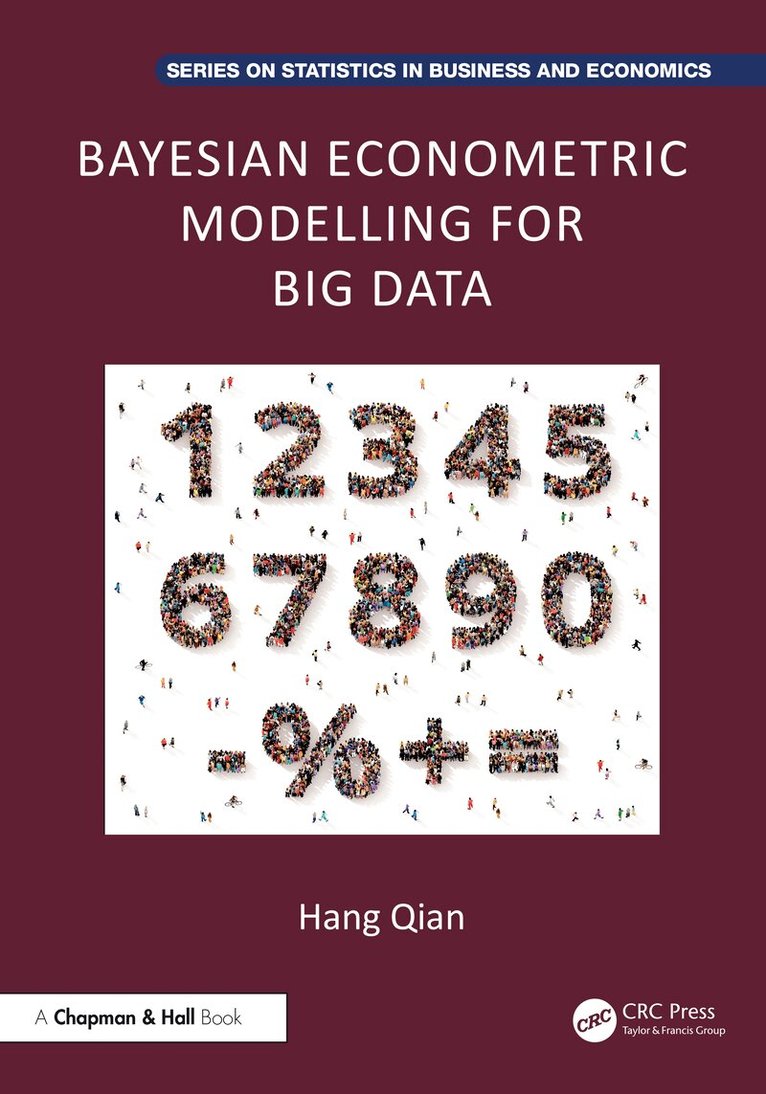
This book delves into scalable Bayesian statistical methods designed to tackle the challenges posed by big data. It explores a variety of divide-and-conquer and subsampling techniques, seamlessly integrating these scalable methods into a broad spectrum of econometric models.In addition to its focus on big data, the book introduces novel concepts within traditional statistics, such as the summation, subtraction, and multiplication of conjugate distributions. These arithmetic operators conceptualize pseudo data in the conjugate prior, sufficient statistics that determine the likelihood, and the posterior as a balance between data and prior information, adding an intriguing dimension to Bayesian analysis. This book also offers a deep dive into Bayesian computation. Given the intricacies of floating-point representation of real numbers, computer programs can sometimes yield unexpected or theoretically impossible results. Drawing from his experience as a senior statistical software developer, the author shares valuable strategies for designing numerically stable algorithms.The book is an essential resource for a diverse audience: graduate students seeking foundational knowledge in Bayesian econometric models, early-career statisticians eager to explore cutting-edge advancements in scalable Bayesian methods, data analysts struggling with out-of-memory challenges in large datasets, and statistical software users and developers striving to program with efficiency and numerical stability.
1 343 kr
Kommande
762 kr
Kommande
1 112 kr
Skickas inom 10-15 vardagar
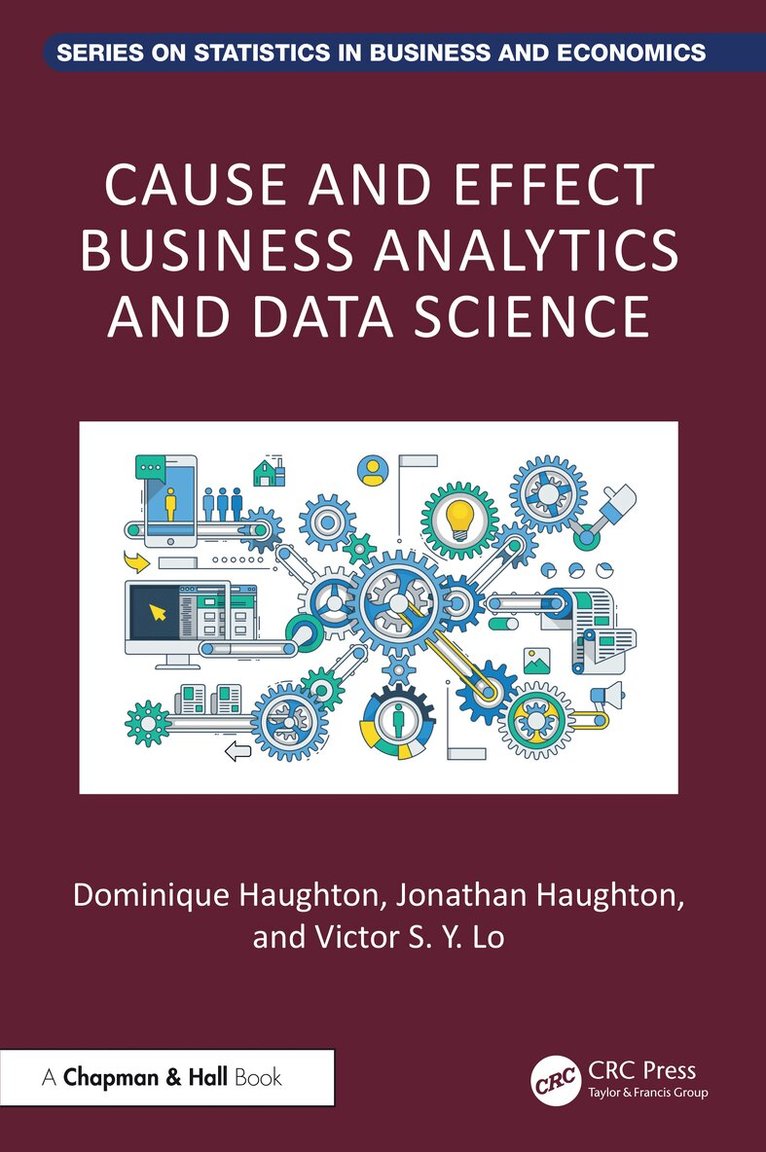
Among the most important questions that businesses ask are some very simple ones: If I decide to do something, will it work? And if so, how large are the effects? To answer these predictive questions, and later base decisions on them, we need to establish causal relationships.Establishing and measuring causality can be difficult. This book explains the most useful techniques for discerning causality and illustrates the principles with numerous examples from business. It discusses randomized experiments (aka A/B testing) and techniques such as propensity score matching, synthetic controls, double differences, and instrumental variables. There is a chapter on the powerful AI approach of Directed Acyclic Graphs (aka Bayesian Networks), another on structural equation models, and one on time-series techniques, including Granger causality.At the heart of the book are four chapters on uplift modeling, where the goal is to help firms determine how best to deploy their resources for marketing or other interventions. We start by modeling uplift, discuss the test-and-learn process, and provide an overview of the prescriptive analytics of uplift.The book is written in an accessible style and will be of interest to data analysts and strategists in business, to students and instructors of business and analytics who have a solid foundation in statistics, and to data scientists who recognize the need to take seriously the need for causality as an essential input into effective decision-making.