Chemistry Student Guides - Böcker
Visar alla böcker i serien Chemistry Student Guides. Handla med fri frakt och snabb leverans.
3 produkter
3 produkter
359 kr
Skickas inom 5-8 vardagar
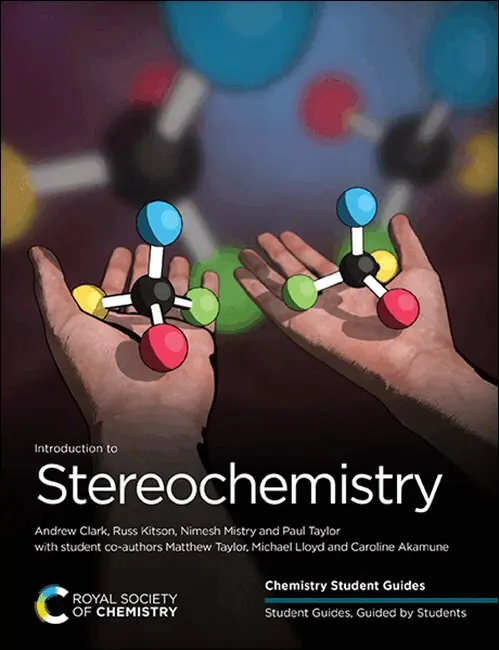
CHEMISTRY STUDENT GUIDES. GUIDED BY STUDENTSWhy did the drug thalidomide cause birth defects? What is the chemical difference between sucrose and lactose in your food? Stereochemistry holds the answer and is essential to the understanding of the chemistry of life.Stereochemistry is an important concept that often causes confusion amongst students when they learn it for the first time. Unlike most other areas of chemistry, it requires the chemist to visualise molecules in 3D, which can be difficult. In this book we deal with tricky concepts like conformation and configuration, how to represent them accurately and how to use the correct terms to describe them in both organic and inorganic chemistry. We involved student's in the writing process to ensure we deal with areas that you find difficult, in an understandable language. With problems designed to focus on common errors and misconceptions, real life examples, and practical hands-on exercises coupled with visualisation tips, our intention is to give you the tools to become confident in stererochemistry. Complementing mainstream organic textbooks, or self-study, this book is for anyone who has struggled with describing alkenes as E or Z, assigning R and S absolute configurations, drawing Newman projections or chair representations of cyclohexanes, axial chirality, understanding the stereochemistry of octahedral metal complexes and indeed explaining complexities observed in NMR spectra.Chemistry Student Guides are written with current students involved at every stage, guiding the books towards the most challenging aspects of the topic. Student co-authors for Introduction to Stereochemistry are Caroline Akamune, Michael Lloyd and Matthew Taylor.
359 kr
Skickas inom 5-8 vardagar
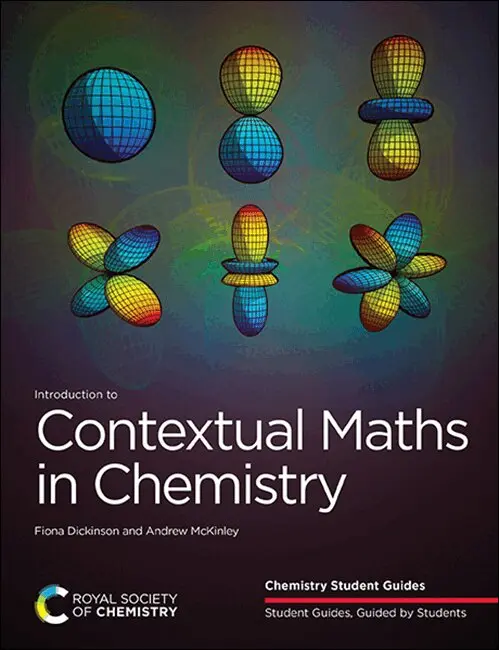
CHEMISTRY STUDENT GUIDES. GUIDED BY STUDENTSFor any student who has ever struggled with a mathematical understanding of chemistry, this book is for you.Mathematics is the essential tool for physical scientists. We know that confidence in using mathematics early on in a chemistry degree builds a solid foundation for further study. However, applying the abstract mathematics taught in schools to chemical phenomena is one of the biggest challenges that chemistry students face. In this book, we take a 'chemistry-first' approach. We link the mathematics to recognisable chemical concepts, building on high school chemistry, to facilitate deeper understanding. We cover the practical mathematical skills, including representation of data as tables and graphs, and give an overview of error handling in the physical sciences. More advanced mathematical concepts are introduced, using calculus to determine kinetic rate laws, intermolecular forces and in quantifying energetic change in thermodynamics. We also introduce the concept of the complex number and its role in considering quantum wave functions, widely used in computational chemistry.There are worked examples and problem sets to provide plenty of practise material to build proficiency. We also include insights from real students, which identify common problem areas and provide the prompts that helped them to overcome these.Chemistry Student Guides are written with current students involved at every stage, guiding the books towards the most challenging aspects of the topic.
437 kr
Kommande
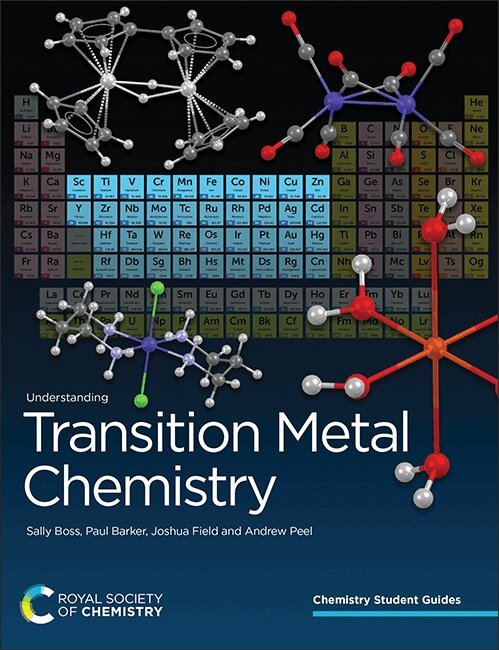
This book is part of the Chemistry Student Guides series and has been co-authored by lecturers and students from the Universities of Cambridge and Oxford and a structural scientist from the Cambridge Crystallographic Data Centre. The book provides a comprehensive grounding in first row transition metal chemistry.Two topics that are central to transition metal chemistry are Coordination Chemistry and Organometallic Chemistry and these are commonly taught separately despite there being extensive overlap and sharing of key concepts. We think this somewhat artificial separation of topics makes it harder to appreciate the key chemical theories which underpin all transition metal chemistry. With that in mind, our aim in writing this book is to provide one text which builds your understanding of the structure, bonding and reactivity of all first-row transition metal compounds. We will introduce you to many of the fundamental principles of transition metal chemistry and explain the models which allow us to rationalise and predict the bonding and reactivity of these species. We hope that our approach will provide a broad perspective on this important segment of the periodic table and ultimately make the chemistry easier to understand.Exploring the different perspectives of lecturers and students has been a big part of the writing process for this text. The story that we tell reflects this co-authorship. You will see that we adopt a tutorial style; text is interspersed with hints to help with your understanding and gently steer you away from common misconceptions. Additionally, the conceptual models presented are supported through experimental data using structures from the Cambridge Structural Database to give you a sense of the way transition metal compounds look in reality.We hope the collaborative way that we have written this book makes it easier for you to absorb the ideas we present and to test your knowledge as it develops over the course of reading the chapters.Good luck! We hope you enjoy getting to know the transition metals and becoming confident in the theories that underpin their chemistry.