Chicago Studies in American Politics (CHUP) - Böcker
Visar alla böcker i serien Chicago Studies in American Politics (CHUP). Handla med fri frakt och snabb leverans.
7 produkter
7 produkter
229 kr
Skickas inom 7-10 vardagar
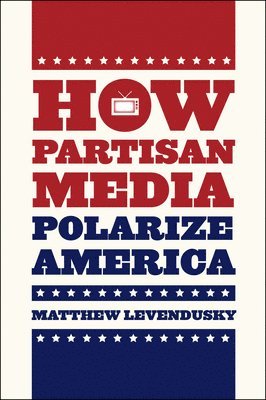
Forty years ago, viewers who wanted to watch the news could only choose from among the major broadcast networks, all of which presented the same news without any particular point of view. Today we have a much broader array of choices, including cable channels offering a partisan take. With partisan programs gaining in popularity, some argue that they are polarizing American politics, while others counter that only a tiny portion of the population watches such programs and that their viewers tend to already hold similar beliefs. In How Partisan Media Polarize America, Matthew Levendusky confirms - but also qualifies - both of these claims. Drawing on experiments and survey data, he shows that Americans who watch partisan programming do become more certain of their beliefs and less willing to weigh the merits of opposing views or to compromise. And while only a small segment of the American population watches partisan media programs, those who do tend to be more politically engaged, and their effects on national politics are therefore far-reaching.In a time when politics seem doomed to partisan discord, How Partisan Media Polarize America offers a much-needed clarification of the role partisan media might play.
482 kr
Skickas inom 7-10 vardagar
Despite George W. Bush's professed opposition to big government, federal spending has increased under his watch more quickly than it did during the Clinton administration, and demands on government have continued to grow. Why? Lawrence D. Brown and Lawrence R. Jacobs show that conservative efforts to expand markets and shrink government often have the ironic effect of expanding government's reach by creating problems that force legislators to enact new rules and regulations. Dismantling the flawed reasoning behind these attempts to cast markets and public power in opposing roles, "The Private Abuse of the Public Interest" urges citizens and policy makers to recognize that properly functioning markets presuppose the government's ability to create, sustain, and repair them over time.The authors support their pragmatic approach with evidence drawn from in-depth analyses of education, transportation, and health care policies. In each policy area, initiatives such as school choice, deregulation of airlines and other carriers, and the promotion of managed care have introduced or enlarged the role of market forces with the aim of eliminating bureaucratic inefficiency.But in each case, the authors show, reality proved to be much more complex than market models predicted. This complexity has resulted in a political cycle - strikingly consistent across policy spheres - that culminates in public interventions to sustain markets while protecting citizens from their undesirable effects. Situating these case studies in the context of more than two hundred years of debate about the role of markets in society, Brown and Jacobs call for a renewed focus on public-private partnerships that recognize and respect both sectors' vital - and fundamentally complementary - roles.
244 kr
Skickas inom 7-10 vardagar
Throughout the contest for the 2008 Democratic presidential nomination, politicians and voters alike worried that the outcome might depend on the preferences of unelected superdelegates. This concern threw into relief the prevailing notion that - such unusually competitive cases notwithstanding - people, rather than parties, should and do control presidential nominations. But for the past several decades, "The Party Decides" shows, unelected insiders in both major parties have effectively selected candidates long before citizens reached the ballot box.Tracing the evolution of presidential nominations since the 1790s, this volume demonstrates how party insiders have sought since America's founding to control nominations as a means of getting what they want from government. Contrary to the common view that the party reforms of the 1970s gave voters more power, the authors contend that the most consequential contests remain the candidates' fights for prominent endorsements and the support of various interest groups and state party leaders.These invisible primaries produce front-runners long before most voters start paying attention, profoundly influencing final election outcomes and investing parties with far more nominating power than is generally recognized.
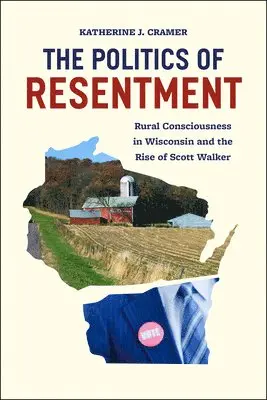
Politics of Resentment – Rural Consciousness in Wisconsin and the Rise of Scott Walker
Häftad, Engelska, 2016
351 kr
Skickas inom 7-10 vardagar
Since the election of Scott Walker, Wisconsin has been seen as ground zero for debates about the appropriate role of government in the wake of the Great Recession. In a time of rising inequality, Walker not only survived a bitterly contested recall that brought thousands of protesters to Capitol Square, he was subsequently reelected. How could this happen? How is it that the very people who stand to benefit from strong government services not only vote against the candidates who support those services but are vehemently against the very idea of big government? With The Politics of Resentment, Katherine J. Cramer uncovers an oft-overlooked piece of the puzzle: rural political consciousness and the resentment of the “liberal elite.” Rural voters are distrustful that politicians will respect the distinct values of their communities and allocate a fair share of resources. What can look like disagreements about basic political principles are therefore actually rooted in something even more fundamental: who we are as people and how closely a candidate’s social identity matches our own. Using Scott Walker and Wisconsin’s prominent and protracted debate about the appropriate role of government, Cramer illuminates the contours of rural consciousness, showing how place-based identities profoundly influence how people understand politics, regardless of whether urban politicians and their supporters really do shortchange or look down on those living in the country.The Politics of Resentment shows that rural resentment—no less than partisanship, race, or class—plays a major role in dividing America against itself.
790 kr
Skickas inom 7-10 vardagar
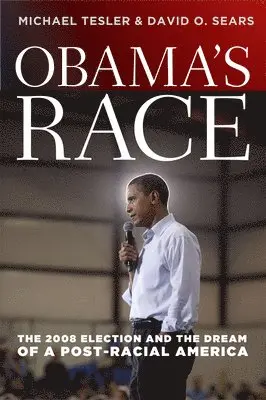
Barack Obama's presidential victory naturally led people to believe that the United States might finally be moving into a post-racial era. "Obama's Race" - and its eye-opening account of the role played by race in the election - paints a dramatically different picture. The authors argue that the 2008 election was more polarized by racial attitudes than any other presidential election on record - and perhaps more significantly, that there were two sides to this racialization: resentful opposition to and racially liberal support for Obama. As Obama's campaign was given a boost in the primaries from racial liberals that extended well beyond that usually offered to ideologically similar white candidates, Hillary Clinton lost much of her long-standing support and instead became the preferred candidate of Democratic racial conservatives. Time and again, voters' racial predispositions trumped their ideological preferences as John McCain - seldom described as conservative in matters of race - became the darling of racial conservatives from both parties. Hard-hitting and sure to be controversial, "Obama's Race" will be both praised and criticized - but certainly not ignored.
1 025 kr
Skickas inom 7-10 vardagar
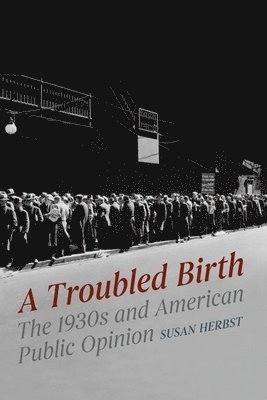
Pollsters and pundits armed with the best public opinion polls failed to predict the election of Donald Trump in 2016. Is this because we no longer understand what the American public is? In A Troubled Birth, Susan Herbst argues that we need to return to earlier meanings of "public opinion" to understand our current climate.Herbst contends that the idea that there was a public-whose opinions mattered-emerged during the Great Depression, with the diffusion of radio, the devastating impact of the economic collapse on so many people, the appearance of professional pollsters, and Franklin Roosevelt's powerful rhetoric. She argues that public opinion about issues can only be seen as a messy mixture of culture, politics, and economics-in short, all the things that influence how people live. Herbst deftly pins down contours of public opinion in new ways and explores what endures and what doesn't in the extraordinarily troubled, polarized, and hyper-mediated present. Before we can ask the most important questions about public opinion in American democracy today, we must reckon yet again with the politics and culture of the 1930s.
268 kr
Skickas inom 7-10 vardagar
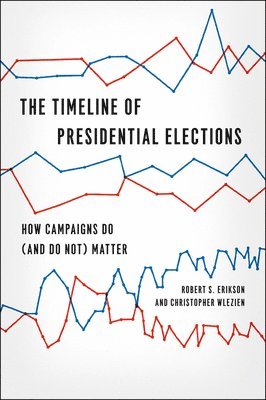
With the 2012 presidential election upon us, will voters cast their ballots for the candidates whose platforms and positions best match their own? Or will the race for the next president of the United States come down largely to who runs the most effective campaigning? It's a question those who study elections have been considering for years with no clear resolution. In "The Timeline of Presidential Elections", Robert S. Erikson and Christopher Wlezien reveal for the first time how both factors come into play. Erikson and Wlezien have amassed data from close to two thousand national polls covering every presidential election from 1952 to 2008, allowing them to see how outcomes take shape over the course of an election year. Polls from the beginning of the year, they show, have virtually no predictive power. By mid-April, when the candidates have been identified and matched in pollsters' trial heats, preferences have come into focus - and predicted the winner in eleven of the fifteen elections.But a similar process of forming favorites takes place in the last six months, during which voters' intentions change only gradually, with particular events - including presidential debates - rarely resulting in dramatic change. Ultimately, Erikson and Wlezien show that it is through campaigns that voters are made aware of - or not made aware of - fundamental factors like candidates' policy positions that determine which ticket will get their votes. In other words, fundamentals matter, but only because of campaigns. Timely and compelling, this book will force us to rethink our assumptions about presidential elections.