Classics in Organization & Management Series - Böcker
Visar alla böcker i serien Classics in Organization & Management Series. Handla med fri frakt och snabb leverans.
4 produkter
4 produkter
667 kr
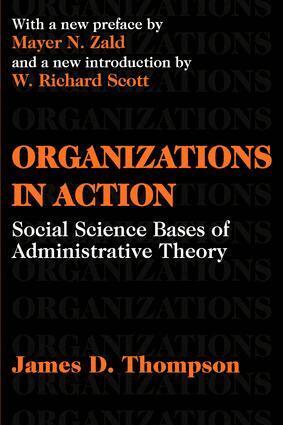
Organizations act, but what determines how and when they will act? There is precedent for believing that the organization is but an extension of one or a few people, but this is a deceptively simplified approach and, in reality, makes any generalization in organizational theory enormously difficult. Modern-day organizations—manufacturing firms, hospitals, schools, armies, community agencies—are extremely complex in nature, and several strategies, employing a variety of disciplines, are needed to gain a proper understanding of them.Organizations in Action is a classic multidisciplinary study of the behavior of complex organizations as entities. Previous books on the subject focused on the behavior of people in organizational contexts, but this volume considers individual behavior only to the extent that it helps explain the nature of organizations. James D. Thompson offers ninety-five distinct propositions about the behavior of organizations, all relevant regardless of the culture in which they are found. Thompson classifies organizations according to their technologies and environments. That organizations must meet and handle uncertainty is central to his thesis.Organizations in Action is firmly grounded in concepts and theories in the social and behavioral sciences. While it does not offer an actual theory of administration, the book successfully extends the scientific base upon which any emerging administrative theory must rest. This classic work is of continuing value to organizational and management specialists, behavioral scientists, sociologists, administrators, and policymakers.
2 089 kr
Skickas inom 10-15 vardagar
Organizations act, but what determines how and when they will act? There is precedent for believing that the organization is but an extension of one or a few people, but this is a deceptively simplified approach and, in reality, makes any generalization in organizational theory enormously difficult. Modern-day organizations manufacturing firms, hospitals, schools, armies, community agencies are extremely complex in nature, and several strategies, employing a variety of disciplines, are needed to gain a proper understanding of them.Organizations in Action is a classic multidisciplinary study of the behavior of complex organizations as entities. Previous books on the subject focused on the behavior of people in organizational contexts, but this volume considers individual behavior only to the extent that it helps explain the nature of organizations. James D. Thompson offers ninety-five distinct propositions about the behavior of organizations, all relevant regardless of the culture in which they are found. Thompson classifies organizations according to their technologies and environments. That organizations must meet and handle uncertainty is central to his thesis.Organizations in Action is firmly grounded in concepts and theories in the social and behavioral sciences. While it does not offer an actual theory of administration, the book successfully extends the scientific base upon which any emerging administrative theory must rest. This classic work is of continuing value to organizational and management specialists, behavioral scientists, sociologists, administrators, and policymakers.
2 159 kr
Skickas inom 10-15 vardagar
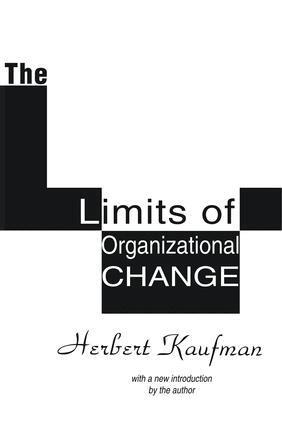
The environment of modern organizations is so complex and volatile that we take for granted that organizational change is necessary for organizational survival. Yet the literature on organizations has for years described manifold obstacles to such change. First published in 1971, this book extracts from that literature and from experience a comprehensive yet concise overview of those barriers. Because these elements of the analysis are as valid now as when they were originally written, The Limits of Organizational Change is still widely read and cited nearly a quarter-century later.From the premises of this argument, Kaufman drew a number of conclusions about organizational survival and extinction, age and size, centralization and decentralization, and organizational evolution. Subsequent research and reflection induced him to refine and modify some of those inferences. The modifications are spelled out in a new preface that gives fresh relevance to his findings and his conjectures.Yet The Limits of Organizational Change is not a ponderous, labored work. As one reviewer remarked, it is "a delightful set of essays . . . a review of empirical research in a witty, conversational style. . . ." (The Rocky Mountain Social Science Journal). It is a book one can enjoy as well as profit from, and will be a useful tool for managers, organizational studies scholars, and sociologists.
687 kr
Skickas inom 10-15 vardagar
The environment of modern organizations is so complex and volatile that we take for granted that organizational change is necessary for organizational survival. Yet the literature on organizations has for years described manifold obstacles to such change. First published in 1971, this book extracts from that literature and from experience a comprehensive yet concise overview of those barriers. Because these elements of the analysis are as valid now as when they were originally written, The Limits of Organizational Change is still widely read and cited nearly a quarter-century later.From the premises of this argument, Kaufman drew a number of conclusions about organizational survival and extinction, age and size, centralization and decentralization, and organizational evolution. Subsequent research and reflection induced him to refine and modify some of those inferences. The modifications are spelled out in a new preface that gives fresh relevance to his findings and his conjectures.Yet The Limits of Organizational Change is not a ponderous, labored work. As one reviewer remarked, it is "a delightful set of essays . . . a review of empirical research in a witty, conversational style. . . ." (The Rocky Mountain Social Science Journal). It is a book one can enjoy as well as profit from, and will be a useful tool for managers, organizational studies scholars, and sociologists.