
Comparative Ethics – serie
Visar alla böcker i serien Comparative Ethics. Handla med fri frakt och snabb leverans.
3 produkter
3 produkter
Häftad, Engelska, 1985
384 kr
Skickas inom 10-15 vardagar
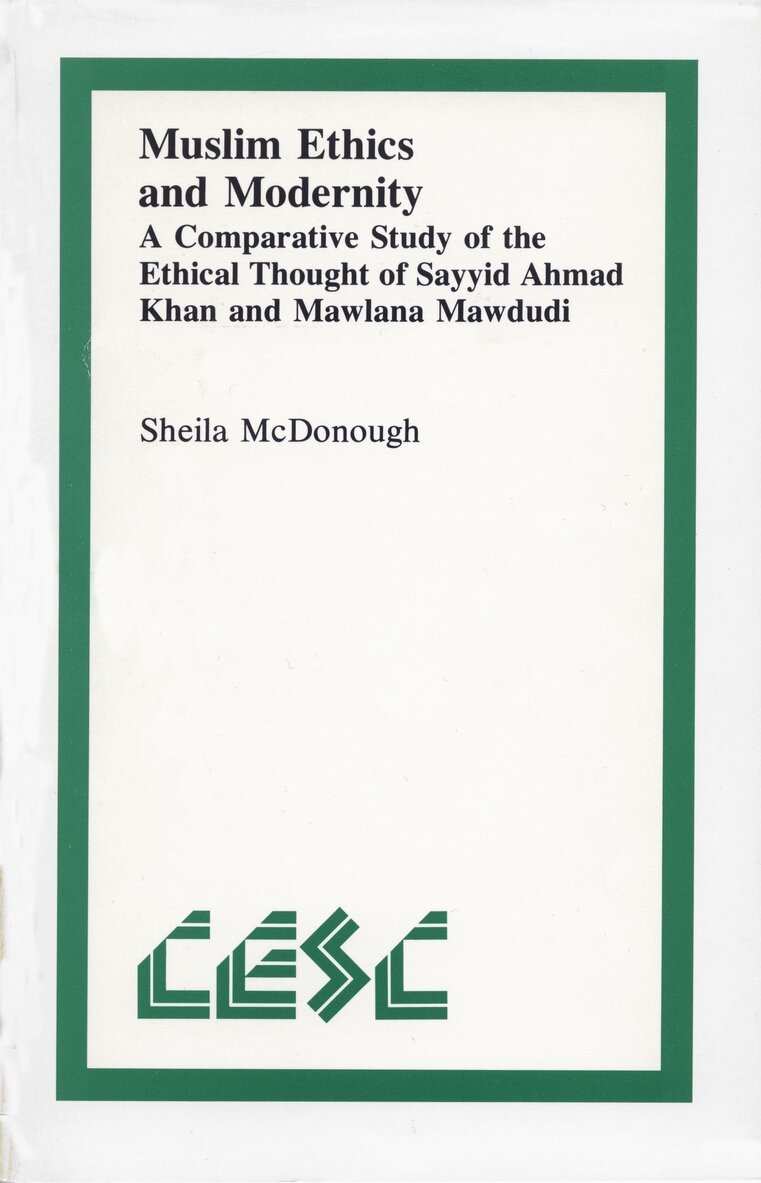
A study of modern Muslim ethics, focussed upon the lives and writings of Sayyid Ahmad Khan and Mawlana Mawdudi, this monograph sheds light upon the modern ethical problems of contemporary Islam. Sayyid Ahmad Khan, often called a liberal, a modernist, or an acculturationist, represents the ""liberal"" trend of Sunni Muslim ethics. Khan's approach borrows much from reason, yet for Khanreason and revelation are not in conflict. Reason guides the interpretation of Islam when revelation is insufficient. In contrast, Mawlana Mawdudi's fundamentalism is, at least in part, anti-rational; it depends upon revelation (as it comes to one man in particular) and is very autocratic. McDonough is concerned with Khan and Mawdudi, both writers within the Indo-Pakistan Muslim tradition. Their conflicting views, their differing interpretations of ethics that suit Islam in the contemporary world, exemplify the difficulties and turmoil faced by Muslims the world over. For these men, modernity has not spelled the end of Islam; yet each has found a different way of relating Islam to the present and the future in faithfulness to traditional Islam.This monograph will be of interest to students of contemporary Islam, as well as to those interested in questions of comparative ethics, for the liberal/fundamentalist conflicts outlined in this monograph are analogous to manifestations of the same dichotomy in all world religions.

Häftad, Engelska, 1997
398 kr
Skickas inom 10-15 vardagar
In retrospect it is difficult to accept that Western democracies have implicitly supported, or at least tolerated, the legalized system of white supremacy in South Africa known as apartheid. Renate Pratt's new book, In Good Faith, explains why the Christian churches were among the first to publicly protest, and why they provided such cogent and determined international support for the struggle against apartheid. The Taskforce on the Churches and Corporate Responsibility is a coalition of Christian churches that for nearly twenty years was one of Canada's leading anti-apartheid advocates. As the first co-ordinator of this Taskforce, Renate Pratt was at the centre of the early anti-apartheid initiatives in Canada and consequently is able to supply a clear and accurate view. The book traces the history of exchanges between the Taskforce and successive ministers and senior civil servants of the Department of External Affairs. It details the reluctant and weak responses offered by the Canadian government and business community right up to the time of Nelson Mandela's release from prison. In Good Faith will be of particular interest to Canadian Christians concerned with ecumenical co-operation and with the social and political dimensions of their faith. Equally, it will appeal to those interested in the impact of public interest organizations on public policy or the relationship between politics and business interests.
Häftad, Engelska, 2003
457 kr
Skickas inom 11-20 vardagar
Weaving Relationships tells the remarkable, little-known story of a movement that transcends barriers of geography, language, culture, and economic disparity. The story begins in the early 1980s, when 200,000 Maya men, women, and children crossed the Guatemalan border into Mexico, fleeing genocide by the Guatemalan army and seeking refuge. A decade later, many of the refugees returned to their homeland along with 140 Canadians, members of ""Project Accompaniment"". The Canadians were there, by their side, to provide companionship and, more significantly, as an act of solidarity. Weaving Relationships describes the historical roots of this solidarity focusing on the Maya in Guatemala. It relates the story of ""Project Accompaniment"" and two of its founders in Canada, the Christian Task Force on Central America and the Maritimes-Guatemala ""Breaking the Silence"" Network. It reveals solidarity's impact on the Canadians and Guatemalans whose lives have been changed by the experience of relationships across borders. It presents solidarity not as a work of charity apart from or ""for"" them but as a bond of mutuality, of friendship and common struggle with those who are marginalized, excluded, and impoverished in this world. This book speaks of a spirituality based on community and justice, and challenges the church to move beyond its preoccupation with its own survival to solidarity with those who are suffering. It is a book about hope in the face of death and despair.