
Conrad: Eastern and Western Perspectives – serie
Visar alla böcker i serien Conrad: Eastern and Western Perspectives. Handla med fri frakt och snabb leverans.
6 produkter
6 produkter
181 kr
Skickas inom 7-10 vardagar
This monograph brings together studies that deal with various aspects of Joseph Conrad’s literary art. The core concept organizing its structure is intertextuality. Intertextual relationships are seen in terms of either affinities/points of contact and the influence of earlier literary works upon his oeuvre or the influence of Conrad’s texts upon literary works by authors following him. Each such relationship is understood as a chord that is vibrant and resonates with new meanings that emerge from the juxtaposition of literary works by Conrad with those by other artists; these new meanings add additional value and significance to Conrad’s literary art.The papers create a truly international constellation of criticism, with their authors affiliated at universities in France, United Kingdom, Turkey, India, Japan, and Poland. The papers apply various types of comparative treatment of Joseph Conrad’s texts: to juxtapose them with literary works by other authors, with specimens of a literary genre, with texts of other fine arts, with aesthetic, philosophical, and ideological tendencies of the epoch. They apply a diverse range of perspectives to Conrad’s literary art, its intertexts, and contexts. The book is a tribute to the literary artistry of Conrad’s literary output, to its tremendous and inexhaustible semantic and artistic potential to be further explored.
181 kr
Skickas inom 7-10 vardagar
This collection of studies examines the various types and uses of ideas of ”the other” and othering in Joseph Conrad’s fiction. It offers examinations of different aspects of the colonial other both in Africa and Latin America, including a personal reminiscence of American imperialism by a descendant of a character mentioned in Conrad’s fiction.The first three papers offer insights into Conrad’s artistic presentation of both the historical and concrete side of capitalism and imperialism as well as the universal aspects of these social-political-economic formations. The next four studies theorize the colonial other, from European/Western perspectives and from Third World perspectives. The final four papers concern otherness in seamanship, in terms of the imperial other and alterity, and the female as other, othering by gender.The dimensions of the other in Conrad’s fiction that the collection examines are mainly colonial, imperial, and civilizational, set in the realities of geographical space of Africa, Latin America, and the Far East, the reality at sea, and the reality of gendered humanity. They are grounded in various contexts significant for Conrad’s epoch: both domestic and pertaining to English and European colonial-imperial overseas expansion, and illuminated from both English/Western and Third World perspectives.Various Dimensions of the Other in Joseph Conrad’s Fiction features both general theoretical arguments and distinctive methodological approaches to Conrad’s oeuvre, such as historical contextualization and source studies, postcolonial theory, imagology, Levinas’s theory of alterity, the Lacanian theory of jouissance, literary feminism, and personal narrative.The book is volume 29 of the series Conrad: Eastern and Western Perspectives: within this series it offers the first complex and direct treatment of multifarious incarnations of the other in Joseph Conrad’s fiction.The studies included create a truly international constellation of criticism, with authors at universities in the United States of America, France, Switzerland, Ukraine, Algeria, Iran, Japan, and Poland. Owing to their unique national and cultural-literary backgrounds and perspectives upon Joseph Conrad’s oeuvre, Various Dimensions of the Other in Joseph Conrad’s Fiction continues and strengthens the transnational profile of the series Conrad: Eastern and Western Perspectives.
181 kr
Skickas inom 7-10 vardagar
Joseph Conrad’s ethical perspective is one of the deepest in twentieth-century fiction, yet its study has been overlooked in recent scholarship. Joseph Conrad and Ethics is one of very few books fully devoted to ethics in Conrad’s fiction. It offers a thorough, in-depth analysis of Conrad’s ethical reflection that challenges and extends current scholarly discussions.The authors of this theoretically informed, accessible volume examine Conrad’s representation of ethics through the lens of Levinas, Derrida, Foucault, Deleuze, and Ricoeur, among others, and confront Conrad’s ethical perspective to these philosophers’ views. Through detailed studies of works like “Heart of Darkness,” The Secret Agent, Lord Jim and Under Western Eyes, they navigate the conflicted terrain of ethics and morality, highlighting the enmeshment of ethics and aesthetics, ethics and narrative, and ethics and ideology in Conrad’s fiction. The key issues they address include the ethics of storytelling and readership, ethical commitment and detachment, the ethics of uncertainty and uneasiness, and planetary ethics and ethical disillusionment. Conrad is ambivalent about ethics and this interdisciplinary volume pivots around a fundamental Conradian ethical paradox: how to account for ethical responsibility in a world not meant for ethics in the first place and, as Conrad stated, whose “aim cannot be ethical at all.” It demonstrates that Conrad adopts a planetary ethics that embraces the human condition in its universality, while he also doubts the viability of ethics itself. Via his protagonists’ moral predicaments he expresses both the necessity of ethics in human relationships and the impossibility of individual ethical fulfillment.The book is volume 30 of the series Conrad: Eastern and Western Perspectives, edited by Wiesław Krajka. It explores a major, understudied Conradian topic – Ethics, and adds an important thematic and theoretical dimension to this series. The chapters are written by experts from various universities worldwide, in keeping with the international, cosmopolitan spirit of Eastern and Western Perspectives. The authors’ wide-ranging, original perspectives on ethics open new venues in Conrad scholarship that will greatly benefit scholars and students of Conrad, modernism, and ethics.
Joseph Conrad and Material Culture – From the Rise of the Commodity Transcendent to the Scramble for Africa
From the Rise of the Commodity Transcendent to the Scramble for Africa
Inbunden, Engelska, 2023
354 kr
Skickas inom 7-10 vardagar
Joseph Conrad and Material Culture offers a fresh approach to Conrad’s work, especially his African fictions, by grounding its discussion in the importance of material culture and its role in shaping the literary art form in modernity. Opening with the description of a uniquely carved African tusk as both a work of art and an object of material culture, Merry M. Pawlowski traces the scenes of African life displayed on that tusk to establish the major themes of her study of selected works of Conrad’s fiction and nonfiction. These themes include the presence of transculturation in colonial Africa, the transformation of the African fetish into the commodity fetish, the exploitation of the African continent through mapping, exploration, and trade, and the rise of the transcendent commodity. Employing cartographic, materialist, psychoanalytic, and postcolonial theories as frameworks, Pawlowski offers new insights using details, liminal presences, in Conrad’s texts enhanced by key illustrations to expand those details as revelatory of the broader material culture invoked by the text. The brief mention of a Huntley and Palmers biscuit tin, the single reference to the Great Exhibition of 1851, the intriguing hint of a vile scramble for loot, are a few examples of tantalizing textual presences. Pawlowski explores the presence of material culture through teasing out gaps, silences, and hints deployed in Conrad’s works. Revealing the rich context on which Conrad drew as he wrote, this book offers an opportunity for the reader to enter Conrad’s world through envisioning the defamiliarizing spaces from which he drew inspiration for his art.This book is volume 31 of the series Conrad: Eastern and Western Perspectives, edited by Wiesław Krajka.
354 kr
Skickas inom 7-10 vardagar
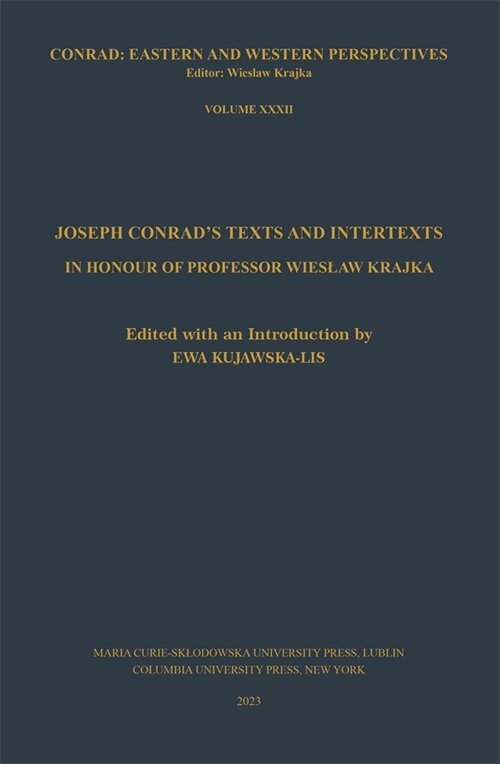
Joseph Conrad’s Texts and Intertexts. In Honour of Professor Wiesław Krajka is a collection of studies that examine various aspects of Joseph Conrad’s literary art, with the organizing ideas being textuality and intertextuality, both broadly understood. Intertextual relationships are perceived in terms of influence of literary, cultural, and philosophical tradition upon his oeuvre, but also affinities between and departures from the works of his predecessors (Miquel Cervantes, John Milton, post-Miltonian tradition), contemporaries (Henry James, H. G. Wells), and those who followed him (Aksel Sandemose, Premendra Mitra) and adapted his works (János Gosztonyi). Textuality is seen from the perspective of the artistic organization of his texts, but also as a means with which to identify the interpretative paths and thematic interests, in particular the social, moral, and economic issues that he tackled in his fiction. The papers apply various theoretical perspectives, ranging from Bakhtinian ethics and Lacanian criticism to Jean-François Lyotard’s philosophy and Georg Simmel’s sociology. Thematically, the essays tackle such diverse issues as escapism, femininity, the arts, illicit conduct, fidelity, secrecy, isolation, immigration, otherness, terrorism, and social equality. Each new reading unveils Conrad’s artistic genius as the authors re-evaluate both the critically acclaimed and the less known works. From this constellation of international scholarship there emerges one common trait discernible in Conrad’s works, both when they analysed on their own and in juxtaposition with those of other writers: ambivalence. This stimulates ever new interpretations and indicate Conrad’s unparalleled ability to provoke readers to constantly rediscover artistic and ethical dimensions of his oeuvre. This book is volume 32 of the series Conrad: Eastern and Western Perspectives, edited by Wiesław Krajka.
701 kr
Skickas inom 7-10 vardagar
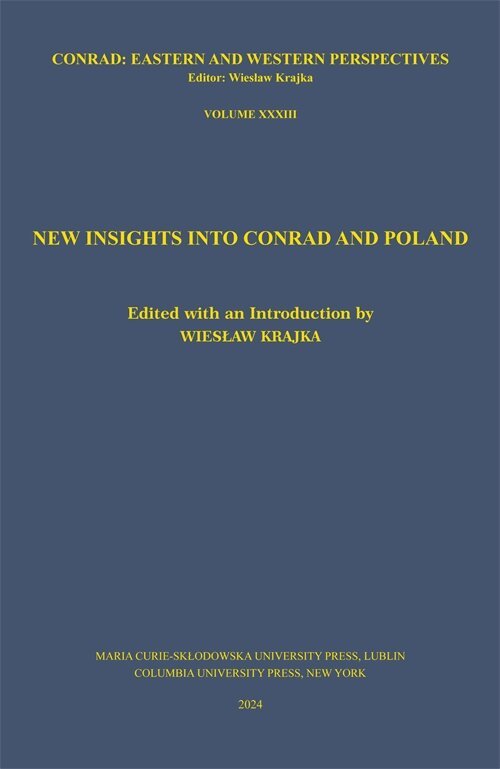
Despite the large number of publications on Joseph Conrad’s Polishness—including previous volumes of the series Conrad: Eastern and Western Perspectives—many questions remain. New Insights Into Conrad and Poland, edited by Wiesław Krajka, brings together a variety of thematic and methodological approaches in search of new insights. After the opening chapter, which comments on Polishness as studied in previous volumes of this series, contributions examine the life of Conrad and members of his close family; Conrad’s literary works in relation to Polish literature; Polish reception of his oeuvre, including adaptations and educational influence, as translations, as works of art, and in schools and popular culture; the Polish Jewish experience; and exilic feelings. The coda of the volume is a study that presents a view of Russia as antithetical to Polishness. Essays range across traditional biographical criticism, literary analysis and interpretation, comparison of Conrad’s literary works and their intertextual study with those by other authors and with other works of art, translation and adaptation studies, investigations of reception of literature and popular culture, archetypal criticism, and philosophical criticism. The book is volume 33 of the series Conrad: Eastern and Western Perspectives, edited by Wiesław Krajka.CONTRIBUTORS: Wiesław Krajka, Lilia Omelan, Karol Samsel, Daniel Vogel, Ewa Kujawska-Lis, Olga Binczyk, Mirosława Buchholtz, Agnieszka Adamowicz-Pośpiech, James Mellor, John G. Peters.