Culture and Society in Western and Central Asia – serie
Visar alla böcker i serien Culture and Society in Western and Central Asia. Handla med fri frakt och snabb leverans.
4 produkter
4 produkter
1 833 kr
Skickas inom 10-15 vardagar
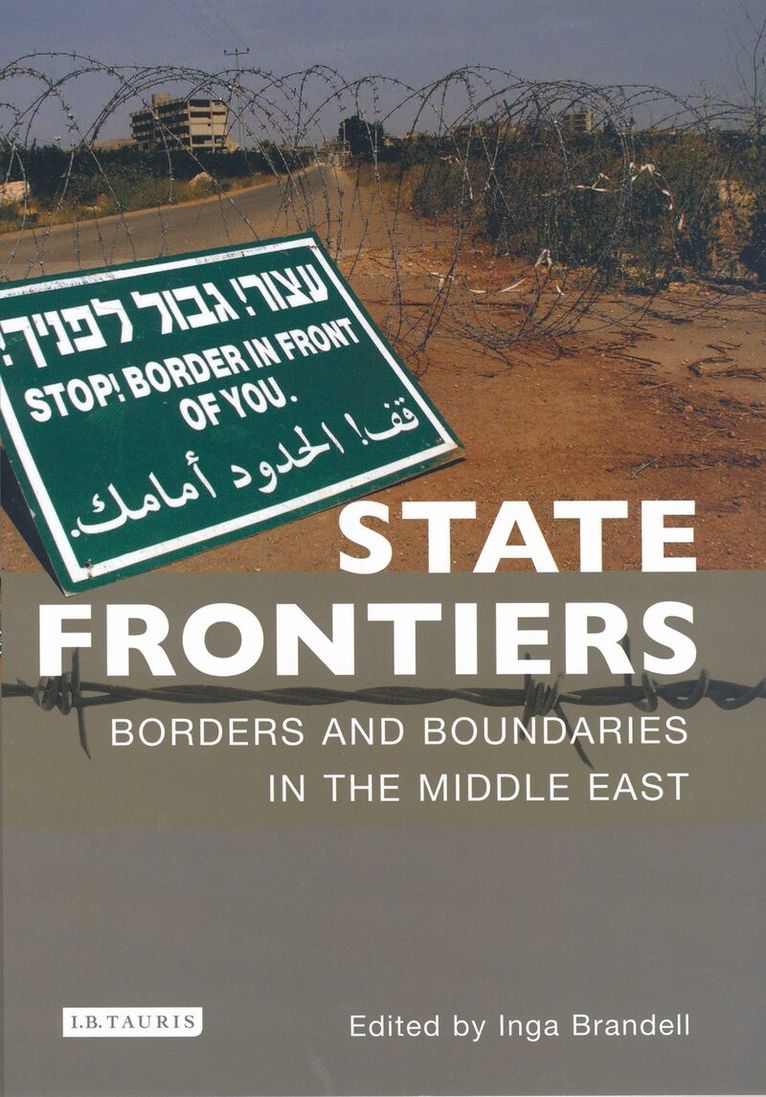
This book deals with a very topical issue in an innovative multidisciplinary approach. It deals with borders that are always a hotly debated and controversial issue. Do borders still define the limits of states? How do communities change when a border is put between them? Is the physical border more important than the conceptual boundary? In recent times, the question of borders in the Middle East has assumed an importance unknown since the collapse of the Ottoman empire. In this fresh examination of the issue, Inga Brandell draws together a variety of disciplinary approaches, and takes the classic debates forward into the 21st century. Casting its net wide from the Anatolian plateau to the mountains of Cyprus, "State Frontiers" brings a number of key issues to light. Brandell brings to our attention the idea of 'straddling' populations, looking at the Syrian-Lebanese business community which has historically shuttled across the border between the two countries as a result of civil war in one and successive economic diktats in the other.Another case study examines the lived experience of borders in Cyprus, detailing not only the physical but also the mental and cultural effects of separation. The usefulness of the discourse of borders is highlighted by looking at the disjunction between Turkish politicians' rhetoric of border inviolability and the Turkish army's regular violation of the South Eastern border with Iraq. Brandell provides rich empirical illumination of the psychological function of borders in creating (and keeping out) an imagined 'other'. She also explores practical dimensions of borders in the context of boundary transgressing resources such as water. Brandell offers important new theoretical insights, discussing the validity of the assumptions which underlie border studies. In the Middle East, borders are widely believed to be arbitrary and ultimately external to the organic development of societies. In its multifaceted portrayal of border life, "State Frontiers" restores the balance and contributes towards a more sophisticated understanding of these issues.
1 703 kr
Skickas inom 10-15 vardagar
President Vladimir Putin's consent after September 11th to the deployment of Western forces in Central Asia and to the US military's use of Central Asian airfields during the US-led operations in Afghanistan represented a dramatic turn in Russian Central Asian policy. How and why did Russian policy change? Was this in part due to Russia's decline in influence on the international arena? Lena Jonson examines Putin's policy from 1999 to 2003 towards Afghanistan and the four key states that surround it - Tajikistan, Uzbekistan, Turkmenistan and Kyrgyzstan and examines how Russia dealt with both the new security challenges of the region and increased foreign engagement. Vladimir Putin and Central Asia is the first book to discuss Russia's Central Asian policy and is vital reading for students, policy-makers and all those who are interested in this politically sensitive region.
Trade, Industrialization and the Firm in Iran
The Impact of Government Policy on Business
Inbunden, Engelska, 2005
1 888 kr
Skickas inom 10-15 vardagar
Government interventions in the economies of developing countries frequently do not achieve their intended goals. Policy-makers' expectations often fall wide of the mark when compared with actual behaviour of consumers, producers and businessmen. In an important study that has wide significance for the field of development economics as a whole, Javad Amid and Amjad Hadjikhani study the impact of trade and industrial policies on the economy and business behaviour of Iran.
1 703 kr
Skickas inom 10-15 vardagar
Asa Lundgren explores Turkish policy towards northern Iraq from the beginning of the 1990s to the US-led invasion of Iraq in 2003 and draws important conclusions about the relation between nation-building and foreign policy. The author argues that there is a crucial interplay between the protection of state borders, foreign policy practice and the construction of national identity. Turkey's policy towards northern Iraq during the last decade can be described as a balancing act where the integrity of the Turkish-Iraqi border was firmly defended by Ankara, while at the same time it was consistently violated through Turkish military incursions against a perceived Kurdish threat and by the permanent military presence of the Turkish army on Iraqi territory. The author's highly original proposition is that Ankara's policy opposition to all attempts to break up Iraq along ethnic lines was a mirror image of an almost obession-like concern with the unity of the Turkish nation state.