Dahlem Workshop Reports -- Environmental Sciences - Böcker
Visar alla böcker i serien Dahlem Workshop Reports -- Environmental Sciences. Handla med fri frakt och snabb leverans.
4 produkter
4 produkter
Del 7 - Dahlem Workshop Reports -- Environmental Sciences
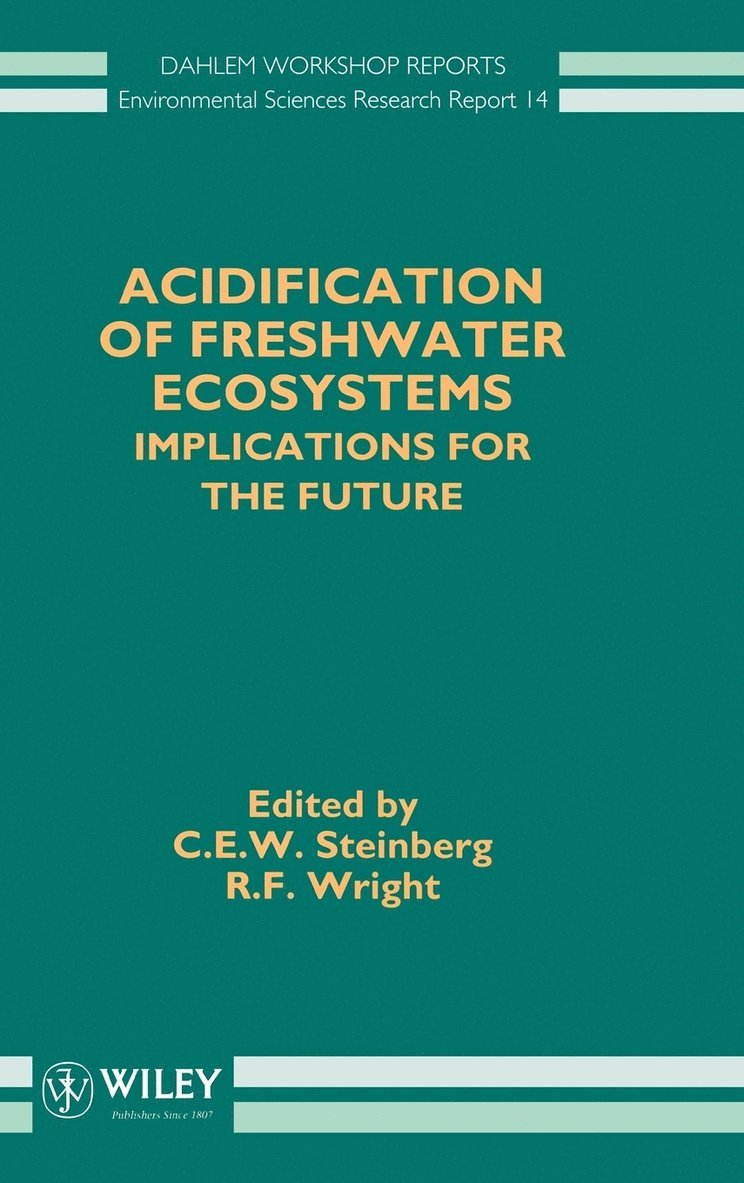
Acidification of Freshwater Ecosystems
Implications for the Future
Inbunden, Engelska, 1994
5 321 kr
Skickas inom 7-10 vardagar
Eminent contributors present articles which evaluate the causes, consequences and reversibility of freshwater acidification--past, present and future.
Del 5 - Dahlem Workshop Reports -- Environmental Sciences
Durability and Change
The Science, Responsibility, and Cost of Sustaining Cultural Heritage
Inbunden, Engelska, 1994
5 980 kr
Skickas inom 11-20 vardagar
The interaction of living materials with inanimate materials via physical and chemical reactions poses an acute danger for the longevity of our cultural heritage, as long as it exists in the material form and not in that of the invincible word. Thus our concern for cultural heritage must reach the same level as our current concern for the conservation of the natural environment, both through public education and through the development of guidelines for scientists, restorers, and conservators. To this end, this volume explores the status of scientific and humanistic approaches to our cultural heritage and the disequilibria in research and related disciplines. Particular areas discussed include the processes of aging and decay, the durability of material objects, the acceleration of the patina and decay processes in cultural materials through environmental and biological hazards, and the techniques that are both available now and under development for protecting, conserving, and restoring our cultural heritage. This volume is a multidisciplinary attempt to set up dialogue between those who do research and those who practice conservation and restoration. It will be of interest to anyone interested in cultural heritage and, in particular, to those art historians, archeologists, architects, communication scientists, chemists, biologists, mineralogists, and physicists who are also seeking to bridge this gap. Goal of this Dahlem Workshop: to evaluate processes that contribute to change in objects, cultural materials, and artifacts, and to find appropriate ways of conserving them.
Del 8 - Dahlem Workshop Reports -- Environmental Sciences
Role of Nonliving Organic Matter in the Earth's Carbon Cycle
Inbunden, Engelska, 1995
5 588 kr
Skickas inom 7-10 vardagar
Nonliving organic matter (NLOM) comprises the bulk of the organic carbon stored in the terrestrial biosphere and a major part of the organic carbon in the sea. Organic substances, which include litter, marine detritus, dissolved organic matter, and soil organic matter, have diverse effects on the Earth's biogeochemical processes and serve as a major reservoir of biospheric carbon, which can be transformed to carbon dioxide, methane, and other "greenhouse" gases. Given this broad spectrum of effects, efforts to adapt to or perhaps benefit from global change require a better understanding and an ability to predict the role of NLOM in the global environment. The overall objective of this volume is to provide experimental and modeling strategies for the assessment of the sensitivity of the global carbon cycle to changes in nonliving organic pools in terrestrial and aquatic ecosystems. The discussions in this volume consider how best to characterize and quantify pools and fluxes of NLOM, the role of NLOM cycling on a global scale, human and climatic perturbations of interactions between NLOM and nutrients, and biological, chemical, and physical processes that control the production and degradation of NLOM, with an emphasis on processes that affect the persistence of NLOM in the environment. One of the most unique aspects of this volume is that it represents extensive exchanges between leading international scientists from both aquatic and terrestrial backgrounds. It will be of particular interest to organic geochemists, microbiologists, ecologists, soil scientists, agricultural scientists, marine chemists, limnologists, and modelers. Goal of this Dahlem Workshop: to devise experimental and modeling strategies for assessment of the sensitivity of the global carbon cycle to changes in nonliving organic pools.
Del 24 - Dahlem Workshop Reports -- Environmental Sciences
Integrating Hydrology, Ecosystem Dynamics, and Biogeochemistry in Complex Landscapes
Inbunden, Engelska, 1999
3 128 kr
Skickas inom 7-10 vardagar
In recent decades, the biosphere has become increasingly stressed, often beyond the point where the internal structure and function of ecosystems are sustained. We have experienced an intensified “exploration” of natural system resources to support agricultural and forest production, to provide water for human consumption, to supply the needs of industrial processes, and to provide, in addition, attractive, diverse landscapes for recreation and tourism. Exceeding thresholds via anthropogenic disturbance that results in degradation of ecosystems is dangerous, since the system-level effects and feedbacks (e.g., soil erosion, famine, polluted drinking water, etc.) are highly undesirable. Finding appropriate compromises in resource use that satisfy existing competitive interests and result in sound environmental management, especially in densely populated regions, requires an improved understanding of the trade-offs that accompany changes in “exploitation” or altered resource allocation at regional and landscape scales. Progress on landscape-level understanding of coupled water, carbon, and nitrogen budgets is limited by a lack of commitment to a rigorous development and application of synthetic techniques (e.g., strongly linked remote sensing studies, geographic information system applications, computer simulation modeling, and ecosystem experimentation) more than by basic site-level measurement alone. Possible research approaches that will contribute to new use of ecosystem knowledge in a landscape and regional context were considered by this Dahlem Workshop. The importance of conducting improved landscape and regional assessment of ecosystem function as input to global scale efforts of the International Geosphere-Biosphere Programme is a major theme of this book.