Development and Inequality in the Market Economy – serie
Visar alla böcker i serien Development and Inequality in the Market Economy. Handla med fri frakt och snabb leverans.
10 produkter
Out of the Red
Building Capitalism and Democracy in Postcommunist Europe
Av Mitchell Alexander Orenstein
Häftad, 2001
382 kr
Lägg i varukorg
After the fall of the Berlin Wall, the countries of East-Central Europe embarked on a journey to transform themselves into democratic capitalist societies. Their governments searched for strategies that would allow them to pursue radical market reforms within the context of nascent democratic …
Distributive Justice and Economic Development
The Case of Chile and Developing Countries
Av Andres Solimano, Eduardo Aninat m. fl.
Inbunden, 2000
1162 kr
Lägg i varukorg
The relationship between the process of creating wealth and distributing it has been a subject of great analytical and policy interest to development economists for many years. Is there an inevitable conflict, or tradeoff, between wealth creation and wealth distribution? Can both growth and social …
Out of the Red
Building Capitalism and Democracy in Postcommunist Europe
Av Mitchell Alexander Orenstein
Inbunden, 2001
1191 kr
Tillfälligt slut
After the fall of the Berlin Wall, the countries of East-Central Europe embarked on a journey to transform themselves into democratic capitalist societies. Their governments searched for strategies that would allow them to pursue radical market reforms within the context of nascent democratic …
Road Maps to Prosperity
Essays on Growth and Development
Inbunden, 1996
1439 kr
Tillfälligt slut
The 1990s are witnessing a revitalization of analytical work and policy interest on themes of economic growth, savings generation, capital formation, and long-run development. The contributions to this volume, from leading scholars in the field, set out to examine critical issues in …
Social Inequality
Values, Growth, and the State
Inbunden, 1998
1368 kr
Tillfälligt slut
Inequality of income, wealth, and opportunities is an ancient concern of economists, philosophers, political leaders, and the community at large. Is inequality the unavoidable dark side of capitalism? Is it the price to be paid for fostering wealth creation and material progress? Can economic …
After Neoliberalism
What Next for Latin America?
Av Lance Taylor
Inbunden, 1999
1368 kr
Tillfälligt slut
In the past twenty years, economic policy in Latin America has veered toward neoliberalism, or market friendliness. State interventions in the economy were cut back in many areas, in the form of reductions in fiscal deficits; privatization of public enterprises; reductions of import quotas and …
Capital Flows, Capital Controls, and Currency Crises
Latin America in the 1990s
Inbunden, 2001
1439 kr
Tillfälligt slut
After a decade of financial isolation from world private capital markets following the external debt crisis of the early 1980s, Latin America became an effective magnet for private capital in the 1990s. Two major events, however, altered an otherwise positive picture for this region: the Mexican …
Economic Reforms in Chile
From Dictatorship to Democracy
Inbunden, 2002
1260 kr
Tillfälligt slut
Articulate and provocative, Richardo Ffrench-Davis offers the most comprehensive and timely assessment available of Chilean economic reform, from the military dictatorship of Pinochet in the 1970s up to the "reforms of reforms" made by the democratic governments in the 1990s. Written in accessible …
International Capital Flows in Calm and Turbulent Times
The Need for New International Architecture
Av Stephany Griffith-Jones, Ricardo Gottschalk m. fl.
Inbunden, 2003
1439 kr
Tillfälligt slut
International Capital Flows in Calm and Turbulent Times analyzes the financial crises of the late 1990s and draws attention to the type of lenders and investors that triggered and deepened the crises. It concentrates on institutional investors and banks and provides detailed analysis of the …
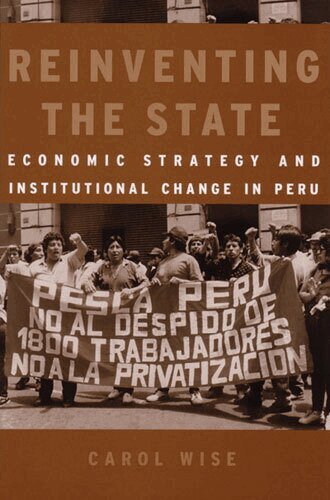
Reinventing the State
Economic Strategy and Institutional Change in Peru
Av Carol Wise
Inbunden, 2003
1260 kr
Tillfälligt slut
The political economic history of Latin America in the post-World War II era has largely been one of underachievement and opportunities lost. This all changed with the wave of market reforms that were implemented in the 1990s. However, the precise role of these reforms as an agent of change is …