E. H. Gombrich Lecture Series - Böcker
Visar alla böcker i serien E. H. Gombrich Lecture Series. Handla med fri frakt och snabb leverans.
6 produkter
6 produkter
234 kr
Skickas inom 7-10 vardagar
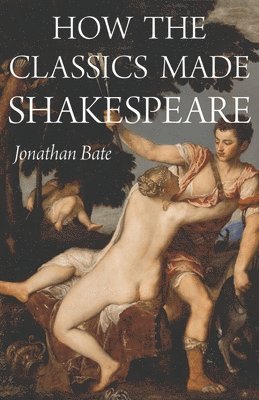
From one of our most eminent and accessible literary critics, a groundbreaking account of how the Greek and Roman classics forged Shakespeare’s imaginationBen Jonson famously accused Shakespeare of having “small Latin and less Greek.” But he was exaggerating. Shakespeare was steeped in the classics. Shaped by his grammar school education in Roman literature, history, and rhetoric, he moved to London, a city that modeled itself on ancient Rome. He worked in a theatrical profession that had inherited the conventions and forms of classical drama, and he read deeply in Ovid, Virgil, and Seneca. In a book of extraordinary range, acclaimed literary critic and biographer Jonathan Bate, one of the world’s leading authorities on Shakespeare, offers groundbreaking insights into how, perhaps more than any other influence, the classics made Shakespeare the writer he became.Revealing in new depth the influence of Cicero and Horace on Shakespeare and finding new links between him and classical traditions, ranging from myths and magic to monuments and politics, Bate offers striking new readings of a wide array of the plays and poems. At the heart of the book is an argument that Shakespeare’s supreme valuation of the force of imagination was honed by the classical tradition and designed as a defense of poetry and theater in a hostile world of emergent Puritanism.Rounded off with a fascinating account of how Shakespeare became our modern classic and has ended up playing much the same role for us as the Greek and Roman classics did for him, How the Classics Made Shakespeare combines stylistic brilliance, accessibility, and scholarship, demonstrating why Jonathan Bate is one of our most eminent and readable literary critics.
460 kr
Skickas inom 7-10 vardagar
Saint Augustine famously “wept for Dido, who killed herself by the sword,” and many later medieval schoolboys were taught to respond in similarly emotional ways to the pain of female characters in Virgil’s Aeneid and other classical texts. In Weeping for Dido, Marjorie Curry Woods takes readers into the medieval classroom, where boys identified with Dido, where teachers turned an unfinished classical poem into a bildungsroman about young Achilles, and where students not only studied but performed classical works.Woods opens the classroom door by examining teachers’ notes and marginal commentary in manuscripts of the Aeneid and two short verse narratives: the Achilleid of Statius and the Ilias latina, a Latin epitome of Homer’s Iliad. She focuses on interlinear glosses—individual words and short phrases written above lines of text that elucidate grammar, syntax, and vocabulary, but that also indicate how students engaged with the feelings and motivations of characters. Interlinear and marginal glosses, which were the foundation of the medieval classroom study of classical literature, reveal that in learning the Aeneid, boys studied and empathized with the feelings of female characters; that the unfinished Achilleid was restructured into a complete narrative showing young Achilles mirroring his mentors, including his mother, Thetis; and that the Ilias latina offered boys a condensed version of the Iliad focusing on the deaths of young men. Manuscript evidence even indicates how specific passages could be performed.The result is a groundbreaking study that provides a surprising new picture of medieval education and writes a new chapter in the reception history of classical literature.
487 kr
Skickas inom 7-10 vardagar
A unique look at how classical notions of ascent and flight preoccupied early modern British writers and artistsBetween the late sixteenth century and early nineteenth century, the British imagination—poetic, political, intellectual, spiritual and religious—displayed a pronounced fascination with images of ascent and flight to the heavens. Celestial Aspirations explores how British literature and art during that period exploited classical representations of these soaring themes—through philosophical, scientific and poetic flights of the mind; the ascension of the disembodied soul; and the celestial glorification of the ruler.From textual reachings for the heavens in Spenser, Marlowe, Shakespeare, Donne and Cowley, to the ceiling paintings of Rubens, Verrio and Thornhill, Philip Hardie focuses on the ways that the history, ideologies and aesthetics of the postclassical world received and transformed the ideas of antiquity. In England, narratives of ascent appear on the grandest scale in Milton’s Paradise Lost, an epic built around a Christian plot of falling and rising, and one of the most intensely classicizing works of English poetry. Examining the reception of flight up to the Romanticism of Wordsworth and Tennyson, Hardie considers the Whig sublime, as well as the works of Alexander Pope and Edward Young. Throughout, he looks at motivations both public and private for aspiring to the heavens—as a reward for political and military achievement on the one hand, and as a goal of individual intellectual and spiritual exertion on the other.Celestial Aspirations offers an intriguing look at how creative minds reworked ancient visions of time and space in the early modern era.
179 kr
Skickas inom 7-10 vardagar
From one of our most eminent and accessible literary critics, a groundbreaking account of how the Greek and Roman classics forged Shakespeare's imaginationBen Jonson famously accused Shakespeare of having "small Latin and less Greek." But he was exaggerating. Shakespeare was steeped in the classics. Shaped by his grammar school education in Roman literature, history, and rhetoric, he moved to London, a city that modeled itself on ancient Rome. He worked in a theatrical profession that had inherited the conventions and forms of classical drama, and he read deeply in Ovid, Virgil, and Seneca. In a book that combines stylistic brilliance, accessibility, and extraordinary range, acclaimed literary critic and biographer Jonathan Bate, one of the world's leading authorities on Shakespeare, offers groundbreaking insights into how, perhaps more than any other influence, the classics made Shakespeare the writer he became.
Provenance and Possession
Acquisitions from the Portuguese Empire in Renaissance Italy
Inbunden, Engelska, 2024
371 kr
Skickas inom 7-10 vardagar
A thought-provoking study of how knowledge of provenance was not transferred with enslaved people and goods from the Portuguese trading empire to Renaissance ItalyIn the fifteenth and sixteenth centuries, Renaissance Italy received a bounty of "goods" from Portuguese trading voyages—fruits of empire that included luxury goods, exotic animals and even enslaved people. Many historians hold that this imperial "opening up" of the world transformed the way Europeans understood the global. In this book, K.J.P. Lowe challenges such an assumption, showing that Italians of this era cared more about the possession than the provenance of their newly acquired global goods. With three detailed case studies involving Florence and Rome, and drawing on unpublished archival material, Lowe documents the myriad occasions on which global knowledge became dissociated from overseas objects, animals and people. Fundamental aspects of these imperial imports, including place of origin and provenance, she shows, failed to survive the voyage and make landfall in Europe. Lowe suggests that there were compelling reasons for not knowing or caring about provenance, and concludes that geographical knowledge, like all knowledge, was often restricted and not valued.Examining such documents as ledger entries, journals and public and private correspondence as well as extant objects, and asking previously unasked questions, Lowe meticulously reconstructs the backstories of Portuguese imperial acquisitions, painstakingly supplying the context. She chronicles the phenomenon of mixed-ancestry children at Florence’s foundling hospital; the ownership of inanimate luxury goods, notably those possessed by the Medicis; and the acquisition of enslaved people and animals. How and where goods were acquired, Lowe argues, were of no interest to fifteenth- and sixteenth-century Italians; possession was paramount.
349 kr
Kommande
Conservators as first responders in a world where our cultural heritage is increasingly at riskConservation can be understood as a form of knowing; conservators extract meaning about the past from what remains, while noting what is missing and sometimes repairing it. In this erudite and virtuosic book, the historian Peter N. Miller imagines the outlines of a new, expansive notion of conservation that links the world around us—natural and man-made—to the world inside us—our genome, our memories. Putting the work of conservation into conversation with history, philosophy, and literature yields a shift in perspective. It raises questions central to the work of the humanities: What does time mean? How do we write about knowledge? How does care connect humans not just with the world but also with each other? And where does freedom exist in a world of things?Miller casts conservators as first responders in a world as fragile as the things they work on. He argues that a broader conception of conservation can provide the necessary intellectual resources for grappling with the scale of the enormous challenges ahead. Offering a kind of sketch of a curriculum for that future, Miller suggests that shaping the person of the conservator is as important as shaping the field. For only those trained to think about change through the painstaking labor of preserving and restoring will be able to do the work of policy and advocacy required by our uncertain future.