Elements in Language and Power - Böcker
Visar alla böcker i serien Elements in Language and Power. Handla med fri frakt och snabb leverans.
6 produkter
6 produkter
241 kr
Skickas inom 7-10 vardagar
This Element aims to examine how language operates as power across the ecosystem of language teacher education (LTE). It maps how language-as-power (LaP) works at three layers: microsystem (teachers and classrooms), mesosystem (institutions), and macrosystem (socio-politics). Section 1 surveys LaP historically, tracing its historical evolution from Plato to contemporary theorists and showing how these ideas shape LTE. Building on this history, Sections 2-4 unpack LaP across ecological layers: microsystem, mesosystem, and macrosystem. Section 5 looks forward, analyzing AI's redistribution of power at each scale, and applying a 3Ps (possible, probable, and preferable) futurology to chart potential pathways. Anchored in experiences from the Global South, the Element argues that LaP in LTE needs awareness and action. It offers ideas on how to address these issues in LTE through solutions such as widening epistemic access, contesting monolingual norms, and institutionalizing dialogic, justice-oriented professionalism and trans-speakerism, to name a few.
775 kr
Skickas inom 7-10 vardagar
This Element aims to examine how language operates as power across the ecosystem of language teacher education (LTE). It maps how language-as-power (LaP) works at three layers: microsystem (teachers and classrooms), mesosystem (institutions), and macrosystem (socio-politics). Section 1 surveys LaP historically, tracing its historical evolution from Plato to contemporary theorists and showing how these ideas shape LTE. Building on this history, Sections 2-4 unpack LaP across ecological layers: microsystem, mesosystem, and macrosystem. Section 5 looks forward, analyzing AI's redistribution of power at each scale, and applying a 3Ps (possible, probable, and preferable) futurology to chart potential pathways. Anchored in experiences from the Global South, the Element argues that LaP in LTE needs awareness and action. It offers ideas on how to address these issues in LTE through solutions such as widening epistemic access, contesting monolingual norms, and institutionalizing dialogic, justice-oriented professionalism and trans-speakerism, to name a few.
241 kr
Kommande
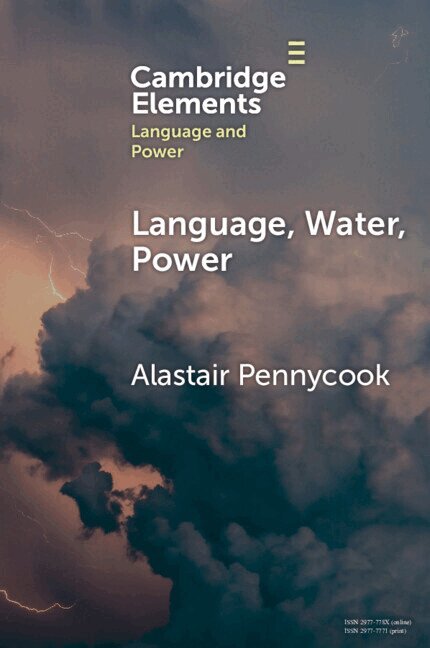
This Element is about language, water and power. It challenges the terracentric bias of much scholarship in language studies, suggesting instead that oceans and rivers should be central in investigations of language, history, culture, society and politics. Working through different engagements with water - swimming, surfing, sailing and diving - this Element explores how thinking in and with water can transform our understandings of justice, power and language. By taking water seriously as both a social and material category, hydrosocial perspectives draw attention to the ways modern water and language are controlled, restricted, standardized and contained. A hydrocolonial lens focuses on the centrality of water in colonial regimes, the oceanic origins of creoles and the need to decolonize control and conceptions of water. For critical hydrosocial language studies language is entangled in an inequitable watery world, and language study from below is a form of spiritual, material and embodied engagement.
775 kr
Kommande
This Element is about language, water and power. It challenges the terracentric bias of much scholarship in language studies, suggesting instead that oceans and rivers should be central in investigations of language, history, culture, society and politics. Working through different engagements with water - swimming, surfing, sailing and diving - this Element explores how thinking in and with water can transform our understandings of justice, power and language. By taking water seriously as both a social and material category, hydrosocial perspectives draw attention to the ways modern water and language are controlled, restricted, standardized and contained. A hydrocolonial lens focuses on the centrality of water in colonial regimes, the oceanic origins of creoles and the need to decolonize control and conceptions of water. For critical hydrosocial language studies language is entangled in an inequitable watery world, and language study from below is a form of spiritual, material and embodied engagement.
234 kr
Kommande
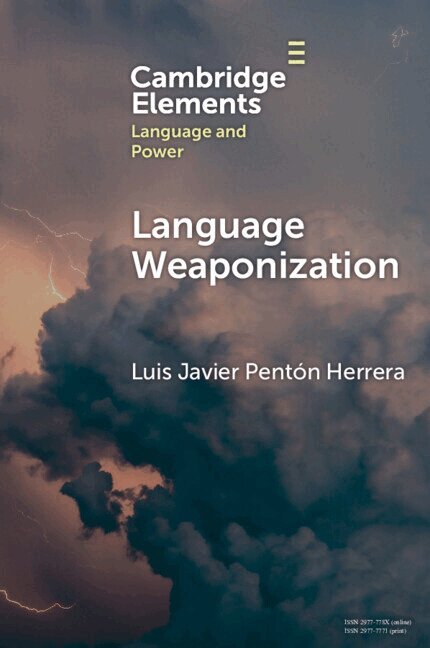
This Element introduces the conceptualization of language weaponization, examining how dominant groups use language to control, marginalize, and harm minoritized communities. It proposes a three-phase framework- (1) stigmatization and othering, (2) dehumanization, and (3) harm-to explain how linguistic practices evolve from prejudice to violence, shaping both social structures and individual identities. Through analysis of the dynamics between dominant and minoritized groups and case studies focused on LGBTQ+ communities, the Element reveals the historical and ongoing consequences of weaponized language. Moving beyond critique, it advances a vision for transformation by positioning applied linguists as central actors in promoting societal healing. Further, storytelling is presented as a vital practice for (re)humanization and collective restoration. Ultimately, this Element invites readers to critically examine how language constructs power and to imagine its potential as a force for healing, peace, and goodness across diverse societies.
727 kr
Kommande
This Element introduces the conceptualization of language weaponization, examining how dominant groups use language to control, marginalize, and harm minoritized communities. It proposes a three-phase framework- (1) stigmatization and othering, (2) dehumanization, and (3) harm-to explain how linguistic practices evolve from prejudice to violence, shaping both social structures and individual identities. Through analysis of the dynamics between dominant and minoritized groups and case studies focused on LGBTQ+ communities, the Element reveals the historical and ongoing consequences of weaponized language. Moving beyond critique, it advances a vision for transformation by positioning applied linguists as central actors in promoting societal healing. Further, storytelling is presented as a vital practice for (re)humanization and collective restoration. Ultimately, this Element invites readers to critically examine how language constructs power and to imagine its potential as a force for healing, peace, and goodness across diverse societies.