Enneads of Plotinus – serie
Visar alla böcker i serien Enneads of Plotinus. Handla med fri frakt och snabb leverans.
16 produkter
16 produkter
Häftad, Engelska, 2020
463 kr
Skickas inom 5-8 vardagar
On Our Allotted Guardian Spirit is a lively and at times perplexing text combining general reflections on the nature of the soul with a discussion of the phenomenon of a personal guardian spirit. Plotinus wants to interpret Plato, and aims to integrate Plato's various statements about daimones into one comprehensive theory. This leads to some views that are, if not exotic, then at least strange on first encounter. However, a closer reading reveals that Plotinus is not interested in demonology per se. Instead, the central concern of the treatise are ideas about the soul, the self, and self-consciousness. Plotinus' explorations produce a theory of the mind as the agent and activity responsible for a person's ethical choices and conduct of life. The demon emerges as a philosophical tool passed down from Plato, but adapted and rationalized to try to explain motivation to action, the impulse toward the ethical life, and even the various differences in human ethical and psychological constitution. This innovative theory is a response to a strong and ongoing current of thought in the philosophical tradition.The introduction offers an overview of ancient demonologies, starting with Homer and the Presocratics, and is followed by an in-depth examination of Plato, the Stoics, Plotinus, and later Neoplatonic developments. As such the book presents Plotinus' specific rationalizing response to the idea of a guardian spirit in the context of ancient philosophical demonologies.
Häftad, Engelska, 2020
396 kr
Skickas inom 5-8 vardagar
This early treatise is placed by Plotinus' editor at the very end of the Enneads, as the culmination of his thought, matching Plotinus' own last recorded instruction, 'to bring the god in you back to the god in the all.' It is a cosmological sketch, arguing that the being of anything depends on its being unified by its orientation to its own good, and so also the being of Everything, the All. The One, or the Good, is at once the goal of all things both individually and collectively, and also the transcendent source of all that we experience, mediated through an intelligible order. But it is also, and perhaps more importantly, intended as a guide to the proper education and discipline of our own motives and experience. We are encouraged to put aside immediate sensory data, egoistic prejudice and sensual impulse, first to grasp at least a little of the intelligible order within which we all live, and at last to purge even those last intellectual attachments and experience what cannot be adequately described: the unity of being.
Häftad, Engelska, 2024
396 kr
Skickas inom 5-8 vardagar
In Ennead I.5 Plotinus attempts to navigate a well-trodden path of inquiry by directly responding to a wide spectrum of popular theories on human flourishing, and insisting emphatically that well-being belongs to the present moment. Indeed, Aristotle—with his insistence that well-being be measured by "a complete life" (Nicomachean Ethics 1098a16–20) or a life measured by virtue, a modus vivendi sustained via the development of appropriate habits (hexis) and the avoidance of misfortunes—is one of Plotinus' central targets. Nevertheless, it is also obvious that the Hellenistic schools, with their almost evangelical insistence that happiness is available to practitioners in the immediacy of the "now," take pride of place in Plotinus' short treatise on the subject. Layne analyzes in depth Plotinus' unique conception of the value of the present moment by highlighting his dialogue with Aristotle and Hellenistic conceptions of the soul, pleasure and pain, time and eternity, and so forth.
Häftad, Engelska, 2022
463 kr
Skickas inom 5-8 vardagar
In Ennead II.4 Plotinus investigates the question of what underlies the forms that constitute the contents of our minds and senses. Aristotle had called this substrate "matter," and Stoic philosophers followed suit. With a critical review of their notions, and reference to Plato's so-called Receptacle, Plotinus develops an account of matter that makes it a supremely negative entity. How he describes the indescribable, and how he justifies incorporeal matter's indispensability to bodies, are highlights of this tenaciously argued essay.A. A. Long translates and interprets Plotinus' treatise on the matter that underlies all physical and intelligible beings. With a wide-ranging introduction and probing analysis of details, he explains the intricate structure of the text. The book will appeal to everyone interested in the history of Platonism and ancient Greek theories of the world's ultimate principles.
Häftad, Engelska, 2015
396 kr
Skickas inom 5-8 vardagar
Ennead VI.4–5, originally written as a single treatise, contains Plotinus’ most general and sustained exposition of the relationship between the intelligible and sensible realms, addressing and coalescing two central issues in Platonism: the nature of the soul–body relationship and the nature of participation. Its main question is, How can soul animate bodies without sharing in their extension? The treatise seems to have had considerable impact: it is much reflected in Porphyry’s important work, Sententiae, and the doctrine of reception according to the capacity of the recipient, for which this treatise is the main source, resonated in medieval thinkers.
Häftad, Engelska, 2017
517 kr
Skickas inom 5-8 vardagar
How was the universe created, and what is our place within it? These are the questions at the heart of Plotinus’ Against the Gnostics. For the Gnostics, the universe came into being as a result of the soul’s fall from intelligible reality—it is the evil outcome of a botched creation. Plotinus challenges this, and insists that the soul’s creation of the world is the necessary consequence of its contemplation of the ideal forms. While the Gnostics claim to despise the visible universe, Plotinus argues that such contempt displays their ignorance of the higher realities of which the cosmos is a beautiful image.Against the Gnostics is a polemical text. It aims to show the superiority of Plotinus’ philosophy over that of his Gnostic rivals, and poses unique challenges: Plotinus nowhere identifies his opponents by name, he does not set out their doctrines in any great detail, and his arguments are frequently elliptical. The detailed commentary provides a guide through these difficulties, making Plotinus’ meandering train of thought in this important treatise accessible to the reader.
Häftad, Engelska, 2017
517 kr
Skickas inom 5-8 vardagar
Ennead VI.8 gives us access to the living mind of a long dead sage as he tries to answer some of the most fundamental questions we in the modern world continue to ask: are we really free when most of the time we are overwhelmed by compulsions, addictions, and necessities, and how can we know that we are free? Can we trace this freedom through our own agency to the gods, to the Soul, Intellect, and the Good? How do we know that the world is meaningful and not simply the result of chance or randomness?Plotinus' On the Voluntary and on the Free Will of the One is a groundbreaking work that provides a new understanding of the importance and nature of free human agency. It articulates a creative idea of agency and radical freedom by showing how such terms as desire, will, self-dependence, and freedom in the human ethical sphere can be genuinely applied to Intellect and the One while preserving the radical inability of all metaphysical language to express anything about God or gods.
Häftad, Engelska, 2015
396 kr
Skickas inom 5-8 vardagar
The term dunamis (potentiality) entered into the philosophical vocabulary with Plato, but it was with Aristotle that it acquired, together with energeia (actuality), the strong technical meaning that the two terms have maintained, with variations, throughout subsequent philosophical tradition.The significance of the notions of actuality and potentiality in Plotinus’ thought can hardly be overstated. Throughout the Enneads, they are crucial to understanding the specific causality of intelligible realities and the relation of participation between intelligible and sensible realms.In Ennead II.5, Plotinus for the first time provides a systematic clarification of his peculiar use of these terms, through a sustained revision of Aristotle’s own elaboration of the topic and of his terminology. The treatise discusses the different meanings of potentiality and actuality as well as the way each of them applies or does not apply to the sensible realm, to the intelligible realm, and to matter.While the structure of the text unfolds in a coherent and cohesive manner, Plotinus’ writing in this treatise is dense and at times dry in its technicality. The detailed commentary guides the reader step by step, making an otherwise particularly difficult text accessible.
Häftad, Engelska, 2018
396 kr
Skickas inom 5-8 vardagar
Plotinus’ Ennead V.8, originally part of a single work (with III.8, V.5, and II.9), provides the foundation for a positive view of the universe as an image of divine beauty against the Gnostic rejection of the world. Although it emphasizes the cosmic dimension of beauty, it is, as are most treatises of Plotinus, concerned with the individual soul. The notion that the artist has within him an idea of beauty that derives directly from the intelligible world in fact coincides with his theory that each one of us has access to Intellect through his or her own intellect. It is the exploitation of this theme that forms the central dynamic of the treatise, with its stress on our ability to ""see"" and be one with the intelligible world and its beauty.
Häftad, Engelska, 2015
468 kr
Skickas inom 3-6 vardagar
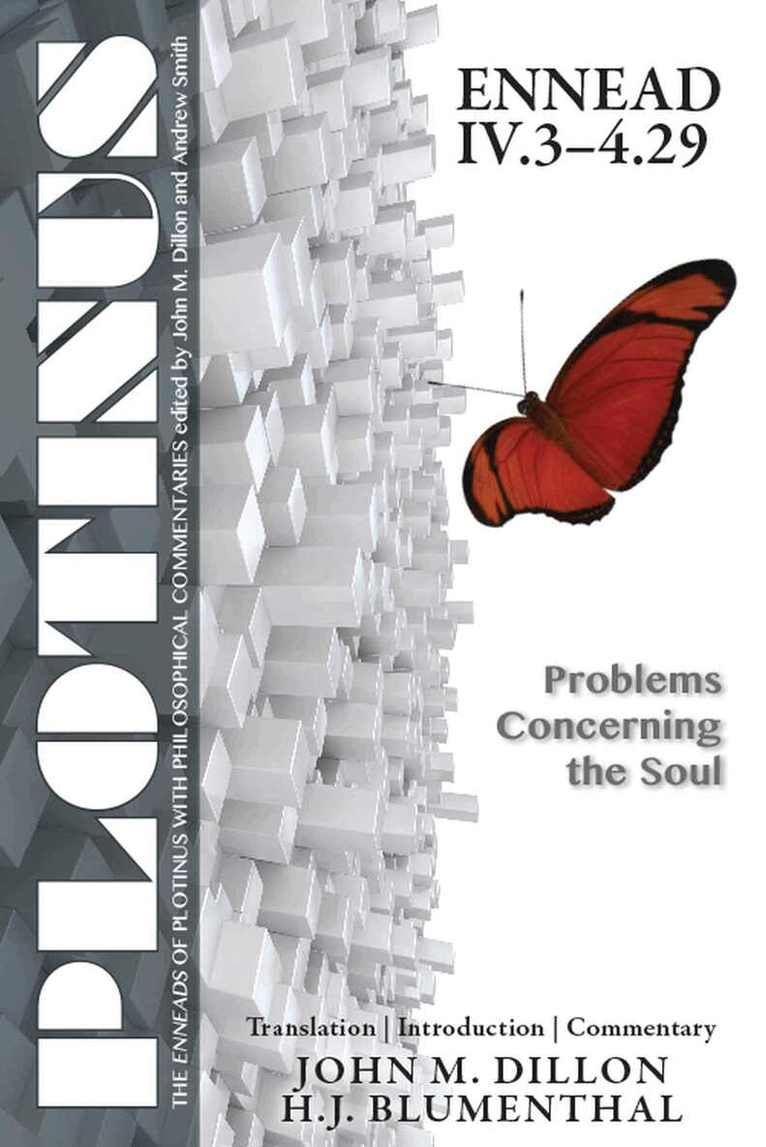
Ennead IV.4.30–45 and IV.5 retrieves the unity in this last section of Plotinus’ treatise on Problems concerning the Soul. Combining translation with commentary, Gurtler enhances both the accuracy of the translation and the recovery of Plotinus’ often unsuspected originality. This is especially true for IV.5, where previous translations fail to convey the concise nature of his argument against both the Aristotelian and Platonic theories of vision.Plato and Aristotle each claim that vision depends on the light between the eye and the object, but Plotinus presents evidence that this is not the case and develops a novel theory of light as a second activity that moves from source to object directly, even arguing that color is in the light itself rather than merely a quality of the object. This theory of vision, in turn, depends on the nature of sympathy developed especially in IV.4.30–45, where Plotinus shows how action at a distance is both possible and necessary for the proper unity in diversity of the sensible cosmos.
Häftad, Engelska, 2012
396 kr
Skickas inom 5-8 vardagar
Plotinus was much exercised by Plato's doctrines of the soul. In this treatise, at chapter 1 line 27, he talks of "the divine Plato, who has said in many places in his works many noble things about the soul and its arrival here, so that we can hope for some clarity from him. So what does the philosopher say? It is clear that he does not always speak with sufficient consistency for us to make out his intentions with any ease." The issue in this treatise is one that has puzzled students of Plato from ancient to modern times—and is indeed a popular topic for undergraduate essays even today: Why should the philosopher, who has ascended through a long and painful process of dialectic to "assimilation to the divine," ever descend back into the body? Plotinus himself is said by Porphyry to have attained such a state of other-worldly transcendence on at least four occasions during his lifetime, so this was a very real and personal issue for him. In this treatise we see him grappling with it.
Häftad, Engelska, 2013
396 kr
Skickas inom 5-8 vardagar
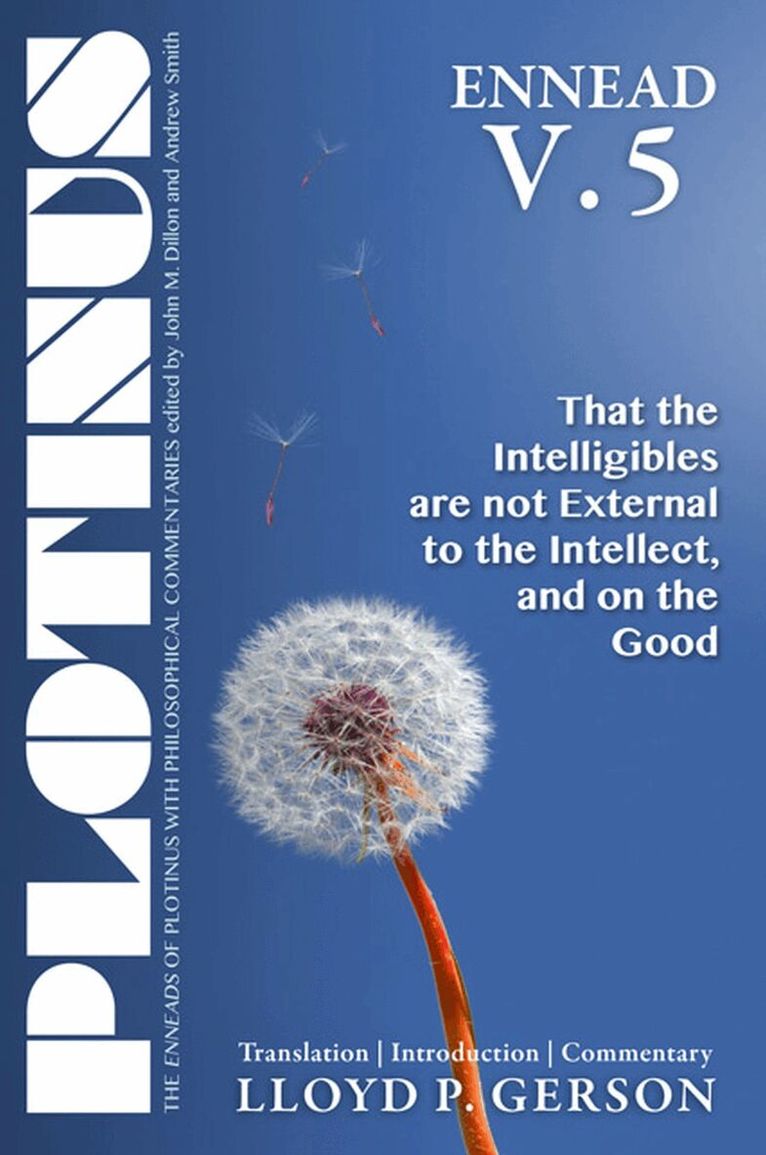
Platonists beginning in the Old Academy itself and up to and including Plotinus struggled to understand and articulate the relation between Plato’s Demiurge and the Living Animal which served as the model for creation. The central question is whether “contents” of the Living Animal, the Forms, are internal to the mind of the Demiurge or external and independent. For Plotinus, the solution depends heavily on how the Intellect that is the Demiurge and the Forms or intelligibles are to be understood in relation to the first principle of all, the One or the Good. The treatise V.5 [32] sets out the case for the internality of Forms and argues for the necessary existence of an absolutely simple and transcendent first principle of all, the One or the Good. Not only Intellect and the Forms, but everything else depends on this principle for their being.
Häftad, Engelska, 2015
463 kr
Skickas inom 5-8 vardagar
Plotinus’ Treatise V.1 comes closer than any other to providing an outline of his entire spiritual and metaphysical system, and as such it may serve to some degree as an introduction to his philosophy. It addresses in condensed form a great many topics to which Plotinus elsewhere devotes extended discussion, including the problem of the multiple self; eternity and time; the unity-in-duality of intellect and the intelligible; and the derivation of intelligible being from the One. Above all, it shows that the so-called “three hypostases”—soul, intellect, and the One—are best understood not as a sequence of three things additional to one another, but as three levels of possession of the same content, so that each lower level—soul in relation to intellect and intellect in relation to the One—is an “image” and “expression” of its superior.Plotinus exhorts the human soul to overcome its alienation from its own true nature and its divine origin by first recognizing itself as superior to the body and the same in kind as the animating principle of the entire cosmos, and then discovering within itself the still higher levels of reality from which it derives: intellect and, ultimately, the One or Good, the supreme first principle of all things. To do so the soul must redirect its attention inward and upward to become aware of the divinity which is always within it but from which it is distracted by the clamor of the senses.
Häftad, Engelska, 2017
463 kr
Skickas inom 5-8 vardagar
Ennead I.1 is a succinct and concentrated analysis of key themes in Plotinus' psychology and ethics. It focuses on the soul-body relation, discussing various Platonic, Aristotelian, and Stoic views before arguing that there is only a soul-trace in the body (forming with the body a “compound”), while the reasoning soul itself is impassive and flawless. The soul-trace hypothesis is used to account for human emotions, beliefs, and perceptions, and human fallibility in general. Its problematic relation to our rational powers, as well as the question of moral responsibility, are explored. Plotinus develops his original and characteristic concept of the self or “we,” which is so called because it is investigated as something common to all humans (rather than a private individual self), and because it is multiple, referring to the reasoning soul or to the “living thing” composed of soul-trace and body. Plotinus explores the relation between the “we” and consciousness, and also its relation to the higher metaphysical entities, the Good, and Intellect.
Häftad, Engelska, 2025
460 kr
Skickas inom 5-8 vardagar
Ennead I.8 was written not long before Plotinus’ death in 270 AD, at a time when he was particularly concerned with ethical issues. The treatise’ primary purpose is to argue that evil is not intrinsic to the soul, but since Plotinus always considers ethical issues within a metaphysical framework, it includes an account of the ontological status of matter. Plotinus does his best to preserve a belief in the dependence of all things on a single, supremely good First Principle while admitting that there is evil in the world. He offers a subtle account of the origin of evil in the soul as caused not by either the soul or matter on its own but by the combination of the two. Sheppard shows how Plotinus is responding to ideas found in Plato, Aristotle, the Stoics, and Middle Platonism as well as to the challenge presented by Gnosticism, and argues that the views expressed in I.8 are not inconsistent with what Plotinus has to say about matter and its generation elsewhere. She further considers the criticisms of Plotinus’ views put forward by Proclus and concludes that, despite its weaknesses, Plotinus’ account remains an ingenious attempt to defend monism and the essential goodness of the soul while recognizing the existence of evils.
Häftad, Engelska, 2026
365 kr
Kommande
This short, early treatise undertakes to explain the controversial thesis that all souls—this includes individual human souls and the world-soul—are in some sense just one soul. Plotinus considers a number of objections that can be raised against the thesis. For instance, if the thesis is true, it may seem to follow that that everything that holds for one soul also holds for every other soul. Plotinus seeks to explain that such objections are off the mark, which also shows that the thesis about the unity of soul is not a claim about strict identity of all souls. He then (chapter 5) considers and rejects two materialistic hypotheses about the relationship between individual souls and the world-soul. In the final chapter he presents his own solution: the individual souls and the world-soul are all the soul hypostasis. He likens the relationship between the hypostatic soul and the individual souls with that between a science and the theorems of the science: each theorem potentially contains the whole science and can in a sense be said to be it.