Greenwood Guides to Historic Events of the Ancient World – serie
Visar alla böcker i serien Greenwood Guides to Historic Events of the Ancient World. Handla med fri frakt och snabb leverans.
10 produkter
10 produkter
626 kr
Skickas inom 10-15 vardagar
For Ancient Greece as well as Ancient Rome, the Trojan War provided a history that seemed possessed of a power as magnetic as it was malleable; thus, in this single source these two great civilizations were able to find two distinct sets of heroes, two distinct sets of virtues, and two eternal poets. But different as Greece and Rome's experience of the Trojan War may have been, they united in an identical longing for a heroism that was attainable in the present only by reaching out for an impossible past. In Carol Thomas and Craig Conant's broad and varied account, the reader will have the opportunity to investigate the shadowy historical foundation that underlay the poetic environment of Achilles and Aeneas; as well as examine how the poetic experience altered the understanding of the Trojan War for the many cultures and civilizations that were touched by its expansive forces.Designed as an accessible introduction to this critical event in the Western tradition, The Trojan War offers readers and researchers an engaging mixture of descriptive chapters, biographical sketches, and annotated primary documents. An overview of Troy and the world of the late Bronze Age is presented in the first chapter, followed by sections on: finding Troy and the Trojan War, Homer and the epic tradition, the force of legend, and Troy in the 21st century. An annotated bibliography and index are also included in this work.
716 kr
Skickas inom 10-15 vardagar
Ambitious, intelligent, and desired by men and emperors, Cleopatra VII came to power at a time when Roman and Egyptian interests increasingly tended to concern the same object: the Egyptian Empire itself. Cleopatra lived her whole life at the center of this complex and persistent power struggle, and her death simultaneously heralded the end of the Ptolemaic dynasty, the loss of Egyptian political independence, and the beginning of Caesar Augustus's Roman rule in Egypt. Cleopatra's legacy has since lost much of its former political significance, as she has come to symbolize instead the potent force of female sexuality and power. In this engaging and multifaceted account, however, Stanley M. Burstein displays Cleopatra in the full manifold brilliance of the several cultures, countries, and people that surrounded her throughout her compelling life, and in so doing develops a stunning picture of a legendary Queen, and a deeply historic reign.Designed as an accessible introduction to Cleopatra VII and her time, this book offers readers and researchers an appealing mix of descriptive chapters, biographical sketches, and annotated primary documents. An overview of the Ptolemaic Dynasty is presented in the introduction, and is followed by chapters on Cleopatra's life, the reality of Ptolemaic Egypt, Cleopatra's multicultural Egyptian society, and Alexandria's culture and conflicts. The narrative chapters conclude with a section discussing Cleopatra's significance as a person, a queen, and a symbol. An annotated bibliography and index are also included in this work.
626 kr
Skickas inom 10-15 vardagar
The great pyramids at Giza are among the largest stone structures in the world, unsurpassed in size and scope since the days of antiquity. The Great Pyramid of Khufu (Cheops) is the only one of the ancient Seven Wonders of the World still standing. And yet, despite over four thousand years of study, some debate still surrounds these structures at the most basic levels. Who built the pyramids? How were such feats accomplished years before the advent of modern engineering? Why were the pyramids built in the first place? This volume explores the circumstances surrounding these mighty structures, including pyramid design, construction and architecture, foundations in Egyptian cosmology, symbolism, and political implications.Narrative chapters, primary documents, and detailed histories of individual pyramids bring the reader to a deeper understanding of the Old Kingdom, a unique integration of church and state that allowed its rulers to ascend to the position of god after death. These conditions laid the groundwork for the creation of such massive tomb markers, powerful monuments designed to equip pharaohs for the afterlife and immortalize them for all eternity.
626 kr
Skickas inom 10-15 vardagar
When Justinian first assumed the title of Roman Emperor in 527 CE, his inherited empire—now based in Constantinople— had lost almost all of its connection with the Eternal City itself, and was threatened from within by profound theological splits, and from without by the various barbarian kingdoms that surrounded it. By taking military action against the barbarian Ostrogoths, Visigoths, and Vandals, and signing an eternal peace with Persia, Justinian managed to reclaim much of the lands formerly held by Rome; while through his incessant legislation and monetary contributions to an extensive building program, he sought to reestablish the old Roman cultural institutions of order and architectural beauty in his newly won kingdom. This inveterate reformer and innovative leader, whose name remains on the beams of the Hagia Sophia, and whose influence extends into the legal practices of the present time, remains as compelling a man today as he was to his original historians almost 1500 years ago.Designed as an accessible introduction to Justinian's reign and his time, The Emperor Justinian and the Byzantine Empire offers readers and researchers an appealing mix of descriptive chapters, biographical sketches, and annotated primary documents. An overview of the world of Late Antiquity is presented in the introduction, and is followed by chapters on the shape of the Empire, the Nike revolt of 532, the legal achievements of Justinian, the Empress Theodora, and Justinian's building program. The narrative chapters conclude with a section discussing the imperial achievements as a whole. An annotated bibliography and index are also included in this work.
626 kr
Skickas inom 10-15 vardagar
The Han Dynasty created an enduring Chinese empire comparable to the Roman Empire. In this book, narrative chapters, biographical sketches, and translated primary documents give readers a unique overview of this important founding dynasty.The Han Dynasty (206 B.C.E. to C.E. 221) ruled a large prosperous Chinese empire that was roughly contemporary with the Roman Empire and comparable in size. The Han was founded by Liu Bang who ruled as Emperor Gaozu. The Han emperors turned away from the harsh rule of their Qin predecessors and promoted Confucianism and other schools of thought while retaining some of the useful autocratic features of Legalism. Under Wudi (140-87 B.C.E.) the empire expanded to include parts of Central Asia, Korea and Vietnam. Under the Han dynasty the Chinese developed steel, the water mill, high quality stoneware (china), and paper.Designed as an introduction to the founding and consolidation of the Han Empire, this work offers information on the founding of the Han Empire; conflict between town and countryside and the empire and barbarians; technological innovations like steel and papermaking; social changes and the lives of women and children; and a comparative look at Imperial China in world history. Excerpts from Confucius on government, recently found Qin laws written on bamboo strips, and contemporary historical accounts lend depth and immediacy to the work. Brief biographies of key rulers, rebels, and philosophers give readers a look at events through the eyes of participants. An annotated bibliography, index, chronology, glossary, and 26 illustrations and maps round out the book.
695 kr
Skickas inom 10-15 vardagar
In the 250 years between 250 and 500 C.E., Rome found itself transformed from a mighty global empire into a limited collection of Germanic kingdoms. The aspiration exhibited in these kingdoms (as well as in Constantinople and later in the person of Charlemagne) to recreate and reclaim the glory of the Roman Empire persists to this day, and an examination of this time is critical to anyone interested in politics or history. James Ermatinger's multifaceted account allows the reader a unique opportunity to view through various lenses the many and complex elements that contributed to the demise of this once-vast empire, investigating, among other things: the general religious and political issues of the age, the cultural and economic climate, the nature of the imperial household, and the role of the Germanic invaders. In so doing, he paints a vivid picture of a dying dream. This volume is ideal for use in the classroom, as well as for use in school and public libraries.Designed as an accessible introduction to this critical period, The Decline and Fall of Rome offers readers and researchers an appealing mix of descriptive chapters, biographical sketches, and annotated primary documents. An overview of the period is presented in the introduction, and is followed by chapters on late Roman culture, society, and economics in late antiquity; religious conflicts in Christian Rome; enemies of Rome; and why and when Rome fell. The narrative chapters conclude with a section placing Rome's fall in modern perspective. An annotated bibliography and index are included.
608 kr
Skickas inom 10-15 vardagar
Since ancient times, technological advances have increased man's chances for survival. From the practicality of a Roman aqueduct to the art of the written word, man has always adapted his environment to meet his needs, and to provide himself with sustenance, comfort, comfort, leisure, a higher quality of living, and a thriving culture. This concise reference source takes a closer look at six technological events that significantly impacted the evolution of civilization, from the Palaeolithic age to the height of the Roman Empire. As he touches on the common elements of ancient technology—energy, machines, mining, metallurgy, ceramics, agriculture, engineering, transportation, and communication—Humphrey asks questions central to understanding the impact of ancient tools on the modern world: What prompts change? What cultural traditions inhibit change? What effect do these changes have on their societies and civilization?Humphrey explores technologies as both physical tools and as extensions of the human body, beginning with the invention of the Greek alphabet and including such accomplishments as early Neolithic plant cultivation, the invention of coinage, the building of the Parthenon, and Rome's urban water system. Detailed line drawings of tools and machines make ancient mechanics more easily accessible. Primary documents, glossary, biographies, and a timeline dating from the Palaeolithic age to the Roman Empire round out the work, making this an ideal reference source for understanding the tools of the ancient world.
568 kr
Skickas inom 10-15 vardagar
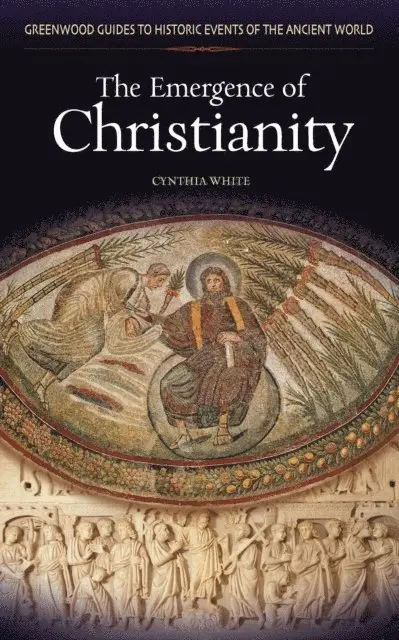
The ancient Romans believed that only proper polytheistic worship could maintain the pax Romana, or Roman Peace. In the first century A.D., a splinter sect of Judaism began to crack this wall, bringing upheaval, persecution, and conversion into the lives of Romans, Jews, Christians, and pagans. This exciting volume explores the emergence of Christianity in Rome during the first four centuries of the Greco-Roman empire, from the first followers of Jesus Christ, to conflicts between Christians and Jewish kings under Roman occupation, to the torture of Christian followers, Diocletian's reforms, and Constantine's eventual conversion to monotheism, which cemented Christianity's status as the official religion of Rome.Supplemented by photos, primary document excerpts, biographies of key figures, a glossary, an annotated bibliography and an index, this volume is an ideal reference source for students and general readers alike.
608 kr
Skickas inom 10-15 vardagar
In the 6th century B.C.E., a young prince named Siddhartha Gotama set out on an ascetic quest to alleviate human suffering. In the middle ground between opulence and self-denial, he discovered a path to enlightenment and self awareness—and he dedicated his life to sharing that discovery. The man called Buddha, the Awakened One, traveled as an itinerant monk, imparting principles of enlightenment throughout India and what is now southern Nepal. He was not worshipped as a god, but became teacher and model to ascetics, royalty, and townsfolk alike. In the 2,500 years that followed, through the spread of Buddha's teachings and the monastic communities that upheld them, the world's oldest missionary religion has grown so that it now boasts over 350 million followers worldwide.The story of Buddhism unfolds through a series of narrative chapters, dealing with the Brahmanical cosmology from which Buddhism emerged, the stories and myths surrounding Buddha's birth, Buddha's path to enlightenment, and the eventual spread of his teachings throughout India and the world. Kinnard's clear telling of the tale helps students understand such complex concepts as the natural law of cause and effect (karma), the birth/life/death/rebirth cycle (samsara), the ever-changing state of suffering (dukkha), and salvation, the absence of all states (nirvana). Primary documents, illustrations, glossary and biographical sketches illuminate the extraordinary life and legacy of the man called Buddha.
608 kr
Skickas inom 10-15 vardagar
Although the ethnic-religious tradition that became classical Judaism solidified around 100 CE, its roots are found in the ancient biblical tales of the Israelites. Stories of the descent into Egypt, the Exodus under Moses, and the eventual rise of the Israelite monarchy are essential to understanding classical rabbinic Judaism. Through the lens of modern biblical scholarship, Hayes explores the shifting cultural contexts—the Babylonian exile, the Roman Empire, the Byzantine period, the rise of Christianity—that affected Jewish thought and practice, and laid the groundwork for the Talmudic era and its modern legacy.Thematic chapters explore the evolution of Judaism through its beginnings in biblical monotheism, the Second Temple Period in Palestine, the interaction of Hellenism and Judaism, the spread of rabbinic authority, and the essence of ethno-religious Jewish identity. Biographical sketches of key figures from patriarchs to prophets, and primary selections from the Hebrew bible, the Dead Sea Scrolls, the Talmud, and others, allow for a greater understanding of an ancient movement, and provide a solid introduction to the origins of one of the world's most influential religions.