Grove Press Poetry - Böcker
Visar alla böcker i serien Grove Press Poetry. Handla med fri frakt och snabb leverans.
7 produkter
7 produkter
139 kr
Tillfälligt slut
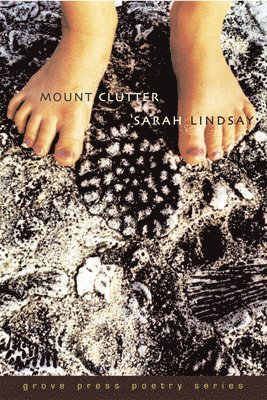
Sarah Lindsay's poems have been hailed as "dark-edged ... with a buoying sense of respect-for the different, the unexpected and the challenging." (Publishers Weekly) Lindsay's new collection, Mount Clutter, is the product of an immensely original and exhilarating poetic sensibility, ranging wide across a highly distinctive imaginary landscape. In a voice that is distinctly her own, Lindsay probes the uncharted territories of history's curious little corners, reanimating obscure accounts of strange discoveries and bizarre scientific findings. A stunning sequence on the discovery of the Bufo Islands imagines what it means to encounter something as yet unnamed, unknown to human history, but bursting with possibilities. Lindsay similarly breathes new life into literary classics and ancient Greek myths, taking, for example, the well-known motif of Orpheus's descent into the underworld and transforming it into a hauntingly resonant portrait of the vicissitudes of loss. Lindsay's poems exude an extraordinary ability of fusing the outlandish and the little-known historical minutiae with the unmistakably familiar markers of the human experience. Mount Clutter is a remarkably sustained and self-assured performance -- stirring new poetry from the acclaimed 1997 national Book Award finalist. "[A] vision that beckons the reader after it into unexpected recognitions." -- W. S. Merwin
139 kr
Tillfälligt slut
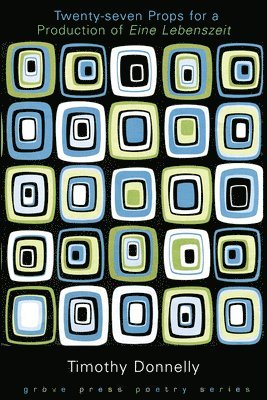
Timothy Donnelly's poems have already garnered a following in some of America's best literary journals (The Paris Review, Ploughshares), and the long-awaited publication of his first collection of poetry will make a spectacular new addition to the Grove Press Poetry Series. Donnelly seduces the reader with his ability to summon up just about any topic, sensibility, or thought, with the self-assurance and effortlessness of a skilled master. The title poem is a brilliant expose of an imaginary play that is an allegorical rendering of a single lifetime. Donnelly imagines a stage and populates it with objects that emerge as pictorial and poetic anchors punctuating the enveloping verse. As the poem craftily weaves around these, its energy builds up to a climax that is both a luminous poetic offering and an amatory overture at the reader. In "Accidental Species," he puts forth a remarkable statement about his own efforts as a poet, a humorous ars poetica ("If I only had a crutch I wouldn't wobble / half so much") by way of a heartbreaking lover's complaint ("The terror I inspired I am made to feel"). Acclaimed by Richard Howard as "brilliant and masterful," Timothy Donnelly's premiere work combines an extraordinary gift for rhetorical exuberance and syntactical intricacy with a stunning poetic maturity. For its thoughtfulness and range, for the sheer energy of its rhetoric, and for the audacity of its poetic acumen, Twenty-Seven Props for a Production of Eine Lebenszeit is a remarkable debut collection from one of our most outstanding and original young poets.
139 kr
Tillfälligt slut
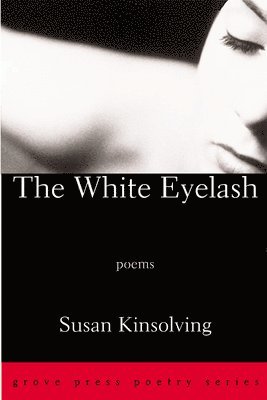
Susan Kinsolving's first collection, Dailies & Rushes, was hailed as a remarkable debut by The New York Times, The New Yorker, and The Wall Street Journal, and named a finalist for the National Book Critics Circle Award. In her new work, The White Eyelash, she turns the extremes of her recent experiences into poems of harsh factuality. This dark narrative sequence is highly contrasted by the humor presented in a section called "Light Fare and Oddballs." Once again, Kinsolving exhibits a daunting range with signature style and substance.
139 kr
Tillfälligt slut
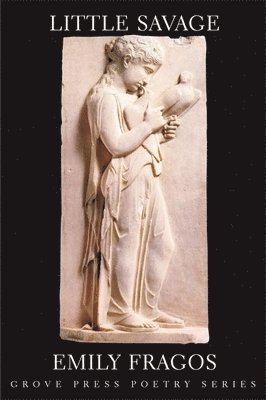
With Little Savage, Emily Fragos delivers a magnificent collection in the American tradition of Robert Lowell and Elizabeth Bishop. With clean, strongly wrought lines she builds poems that are elegant and powerful.Marie Ponsot calls the collection remarkable. What separates Fragos from her contemporaries is her amazing ability to empathize with the characters she createsthe misfits, the artists, the children kept in a fifteenth century school, the composer going mad. She convincingly becomes a young girl in the Venetian conservatory for the abandoned: Sofia del violino. Once I saw myself / in a clear puddle of rain / water. My teeth are very crooked, I / know. We are none of us / startled by the other. We are all / the same. To Heaven.” These moments ache with honesty, humility, and make us wish that every sentiment expressed by Fragos could be true.Deceptively simple poems written by an unostentatiously skilled poet, Little Savage is permeated with a reverence for nature, music, myth and dancea veritable treasure trove of compassion and grace.Richard Howard's ForewordYou are alone in the room, reading her poems. Nothing is happening, nothing wrong, but all at once, say around page 17 or 18, you hear remember, no one is with you, no one else is therea sigh. Or a whispered word: someone. You are not alarmed, but you had thought you were alone. Perhaps not. The sensation is what Freud used to call unheimlich, uncanny. That is the effect of the poems of Emily Fragos. Like their maker, her readers are accompanied, and not to their ulterior knowledge. It is not disagreeable to be thus escorted, attended, joined, but we had not expected it. And as Robert Frost used to tell us (no surprise in the writer, no surprise in the reader”), Fragos too has not expected such visitations, as she will call them. This poetthese poemsendure otherness, they are haunted:I remain, with one of everything.” Even as one is being saved
conjure the army of others” What would happen to my life when all along there has been nothing but me?” Did you not see how I was made to feel when you put me among others” And my bodyuninhabitedsuffers and wonders: whose hands are these? whose hair?”The poems will reveal whose, though I do not think Emily Fragos herself ever finds out. Inevitably, we recall that old surrealist shibboleth, Tell me by what you are haunted and I will tell you who you are;” it can be the password to indentity. But this poet has what she calls luxurious mind” and her ghosts are legion:Alone in my odd-shaped room, I practiceBlindness and the world floatsclose and away. I am uncertain ofeverything. I must walk slowly, carefully.She is acknowledging, with some uneasiness (will you please tidy up?”), that it is not only the beloved dead, the proximate departed who are with her, who possess her, but others, any others. The remarkable thing about this poetic consciousness is that the woman’s body is inhabitedsometimes with mere habitude, sometimes joyously, more often with astonishing painby the prolixity of the real (and of the unreal’); the poems are instinct with others:How dare youCare for me when all my lifeI have had this voltage to igniteme, this rhythm to drive me,when something inside your bodydares me to touch my handsto yours
And quite as remarkable, of course, is the even tonality of such possession; there is nothing hysterical or even driven about the voice of the poems as it records, as it laments or exults in these unsought attendants. There is merelymerely!a loving consistency of heedfulness; and one remembers Blake’s beautiful aphorism: unmixed attention is prayer.Of course such poetic staffage is not peculiar to Emily Fragos; like Maeterlinck, like Rilke, she exults in her discovered awareness: I need the other/the way a virus/needs a host.” Rather, she imbues, she infects all of us with the consciousness that there are no single souls: we are not alone.
139 kr
Tillfälligt slut
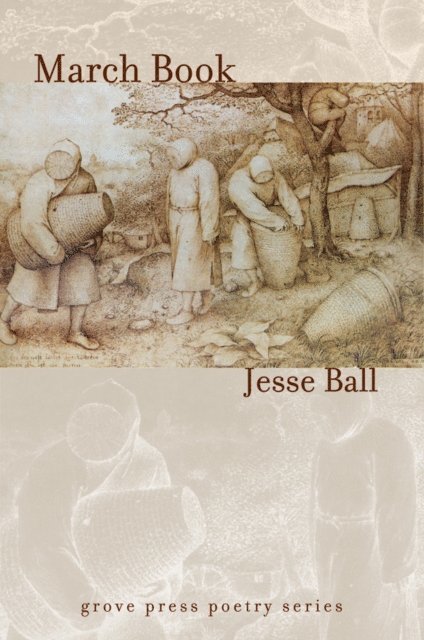
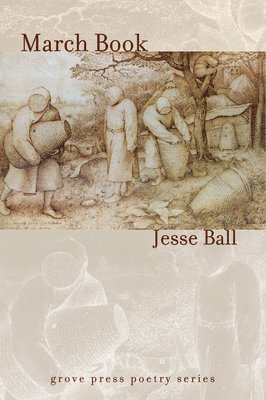
March Book is a wonder and a revelation. A shockingly assured first collection from young poet Jesse Ball, its elegant lines and penetrating voice present a poetic symphony instead of a simple succession of individual, barely-linked poems. Craftsmanship defines this collection; it is full of perfect line-breaks, tenderly selected words, and inventive pairings. Just as impressive is the breadth and ingenuity of its recurring themes, which crescendo as Ball leads us through his fantastic world, quietly opening doors.In five separate sections we meet beekeepers and parsons, a young woman named Anna in a thin, linen dress and an old scribe transferring the eponymous March Book. We witness a Willy Loman-esque worker who "ran out in the noon street / shirt sleeves rolled, and hurried after / that which might have passed" only to be told that there's nothing between him and "the suddenness of age." While these images achingly inform us of our delicate place in the physical world, others remind us why we still yearn to awake in it every day and "make pillows with the down / of stolen geese," "build / rooms in terms of the hours of the day." Like a patient Virgil, insistent and confident, Ball escorts us through his mind, and we're lucky to follow.
139 kr
Tillfälligt slut
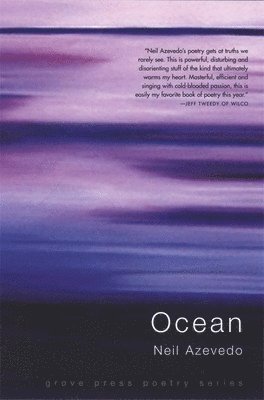
Neil Azevedo has published poems in The Paris Review, The New Criterion, Prairie Schooner, and Image. His first collection, Ocean, introduces a shadowy world populated with dogs and snakes, suicide and children, sickness and satire, Satan and Christ, yet one doesn't feel soggy with introspection. Instead, wisdom emerges from these often personal and well-articulated lyrics; the reader is moved by the juxtaposition of savagery of subject and delicacy of touch. The verbal and often gothic brilliance of the language is stunning. It's not often that a young poet successfully embraces meter, finding a refined, velvet-toned style, and creates such a stellar debut.
139 kr
Tillfälligt slut
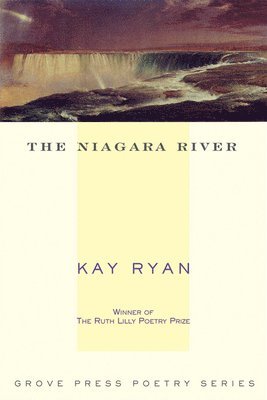
In the citation accompanying Kay's recent award of the prestigious Ruth Lilly Prize, Christine Wiman wrote: "Kay Ryan can take any subject and make it her own. Her poems-which combine extreme concision and formal expertise with broad subjects and deep feeling-could never be mistaken for anyone else's. Her work has the kind of singularity and sustained integrity that are very, very rare
. It's always a dicey business predicting the literary future
[but] for this reader, these poems feel as if there were built to last, and
they have the passion, precision and sheer weirdness to do so."Salon compared the poems in Ryan's last collection to "Fabergé eggs, tiny, ingenious devices that inevitably conceal some hidden wonder." The exquisite poems in The Niagara River provide similarly hidden gems. Bafflingly effective, they seem too brief and blithe to pack so much wallop. Intense and relaxed at once, both buoyant and rueful, their singular music appeals to many people. Her poems, products of an immaculately off-kilter mind, have been featured everywhere from the Sunday funnies to New York subways to plaques at the zoo to the pages of The New Yorker.