History and Philosophy of Psychology – serie
Visar alla böcker i serien History and Philosophy of Psychology. Handla med fri frakt och snabb leverans.
10 produkter
10 produkter
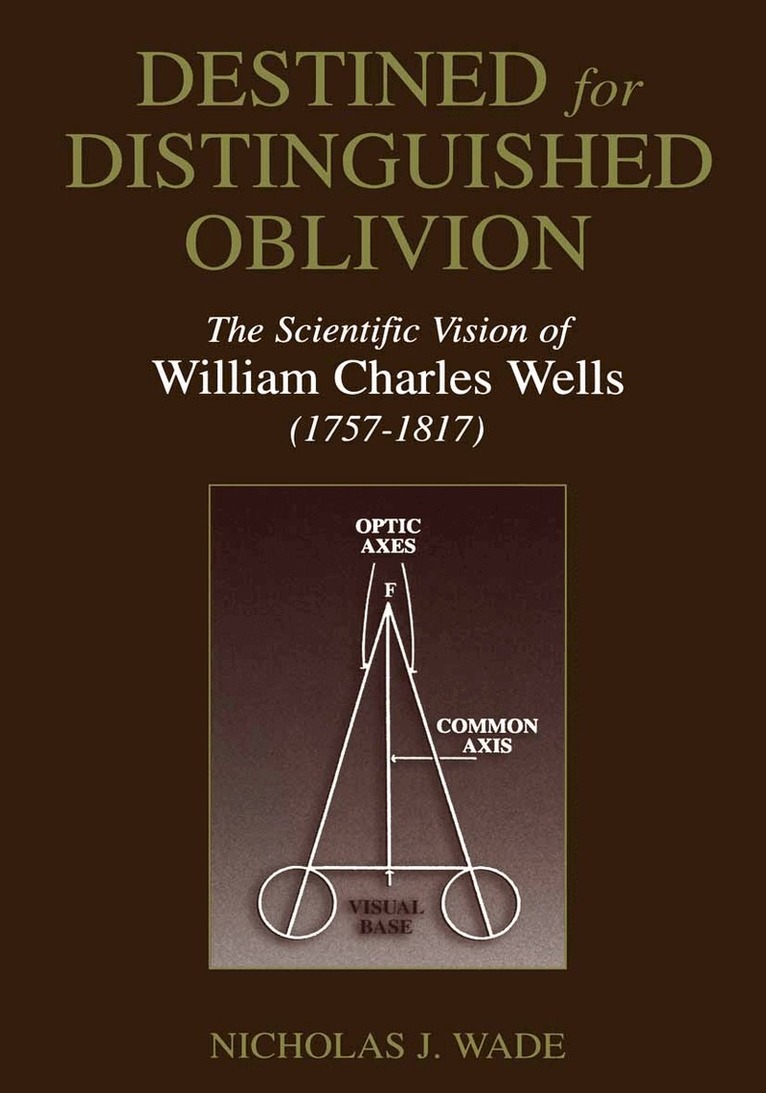
Destined for Distinguished Oblivion
The Scientific Vision of William Charles Wells (1757–1817)
Inbunden, Engelska, 2002
1 589 kr
Skickas inom 10-15 vardagar
William Charles Wells (1757-1817) was one of the foremost, and forgotten, American scientists of the 18th century. He was trained in medicine and conducted experimental studies in vision and vertigo, he proposed a theory of how dew forms, and he speculated on the mechanism of natural selection. Despite the originality of his enquiries in all these areas, Wells' contributions to scientific discovery have been either neglected or ignored. Although he was born in America, Wells was educated in Scotland and practiced medicine for most of his adult life in London. His practice did not thrive, and he had ample time to conduct his experimental enquiries on a variety of natural phenomena. He was acquainted with the leading medical men of the day, and was admired by them. The emergence of experimental studies of vision can be traced to the adoption of Newtonian methods of observation and experiment, and in their application to space perception by Wells (1792). His initial researches were concerned principally with binocular vision, but he also conducted experimental studies of accommodation, acuity, eye movements, and vertigo.With regard to the last, he entered into a debate with Erasmus Darwin concerning the involvement of eye movements in vertigo. Indeed, Wells should be acknowledged as laying the foundations for modern studies of vestibular function as well as eye movements. The book reprints his essay on single vision with two eyes" (1792) and his own memoir of his life (1818).
Rediscovering the History of Psychology
Essays Inspired by the Work of Kurt Danziger
Inbunden, Engelska, 2003
1 094 kr
Skickas inom 10-15 vardagar
For 25 years, Kurt Danziger's work has been at the center of developments in history and theory of psychology. This volume makes Danziger's work the focal point of a variety of contributions representing several active areas of research. The authors are among the leading figures in history and theory of psychology from North America, Europe and South Africa, including Danziger himself. This work should serve as a point of departure for those who wish to acquaint themselves with some of the most important issues in this field.
1 032 kr
Skickas inom 10-15 vardagar
For more than half of the 20* century, psychologists sought to locate the causes of behaviour in individuals and tended to neglect the possibility of locating the psy chological in the social.
Phenomenology and Psychological Science
Historical and Philosophical Perspectives
Inbunden, Engelska, 2006
1 032 kr
Skickas inom 10-15 vardagar
There are no books precisely parallel to this one. The main works of the major authors in phenomenological philosophy (but not phenomenological psychology) are in print – we mean Husserl, Heidegger, Sartre and Merleau- Ponty. General texts on the phenomenological approach in philosophy – including ones which take a historical approach – are available. Notable are: H. Spiegelberg (1981) The Phenomenological Movement (3rd edition) The Hague, Martinus Nijhoff. D. Moran (2000) Introduction to Phenomenology London, Routledge. There are several accounts of psychology from a phenomenological viewpoint in print, some of which refer to the philosophical roots. The extent of the reference varies. None fully spells the connections out, and none has a historical perspective. For example: R .S. Valle and S. Halling (1989) Existential-Phenomenological Perspectives in Psychology New York, Plenum Press. E. Spinelli (2005) The Interpreted World: An introduction to phenomenological psychology (2nd edition) London, Sage. H.R. Pollio, T.B. Henley and C.T. Thompson (1997) The Phenomenology of Everyday Life Cambridge, Cambridge University Press. K. Dahlberg, N. Drew, and M. Nyström (2001) Reflective Lifeworld Research Stockholm, Studentlitteratur. There are books in print which are much more concerned with the practicalities of phenomenologically-based research in psychology than with the history and philosophy underlying this. The most used example is probably: C. Moustakas (1994) Phenomenological Research Methods Thousand Oaks, Sage. I would characterize the current book, in contrast to the above, as having phenomenologically-based research in psychology firmly in view, but addressing in detail the historical development of the phenomenological movement in philosophy insofar as it illuminates the inmpact on psychology. So – the historical development of phenomenological philosophy and the impact, at each stage, on psychology.Answering as a collateral effect the question, What is phenomenological psychology? It is essential to offer an authoritative account of these matters now because: Qualitative research in psychology has achieved acceptance in Europe (though the acceptance is less in the United States at present), and with qualitative research in general, phenomenologically-based research is widely practiced. The British Psychological Society – by whom undergraduate degrees in psychology are accredited (and without this accreditation, students cannot progress to professional training) – has just begun to demand qualitative research training as part of the research methods and practical training programme. This book uniquely contains material that would be needed for a thorough background in phenomenological psychology. The British Psychological Society has also just begun to demand a core module in the History and Philosophy of Psychology as part of the advanced undergraduate education of psychology students. This book – though not intended as a core elementary text – would be right as background reading. In associated, applied areas throughout the world (e.g. health psychology, organizational and industrial psychology, counseling, nursing) phenomenological approaches are well accepted and very widely used. However, the meaning of the approach is often misunderstood – often boiling down to a report of, e.g. patients’ statements about such-and-such a thing. Experience is not rigorously addressed. This book provides a necessary corrective, and indicates what the options are for phenomenologically-based research, and the basis of these options within the history of phenomenological philosophy.
Phenomenology and Psychological Science
Historical and Philosophical Perspectives
Häftad, Engelska, 2010
1 273 kr
Skickas inom 10-15 vardagar
I would characterize the current book, in contrast to the above, as having phenomenologically-based research in psychology firmly in view, but addressing in detail the historical development of the phenomenological movement in philosophy insofar as it illuminates the inmpact on psychology.
1 094 kr
Skickas inom 10-15 vardagar
Throughout the 20th century, psychology generally and social psychology in particular has been dominated by individualism. It has focused on the subject as ultimately biological to the neglect of the subject as a social being. In the late 1960's, this emphasis led to the eruption of a "crisis" in social psychology, a crisis which has yet to be resolved. The most significant response to this crisis has been the development of social constructionism. This approach emphasizes the historicity, context-dependence, and socio-linguistically constituted character of all matters bearing on human activity. Many versions extend this emphasis to the conceptual and methodological practices of psychologists and to the epistemological assumptions which ground these practices, to the "meta-issues" of the discipline. It is these versions of social constructionism which this book addresses, that is, social constructionism as an epistemology (as an alternative to positivism and realism) as well as a theory of the social character of human activity.
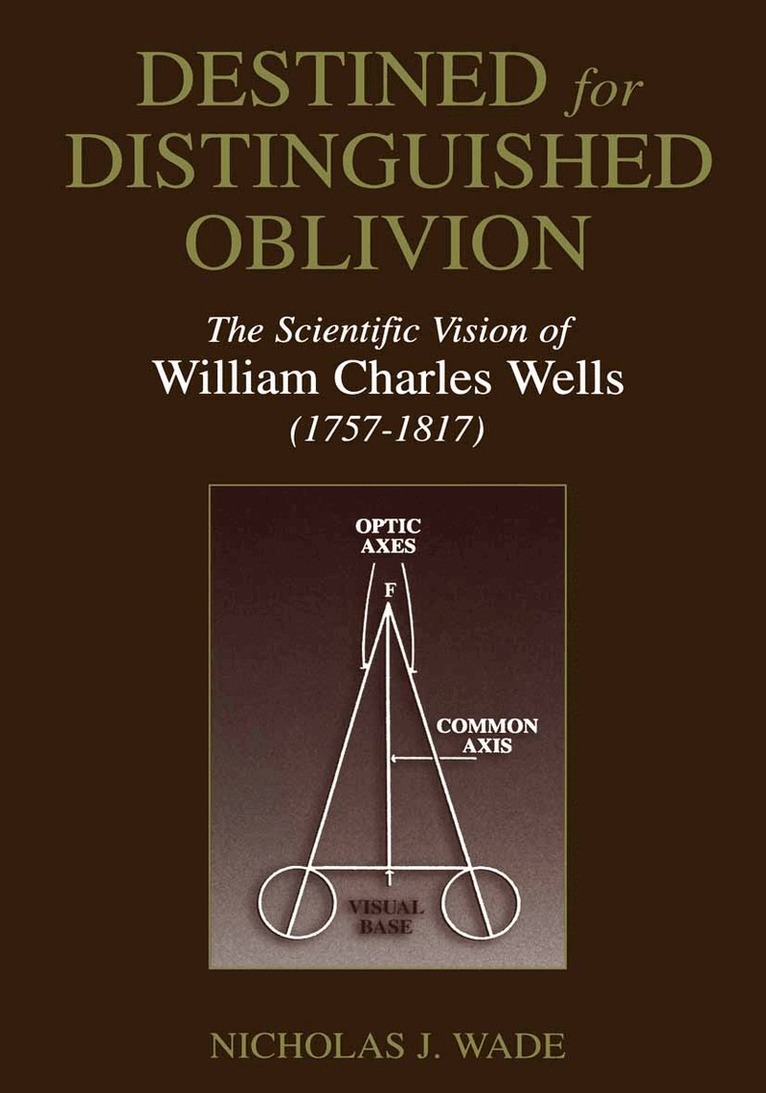
Destined for Distinguished Oblivion
The Scientific Vision of William Charles Wells (1757–1817)
Häftad, Engelska, 2012
1 637 kr
Skickas inom 10-15 vardagar
My fIrst encounter with the name of William Charles Wells, over twenty years ago, was an oblique reference to his Essay upon single vision that Wheatstone (1838) made in a classical article on binocular vision. The reference was enigmatic because it stated that few had paid attention to Wells' theory of visual direction, while doing little to infonn the reader of its novelty. I was fortunate in having the excellent facility of the Rare Books and Manuscripts Department of the Library at the University of St. Andrews near at hand, so that I could cousult a copy of Wells' monograph. However, I was not aware of the full import of its contents until Hiroshi Ono visited Dundee from York University, Ontario, in 1980. Hiroshi had previously fonnalised the principles of binocular visual direction that Hering (1879) had proposed. He returned one day from St. Andrews, having read Wells' Essay upon single vision, amazed to have found that Wells had perfonned similar experiments and reached similar conclusions to Hering. Hiroshi Ono has done much to bring Wells' work on binocular single vision to the notice of visual scientists, although its reception has not been without opposition. As I read more of Wells' work on vision I became aware of its breadth as well as its depth. In addition to his essay on binocular single vision, he wrote about and conducted experiments on accommodation, visual acuity, visual persistence, and vertigo.
Franco Basaglia's Revolution
From the Blue Horse to the Actuality of His Practice
Inbunden, Engelska, 2025
1 378 kr
Skickas inom 10-15 vardagar
It reviews the contemporary status of care and offers new insights for a critical evaluation of care that takes the psychiatric revolution to a new level. Highlights Basaglia’s diagnostic and clinical practiceEmploys a multi-disciplinary approachJoins phenomenology and critical theory
519 kr
Skickas inom 10-15 vardagar
This book presents a scientific biography of Edgar Rubin, one of the outstanding pioneers of perceptual psychology in the early twentieth century. It also argues for the importance of description in psychology.
534 kr
Skickas inom 10-15 vardagar
Edgar Rubin was one of the outstanding pioneers of perceptual psychology in the early twentieth century. His approach involved a turning away from an earlier elementaristic psychology towards an approach based on “perceptual wholes.” Rubin’s approach is closely linked to the Gestalt revolution in perceptual psychology and was eagerly embraced by the Gestaltists. This has often led to Rubin being classified as a Gestalt psychologist. This misrepresents his position as is shown in the book. Rubin’s aim was to develop a descriptive psychology — or aspective psychology to use his terminology — which would do full justice to the complex nature of psychological phenomena. Thus he rejected attempts by the Gestalt psychologists to explain diverse phenomena within a single overarching framework. While Rubin is internationally often misclassified as a Gestalt psychologist, in Denmark he is often hailed as a pioneer of a specific Danish “school of phenomenology.” This also misrepresents Rubin’s approach who was highly critical of psychological “schools.” His criticisms of the overambitious theoretical aspirations of Gestalt psychology, his negative attitude towards school formation in psychology were both highly prescient. What remains today of Gestalt psychology is primarily its descriptive parts; the idea of schools of psychology, so common in early twentieth century psychology is now seen as a totally outmoded viewpoint. There is an interesting moral in this story for the history and status of psychology; to wit, that Rubin’s emphasis on the correct description of psychological phenomena shows what is likely to live on as classic contributions to psychology. This certainly holds for his own work on figure and ground which, after almost a century, is still universally known and admired by psychologists. He was indeed a consummate psychological observer. The book argues for the importance of description in psychology.