Nicholas J. Wade - Böcker
Visar alla böcker från författaren Nicholas J. Wade. Handla med fri frakt och snabb leverans.
6 produkter
6 produkter
1 932 kr
Skickas inom 5-8 vardagar
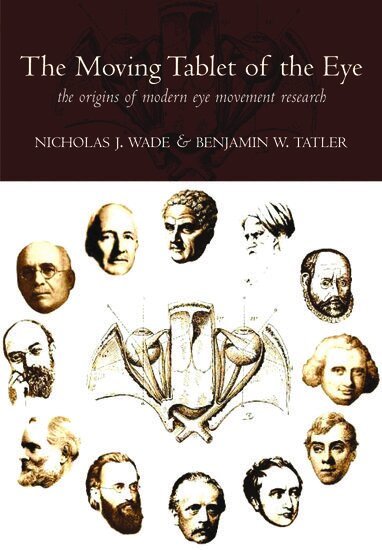
Eye movements are a vital part of our interaction with the world. They play a pivotal role in perception, cognition, and education. Research in this field is now proceeding at a considerable pace and casting new light on how the eyes move and what information we can derive during the frequent and brief periods of fixation. However, the origins of this work are less well known, even though much of our knowledge was derived from this research with far more primitive equipment. This book is unique in tracing the history of eye movement research. It shows how great strides were made in this area before modern recording devices were available, especially in the measurement of nystagmus. When photographic techniques were adapted to measure discontinuous eye movements, from about 1900, many of the issues that are now basic to modern research were then investigated. One of the earliest cognitive tasks examined was reading, and it remains in the vanguard of contemporary research. Modern researchers in this field will be astonished at the subtleties of these early experimental studies and the ingenuity of interpretations that were advanced one and even two centuries ago. Though physicians often carried out the original eye movement research, later on it was pursued by psychologists - it is within contemporary neuroscience that we find these two strands reunited. Anyone interested in the origins of psychology and neuroscience will find much to stimulate and surprise them in this valuable new work.
1 078 kr
Skickas inom 5-8 vardagar
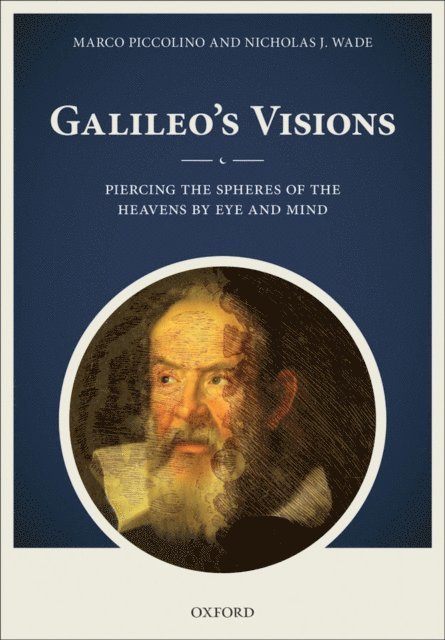
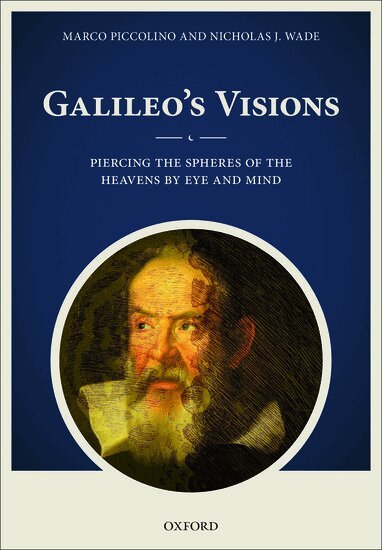
Galileo is known as a pioneer of science - especially of mechanics and astronomy - but far less attention has been paid to his work on the senses generally, and more specifically on vision. In this book, two experts on the history of science look at the novel ways in which Galileo looked at the heavens through his telescope, and, in the process, emphasised the importance of contrast phenomena and visual resolution for all observations. He also described the senses and perception in terms that found an echo in doctrines advanced by nineteenth century sensory physiologists. In a fascinating and accessible style, Marco Piccolino and Nick Wade analyse the scientific and philosophical work of Galileo Galilei from the particular viewpoint of his approach to the senses (and especially vision) as a means of acquiring trustworthy knowledge about the constitution of the world. For Galileo evidence from the senses was potentially ambiguous, hence reliable information capable of penetrating the complexity of reality could only be obtained by interpreting the sensory data critically. The philosophical background of Galileo's attitude to the senses was his awareness that nature had not developed a specific language aimed at communicating with senses generally and human senses in particular. Galileo's analysis of the senses corresponded closely to a fundamental tenet of modern sensory physiology and psychophysics - the absence in the world of specific sensory signals like sounds, colours, tastes, and odours.Fully illustrated throughout, this book is an important contribution to psychology and the vision sciences, but more broadly to our knowledge of a pioneering figure in the history of science.
Destined for Distinguished Oblivion
The Scientific Vision of William Charles Wells (1757–1817)
Inbunden, Engelska, 2002
1 578 kr
Skickas inom 10-15 vardagar
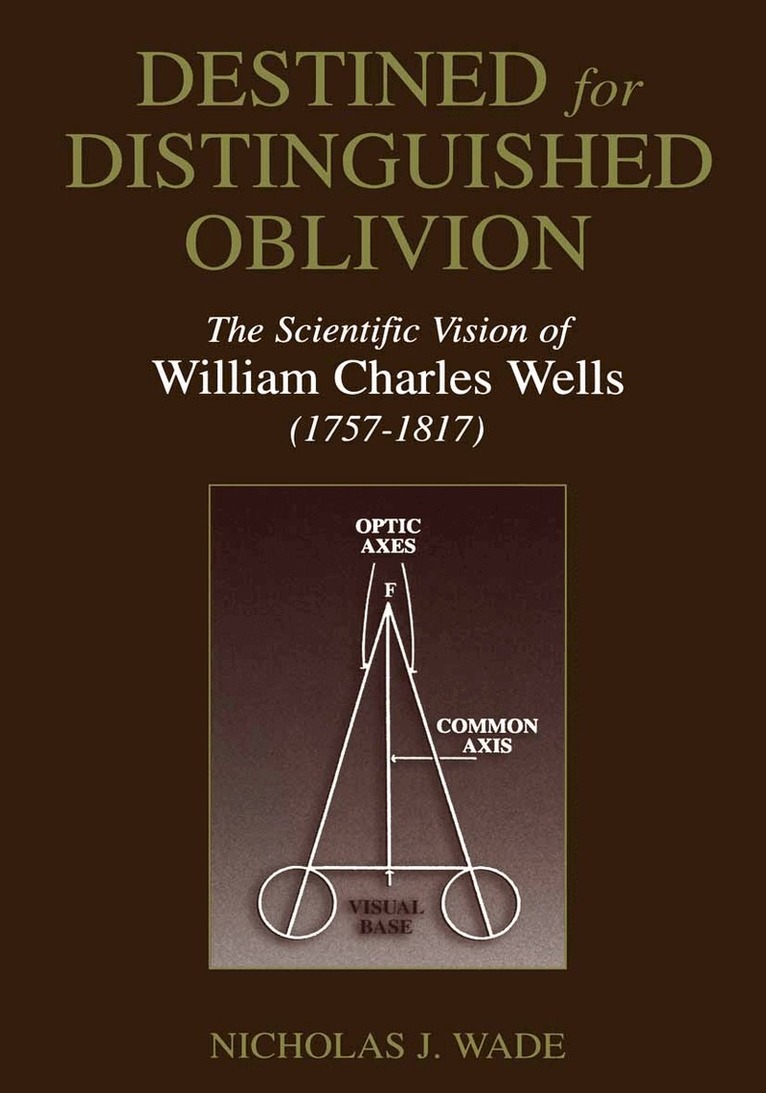
William Charles Wells (1757-1817) was one of the foremost, and forgotten, American scientists of the 18th century. He was trained in medicine and conducted experimental studies in vision and vertigo, he proposed a theory of how dew forms, and he speculated on the mechanism of natural selection. Despite the originality of his enquiries in all these areas, Wells' contributions to scientific discovery have been either neglected or ignored. Although he was born in America, Wells was educated in Scotland and practiced medicine for most of his adult life in London. His practice did not thrive, and he had ample time to conduct his experimental enquiries on a variety of natural phenomena. He was acquainted with the leading medical men of the day, and was admired by them. The emergence of experimental studies of vision can be traced to the adoption of Newtonian methods of observation and experiment, and in their application to space perception by Wells (1792). His initial researches were concerned principally with binocular vision, but he also conducted experimental studies of accommodation, acuity, eye movements, and vertigo.With regard to the last, he entered into a debate with Erasmus Darwin concerning the involvement of eye movements in vertigo. Indeed, Wells should be acknowledged as laying the foundations for modern studies of vestibular function as well as eye movements. The book reprints his essay on single vision with two eyes" (1792) and his own memoir of his life (1818).
842 kr
Skickas inom 10-15 vardagar
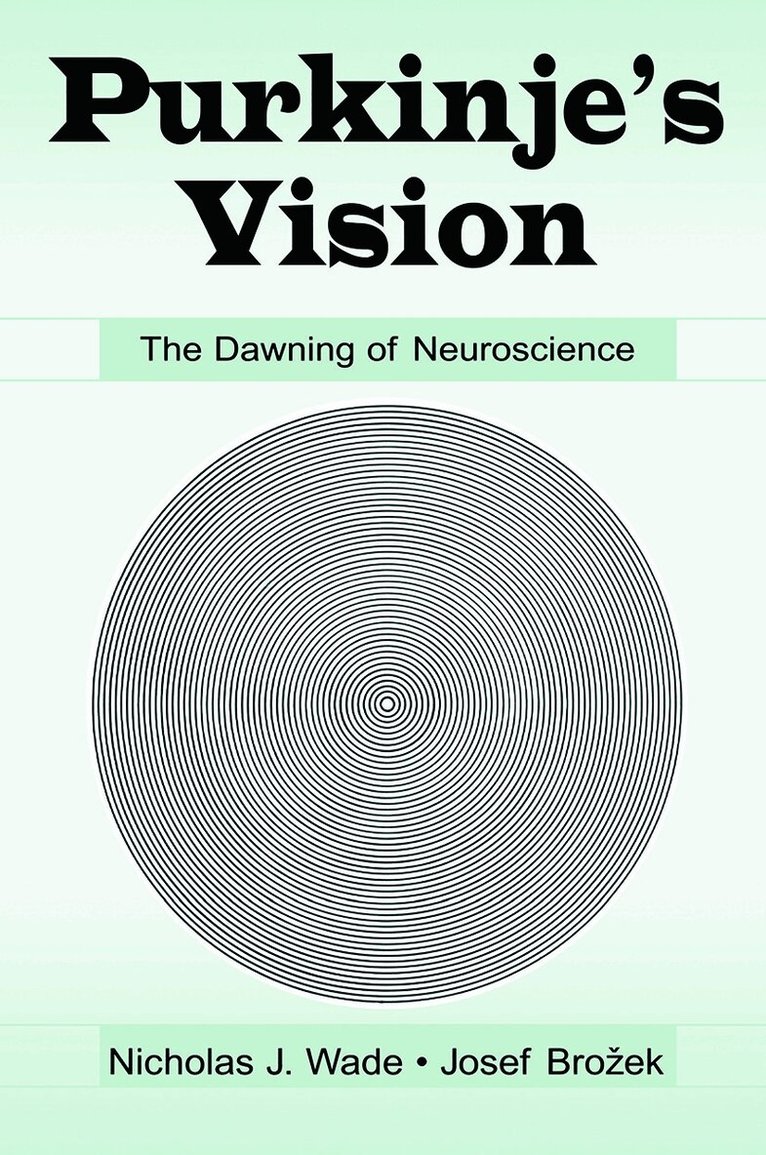
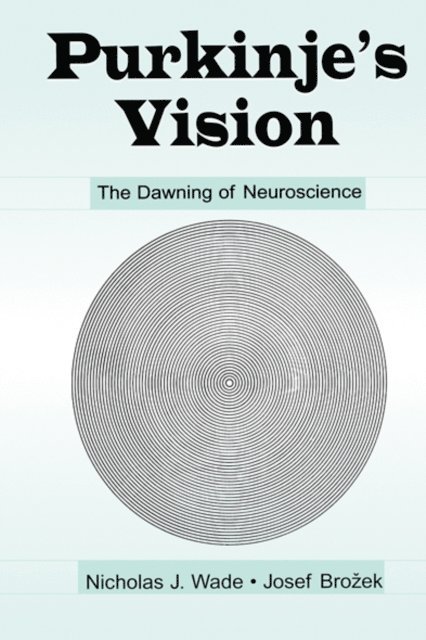
The life of Jan Evangelista Purkinje (1787-1869) has fascinated students from many disciplines. Histologists marvel at his early descriptions of cells; physiologists admire his attempts to relate structure to function; pharmacologists view in awe his heroic experiments on self-administered drugs; forensic scientists acknowledge his role in the use of fingerprints for identification; and Czech patriots salute his awakening of pride in their nation. Yet all these achievements followed his initial enquiries into vision. It is this psychological dimension that fostered this collaboration. As the title suggests, the present volume is bifocal. In the narrow sense it refers to Purkinje's studies of vision, but in its broader view it concerns Purkinje's anticipation of neuroscience. Purkinje provided evidence to support both its cellular and its conceptual base. At the cellular level his acute vision is immortalized within our bodies. At the conceptual level, he sought to relate subjective phenomena to their objective underpinnings--to link psychology to physiology. Vision provides a bond that unites psychology and physiology, and it is this bond that was strengthened by Purkinje's enquiries. The authors have tried to provide a context in which Purkinje's descriptions of visual phenomena can be placed. In some cases this exposes clear precursors of research for which Purkinje has been credited. In others, there was nothing to suggest the phenomena that he exposed. The book translates Purkinje's initial masterpiece on subjective vision and places it in the context of emerging views of neuroscience.
2 012 kr
Skickas inom 10-15 vardagar
The life of Jan Evangelista Purkinje (1787-1869) has fascinated students from many disciplines. Histologists marvel at his early descriptions of cells; physiologists admire his attempts to relate structure to function; pharmacologists view in awe his heroic experiments on self-administered drugs; forensic scientists acknowledge his role in the use of fingerprints for identification; and Czech patriots salute his awakening of pride in their nation. Yet all these achievements followed his initial enquiries into vision. It is this psychological dimension that fostered this collaboration. As the title suggests, the present volume is bifocal. In the narrow sense it refers to Purkinje's studies of vision, but in its broader view it concerns Purkinje's anticipation of neuroscience. Purkinje provided evidence to support both its cellular and its conceptual base. At the cellular level his acute vision is immortalized within our bodies. At the conceptual level, he sought to relate subjective phenomena to their objective underpinnings--to link psychology to physiology. Vision provides a bond that unites psychology and physiology, and it is this bond that was strengthened by Purkinje's enquiries. The authors have tried to provide a context in which Purkinje's descriptions of visual phenomena can be placed. In some cases this exposes clear precursors of research for which Purkinje has been credited. In others, there was nothing to suggest the phenomena that he exposed. The book translates Purkinje's initial masterpiece on subjective vision and places it in the context of emerging views of neuroscience.
Destined for Distinguished Oblivion
The Scientific Vision of William Charles Wells (1757–1817)
Häftad, Engelska, 2012
1 625 kr
Skickas inom 10-15 vardagar
My fIrst encounter with the name of William Charles Wells, over twenty years ago, was an oblique reference to his Essay upon single vision that Wheatstone (1838) made in a classical article on binocular vision. The reference was enigmatic because it stated that few had paid attention to Wells' theory of visual direction, while doing little to infonn the reader of its novelty. I was fortunate in having the excellent facility of the Rare Books and Manuscripts Department of the Library at the University of St. Andrews near at hand, so that I could cousult a copy of Wells' monograph. However, I was not aware of the full import of its contents until Hiroshi Ono visited Dundee from York University, Ontario, in 1980. Hiroshi had previously fonnalised the principles of binocular visual direction that Hering (1879) had proposed. He returned one day from St. Andrews, having read Wells' Essay upon single vision, amazed to have found that Wells had perfonned similar experiments and reached similar conclusions to Hering. Hiroshi Ono has done much to bring Wells' work on binocular single vision to the notice of visual scientists, although its reception has not been without opposition. As I read more of Wells' work on vision I became aware of its breadth as well as its depth. In addition to his essay on binocular single vision, he wrote about and conducted experiments on accommodation, visual acuity, visual persistence, and vertigo.