History of Philosophy - Böcker
Visar alla böcker i serien History of Philosophy. Handla med fri frakt och snabb leverans.
2 produkter
2 produkter
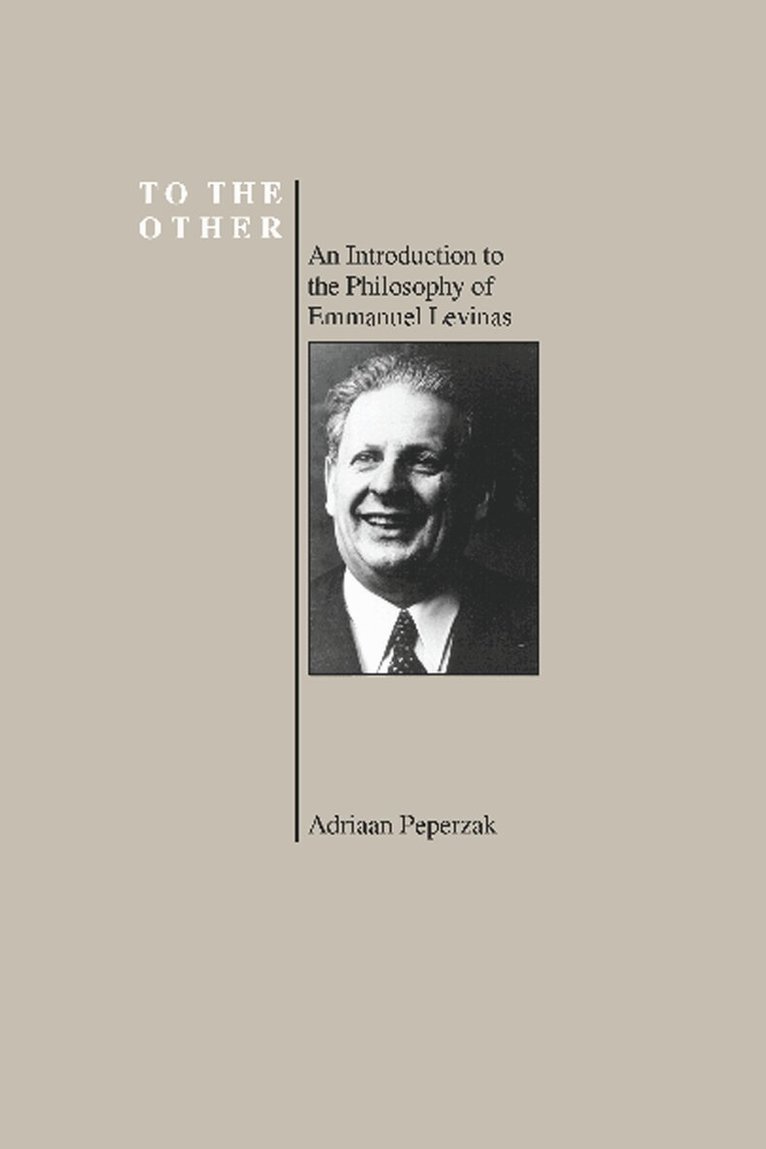
To the Other
An Introduction to the Philosophy of Emmanuel Levinas (Purdue University Series in the History of Philosophy)
Häftad, Engelska, 2005
234 kr
Skickas inom 10-15 vardagar
The fruit of the author's many courses on Emmanuel Levinas in Europe and the United States, this study is a clear introduction for graduate students and scholars who are not yet familiar with Levinas's difficult but exceptionally important oeuvre. After a first chapter on the existential background and the key issues of his thought, chapters 2, 3, and 4 concentrate on and include a short text, "Philosophy and the idea of the Infinite," which contains the program of Levinas's entire oeuvre. Chapter 5 is a companion to the reading of Levinas's first opus magnum, Totality and the Infinite. It analyzes the structure of this book and shows how its questions and answers adhere together. "Through phenomenology toward a saying beyond phenomena and essence" could be the summary of Levinas's attempt to think, with and against Martin Heidegger, the otherness of the Other. This is brought out even more clearly in his second opus magnum, Otherwise Than Being or Beyond Essence, whose significance is shown in chapter 6. A bibliography is added to facilitate further study.
261 kr
Skickas inom 10-15 vardagar
Soren Kierkegaard (1818-55) is perhaps best known for his existentialism, and his critique of the Western metaphysical tradition makes him a religiously committed postmodernist. Becoming a Self provides a reader's guide to the book often taken to be Kierkegaard's most important contribution to philosophy and theology. Merold Westphal includes the portion of Kierkegaard's text that develops his infamous thesis that truth is subjectivity, and offers a dose reading of the entire text of Postscript. In addition, he locates the text in the larger authorship of Kierkegaard, with special attention to the theory of stages or existence spheres; in the debate with Hegel, which is one of its most distinctive features; and in the conversations that make up contemporary postmodern philosophy. While postmodernism is usually thought to be inherently secular, Kierkegaard's pseudonym, Johannes Climacus, shows us what a variety of postmodern insights might look like if appropriated by religious thought. He tries to show that the demise of classical paradigms of selfhood do not require the abandonment of subjectivity and inwardness altogether, and that a decentered self can still be a responsible self. This volume continues Westphal's attempt to show that the individualism and "irrationalism" that have for so long been associated with Kierkegaard's thought are not the abandonment of community and thoughtfulness but powerful protests against major pathologies of complacent modernity. In this light, Kierkegaard's thought can be seen as a non-Marxist form of ideology critique.