Institute for Human Sciences Vienna Lecture Series - Böcker
Visar alla böcker i serien Institute for Human Sciences Vienna Lecture Series. Handla med fri frakt och snabb leverans.
4 produkter
4 produkter
Del 1 - Institute for Human Sciences Vienna Lecture Series
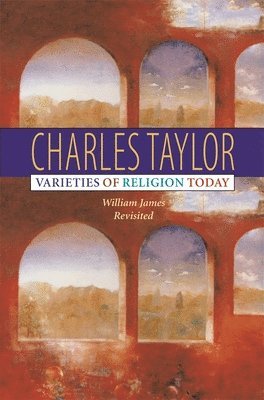
Varieties of Religion Today
William James Revisited
Häftad, Engelska, 2003
296 kr
Skickas inom 10-15 vardagar
“Varieties of Religion Today is a provocative, witty, and worthy conversation with James’s timeless work.” —Publishers WeeklyA hundred years after William James delivered the celebrated lectures that became The Varieties of Religious Experience, one of the foremost thinkers in the English-speaking world returns to the questions posed in James’s masterpiece to clarify the circumstances and conditions of religion in our day. An elegant mix of the philosophy and sociology of religion, Charles Taylor’s powerful book maintains a clear perspective on James’s work in its historical and cultural contexts, while casting a new and revealing light upon the present. Lucid, readable, and dense with ideas that promise to transform current debates about religion and secularism, Varieties of Religion Today is much more than a revisiting of James‘s classic. Rather, it places James’s analysis of religious experience and the dilemmas of doubt and belief in an unfamiliar but illuminating context, namely the social horizon in which questions of religion come to be presented to individuals in the first place. Taylor begins with questions about the way in which James conceives his subject, and shows how these questions arise out of different ways of understanding religion that confronted one another in James‘s time and continue to do so today. Evaluating James’s treatment of the ethics of belief, he goes on to develop an innovative and provocative reading of the public and cultural conditions in which questions of belief or unbelief are perceived to be individual questions. What emerges is a remarkable and penetrating view of the relation between religion and social order and, ultimately, of what “religion” means.
Del 2 - Institute for Human Sciences Vienna Lecture Series
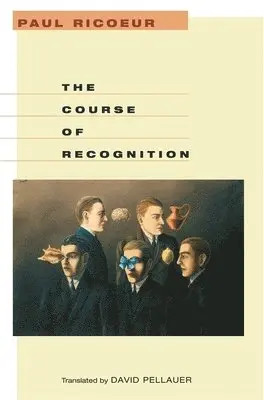
Course of Recognition
Häftad, Engelska, 2007
258 kr
Skickas inom 7-10 vardagar
Recognition, though it figures profoundly in our understanding of objects and persons, identity and ideas, has never before been the subject of a single, sustained philosophical inquiry. This work, by one of contemporary philosophy’s most distinguished voices, pursues recognition through its various philosophical guises and meanings—and, through the “course of recognition,” seeks to develop nothing less than a proper hermeneutics of mutual recognition.Originally delivered as lectures at the Institute for the Human Sciences at Vienna, the essays collected here consider recognition in three of its forms. The first chapter, focusing on knowledge of objects, points to the role of recognition in modern epistemology; the second, concerned with what might be called the recognition of responsibility, traces the understanding of agency and moral responsibility from the ancients up to the present day; and the third takes up the problem of recognition and identity, which extends from Hegel’s discussion of the struggle for recognition through contemporary arguments about identity and multiculturalism. Throughout, Paul Ricoeur probes the significance of our capacity to recognize people and objects, and of self-recognition and self-identity in relation to the gift of mutual recognition. Drawing inspiration from such literary texts as the Odyssey and Oedipus at Colonus, and engaging some of the classic writings of the Continental philosophical tradition—by Kant, Hobbes, Hegel, Augustine, Locke, and Bergson—The Course of Recognition ranges over vast expanses of time and subject matter and in the process suggests a number of highly insightful ways of thinking through the major questions of modern philosophy.
Del 3 - Institute for Human Sciences Vienna Lecture Series
Does Ethics Have a Chance in a World of Consumers?
Häftad, Engelska, 2009
258 kr
Skickas inom 7-10 vardagar
Zygmunt Bauman is one of the most admired social thinkers of our time. Once a Marxist sociologist, he has surrendered the narrowness of both Marxism and sociology, and dares to write in language that ordinary people can understand—about problems they feel ill equipped to solve. This book is no dry treatise but is instead what Bauman calls “a report from a battlefield,” part of the struggle to find new and adequate ways of thinking about the world in which we live. Rather than searching for solutions to what are perhaps the insoluble problems of the modern world, Bauman proposes that we reframe the way we think about these problems. In an era of routine travel, where most people circulate widely, the inherited beliefs that aid our thinking about the world have become an obstacle. Bauman seeks to liberate us from the thinking that renders us hopeless in the face of our own domineering governments and threats from unknown forces abroad. He shows us we can give up belief in a hierarchical arrangement of states and powers. He challenges members of the “knowledge class” to overcome their estrangement from the rest of society. Gracefully, provocatively, Bauman urges us to think in new ways about a newly flexible, newly challenging modern world. As Bauman notes, quoting Vaclav Havel, “hope is not a prognostication.” It is, rather, alongside courage and will, a mundane, common weapon that is too seldom used.
Del 4 - Institute for Human Sciences Vienna Lecture Series
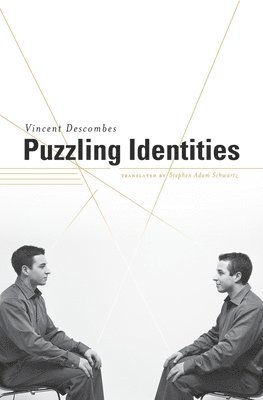
Puzzling Identities
Inbunden, Engelska, 2016
435 kr
Skickas inom 10-15 vardagar
As a logical concept, identity refers to one and the same thing. So why, Vincent Descombes asks, do we routinely use “identity” to describe the feelings associated with membership in a number of different communities, as when we speak of our ethnic identity and religious identity? And how can we ascribe the same “identity” to more than one individual in a group? In Puzzling Identities, one of the leading figures in French philosophy seeks to bridge the abyss between the logical meaning of identity and the psychological sense of “being oneself.”Bringing together an analytic conception of identity derived from Gottlob Frege with a psychosocial understanding stemming from Erik Erikson, Descombes contrasts a rigorously philosophical notion of identity with ideas of collective identity that have become crucial in contemporary cultural and political discourse. He returns to an argument of ancient Greek philosophy about the impossibility of change for a material individual. Distinguishing between reflexive and expressive views of “being oneself,” he shows the connections between subjective identity and one’s life and achievements. We form profound attachments to the particular communities by which we define ourselves. At the same time, becoming oneself as a modern individual requires a process of disembedding oneself from one’s social milieu. This is how undergoing a crisis of identity while coming of age has become for us a normal stage in human life.Puzzling Identities demonstrates why a person has more than one answer to the essential question “Who am I?”