Institutions of American Democracy - Böcker
Visar alla böcker i serien Institutions of American Democracy. Handla med fri frakt och snabb leverans.
6 produkter
6 produkter
845 kr
Skickas inom 5-8 vardagar
From curriculum standards and testing to school choice and civic learning, issues in American education are some of the most debated in the United States. The Public Schools, a collection of essays by the nation's leading education scholars and professionals, is designed to inform the debate and stimulate change.In association with the Annenberg Foundation Trust at Sunnylands and the Annenberg Public Policy Center at the University of Pennsylvania, The Public Schools is the first in a series of books commissioned to enhance public understanding of the nature and function of democratic institutions. A national advisory board--including, among others, Nancy Kassebaum Baker, David Boren, John Brademas, Ellen Condliffe Lagemann, David Gergen, and Lee Hamilton--will guide the vision of the project, which includes future volumes on the press and the three branches of government.Each essay in The Public Schools addresses essential questions for policymakers, educators, and anyone committed to public education. What role should public education play in a democracy? How has that role changed through American history? Have the schools lost sight of their responsibility to teach civics and citizenship? How are current debates about education shaping the future of this democratic institution?Among the contributors are William Galston, Director of the Institute for Philosophy and Public Policy at the University of Maryland;Clarence Stone, Professor in the Department of Government and Politics at the University of Maryland - College Park and editor of Changing Urban Education and Regime Politics: Governing Atlanta, 1946-1988 (University Press of Kansas, 1998).; Susan Moore Johnson, Pforzheimer Professor of Education in Learning and Teaching, Harvard University; Michael Johanek, Executive Director of K-12 Professional Development, College Board; Kathy Simon, co-executive director of the Coalition for Essential Schools and author of Moral Questions in the Classroom (Yale University Press, 2001); and Jennifer Hochschild, Professor of Government and Professor of Afro-American Studies at Harvard University and author of Facing Up to the American Dream: Race, Class, and the Soul of the Nation (Princeton University Press, 1995).
895 kr
Skickas inom 5-8 vardagar
The presidency and the agencies of the executive branch are deeply interwoven with other core institutions of American government and politics. While the framers of the Constitution granted power to the president, they likewise imbued the legislative and judicial branches of government with the powers necessary to hold the executive in check. The Executive Branch, edited by Joel D. Aberbach and Mark A. Peterson, examines the delicate and shifting balance among the three branches of government, which is constantly renegotiated as political leaders contend with the public's paradoxical sentiments-yearning for strong executive leadership yet fearing too much executive power, and welcoming the benefits of public programs yet uneasy about, and indeed often distrusting, big government. The Executive Branch, a collection of essays by some of the nation's leading political scientists and public policy scholars, examines the historical emergence and contemporary performance of the presidency and bureaucracy, as well as their respective relationships with the Congress, the courts, political parties, and American federalism. Presidential elections are defining moments for the nation's democracy-by linking citizens directly to their government, elections serve as a mechanism for exercising collective public choice. After the election, however, the work of government begins and involves elected and appointed political leaders at all levels of government, career civil servants, government contractors, interest organizations, the media, and engaged citizens. The essays in this volume delve deeply into the organizations and politics that make the executive branch such a complex and fascinating part of American government. The volume provides an assessment from the past to the present of the role and development of the presidency and executive branch agencies, including analysis of the favorable and problematic strategies, and personal attributes, that presidents have brought to the challenge of leadership. It examines the presidency and the executive agencies both separately and together as they influence-or are influenced by-other major institutions of American government and politics, with close attention to how they relate to civic participation and democracy.
356 kr
Skickas inom 5-8 vardagar
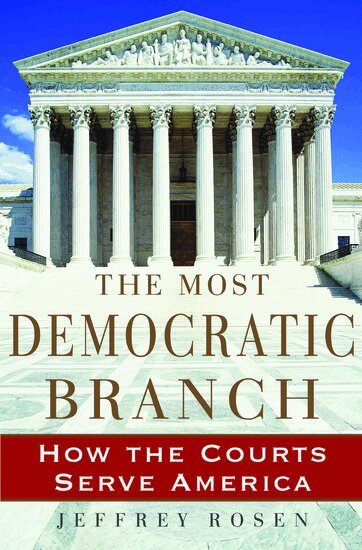
Many critics attack federal judges as anti-democratic elitists, activists out of step with the mainstream of American thought. But others argue that judges should stand alone as the ultimate guardians of American values, placing principle before the views of the people. In The Most Democratic Branch, Jeffrey Rosen disagrees with both assertions. Contrary to what interest groups may claim, he contends that, from the days of John Marshall right up to the present, the federal courts by and large have reflected the opinions of the mainstream. More important, he argues that the Supreme Court is most successful when it defers to the constitutional views of the American people, as represented most notably by Congress and the Presidency. And on the rare occasion when they departed from the consensus, the result has often been a disaster. To illustrate, Rosen provides a penetrating look at some of the most important Supreme Court cases in American history--cases involving racial equality, affirmative action, abortion, gay rights and gay marriage, the right to die, electoral disputes, and civil liberties in wartime. Rosen shows that the most notorious constitutional decisions in American history--the ones that have been most strenuously criticized, such as Dred Scott or Roe v. Wade--have gone against mainstream opinion. By contrast, the most successful decisions--from Marbury v. Madison to Brown v. Board of Education--have avoided imposing constitutional principles over the wishes of the people. Rosen concludes that the judiciary works best when it identifies the constitutional principles accepted by a majority of Americans, and enforces them unequivocally as fundamental law. Jeffrey Rosen is one of the most respected legal experts writing today, a regular contributor to The New York Times Magazine and the Legal Affairs Editor of The New Republic. The provocative arguments that he puts forth here are bound to fuel heated debate at a time when the federal judiciary is already the focus of fierce criticism.
485 kr
Skickas inom 5-8 vardagar
The presidency and the agencies of the executive branch are deeply interwoven with other core institutions of American government and politics. While the framers of the Constitution granted power to the president, they likewise imbued the legislative and judicial branches of government with the powers necessary to hold the executive in check. The Executive Branch, edited byJoel D. Aberbach and Mark A. Peterson, examines the delicate and shifting balance among the three branches of government, which is constantly renegotiated as political leaders contend with the public's paradoxical sentiments-yearning for strong executive leadership yet fearing too much executive power, and welcoming the benefits of public programs yet uneasy about, and indeed often distrusting, big government. The Executive Branch, a collection of essays by some of the nation's leading political scientists and public policy scholars, examines the historical emergence and contemporary performance of the presidency and bureaucracy, as well as their respective relationships with the Congress, the courts, political parties, and American federalism. Presidential elections are defining moments for the nation's democracy-by linking citizens directly to their government, elections serve as a mechanism for exercising collective public choice. After the election, however, the work of government begins and involves elected and appointed political leaders at all levels of government, career civil servants, government contractors, interest organizations, the media, and engaged citizens. The essays in this volume delve deeply into the organizations and politics that make the executive branch such a complex and fascinating part of American government. The volume provides an assessment from the past to the present of the role and development of the presidency and executive branch agencies, including analysis of the favorable and problematic strategies, and personal attributes, that presidents have brought to the challenge of leadership. It examines the presidency and the executive agencies both separately and together as they influence-or are influenced by-other major institutions of American government and politics, with close attention to how they relate to civic participation and democracy.
175 kr
Skickas inom 5-8 vardagar
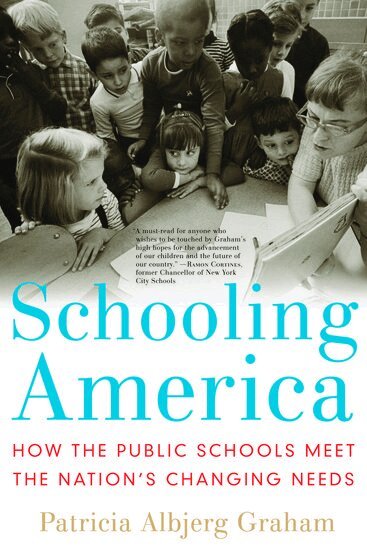
Patricia Graham is one of America's most esteemed historians of education, formerly Dean of Harvard's Graduate School of Education and Director of the National Institute of Education. In this informative volume, Graham offers a vibrant history of American education in the last century.Drawing on a wide array of sources, from government reports to colorful anecdotes, Graham skillfully illustrates Americans' changing demands for our schools, and how schools have responded by providing what critics want, though never as completely or as quickly as they would like. In 1900, as waves of immigrants swept the nation, the American public wanted schools to assimilate students into American life, combining the basics of English and arithmetic with emphasis on patriotism, hard work, fair play and honesty. In the 1920s, the focus shifted from schools serving a national need to serving individual needs; education was to help children adjust to life. By 1954 the emphasis moved to access, particularly for African-American children to desegregated classrooms, but also access to special programs for the gifted, the poor, the disabled, and non-English speakers. Now Americans want achievement for all, defined as higher test scores. The public largely ignored colleges until after World War II when research received international recognition and enrollments grew. Throughout the narrative, we meet the passionate educators, scholars and journalists who drove particular agendas, and we also meet Graham's own family, starting with her immigrant father's first day of school and moving through her experiences as a teacher.Invaluable background in the ongoing debate on education in the United States, this book offers an insightful look at what the public has sought from its educational institutions, what educators have delivered, and what remains to be done.
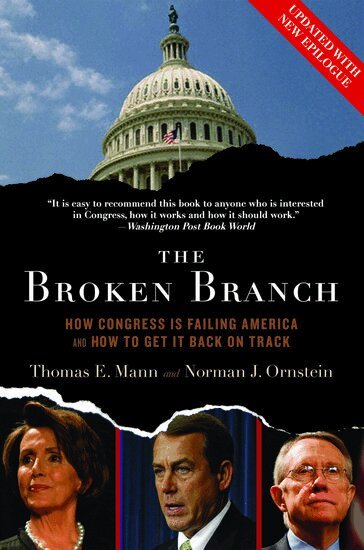
The Broken Branch
How Congress Is Failing America and How to Get It Back on Track
Häftad, Engelska, 2008
170 kr
Skickas inom 5-8 vardagar
In this book, the third of the five trade books for the Institutions of Democracy project, Thomas Mann and Norman Ornstein argue that congress faces a crisis of self-identity and role in the American Constitutional System. Congress is supposed to be the driving force behind policy in the nation and a vital check and balance against the executive, but it is neither, particularly under the current administration. As with other books in this series Mann and Ornstein will examine the first principles of the intended role of the legislative branch, look throughout history at how congress has fulfilled this role, and consider what can be done to improve it and bring it back to its original purpose.