Jaakko Hintikka Selected Papers - Böcker
Visar alla böcker i serien Jaakko Hintikka Selected Papers. Handla med fri frakt och snabb leverans.
14 produkter
14 produkter
1 588 kr
Skickas inom 10-15 vardagar
Frequently, a genuine understanding of a thinker's ideas is possible only by following them further than he did himself. Wittgenstein's Viennese contemporary Karl Kraus spoke in a similar context of one-and-a-half truths in contradistinction to half-truths. In this volume of essays, Jaakko Hintikka examines the two grand visions concerning the interrelations of language, self and the world that guided Wittgenstein's thought at the different stages of his philosophical development. He seeks to show how one of them, the so-called picture theory of language, was in reality a combination of several independent assumptions, while the other, the idea of language-games as the vehicles of meaning, was the end product of an intriguing development. Hintikka asserts that many of Wittgenstein's best-known ideas can, and must, be understood as defences or rationalizations of his overall visions. In several essays, Wittgenstein's ideas are illuminated through comparisons with other philosophers, including Russell, Husserl and Carnap.
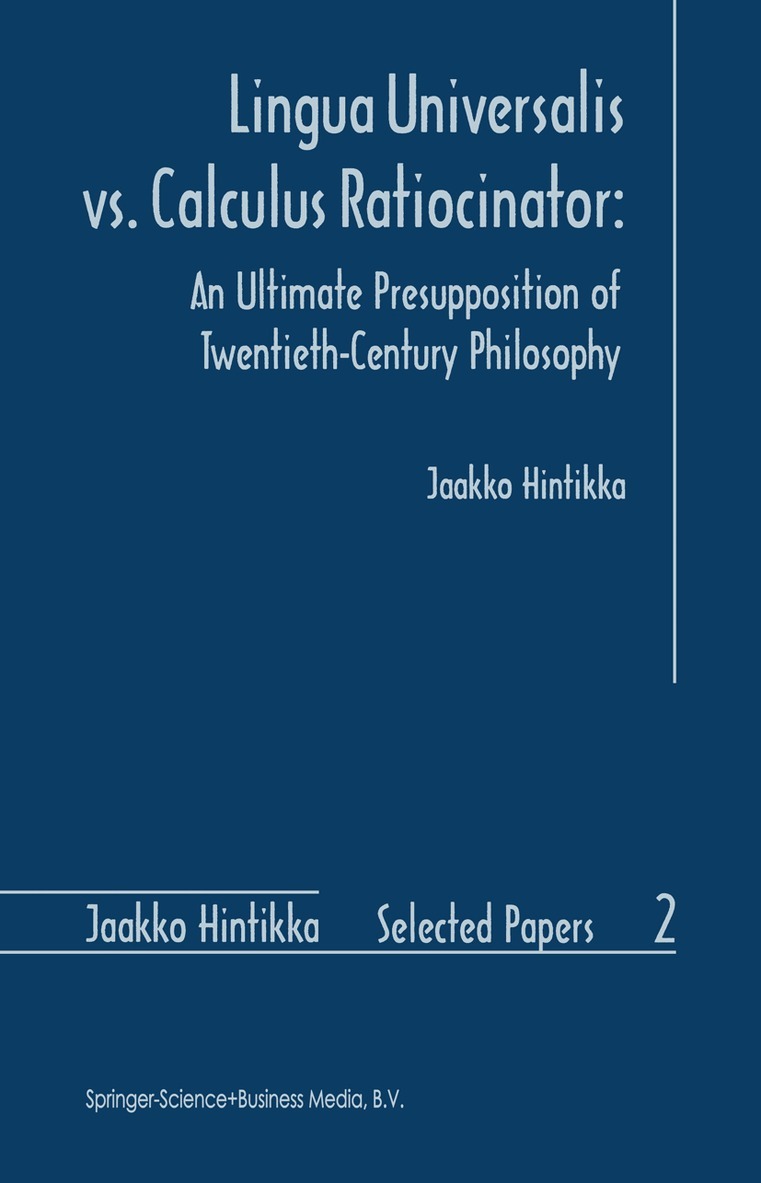
Lingua Universalis vs. Calculus Ratiocinator:
An Ultimate Presupposition of Twentieth-Century Philosophy
Inbunden, Engelska, 1996
2 325 kr
Skickas inom 10-15 vardagar
The essays collected here explore a fundamental contrast between two overall visions of language and its availability to self-examination. They can be characterized as "language as the universal medium" and "language as calculus" (or the model-theoretical view). The former normally includes the ineffability of semantics and a one-world ontology. This contrast has dominated twentieth-century philosophy but has scarcely been acknowledged before. Philosophers examined here from the vantage point of the contrast include Peirce, Frege, Wittgenstein, Carnap, Quine, Husserl and Heidegger. Tarski's famous result concerning the indefinability of truth seems to decide the issue in favor of the universalists. Hintikka nevertheless shows that Tarski's result is inconclusive and that truth can in fact be defined in languages which are in certain respects comparable to ordinary language. This unique volume is a must for every contemporary philosopher and for everyone interested in the semantics of our language.
1 588 kr
Skickas inom 10-15 vardagar
IF WITI'GENSTEIN COULD TALK, COULD WE UNDERSTAND HIM? Perusing the secondary literature on Wittgenstein, I have frequently experienced a perfect Brechtean Entfremdungseffekt. This is interesting, I have felt like saying when reading books and papers on Wittgenstein, but who is the writer talking about? Certainly not Ludwig Wittgenstein the actual person who wrote his books and notebooks and whom I happened to meet. Why is there this strange gap between the ideas of the actual philosopher and the musings of his interpreters? Wittgenstein is talking to us through the posthumous publication of his writings. Why don't philosophers understand what he is saying? A partial reason is outlined in the first essay of this volume. Wittgenstein was far too impatient to explain in his books and book drafts what his problems were, what it was that he was trying to get clear about. He was even too impatient to explain in full his earlier solutions, often merely referring to them casually as it were ina shorthand notation. For one important instance, in The Brown Book, Wittgenstein had explained in some detail what name-object relationships amount to in his view. There he offers both an explanation of what his problem is and an account of his own view illustrated by means of specific examples of language-games. But when he raises the same question again in Philosophical Investigations I, sec.
Del 3 - Jaakko Hintikka Selected Papers
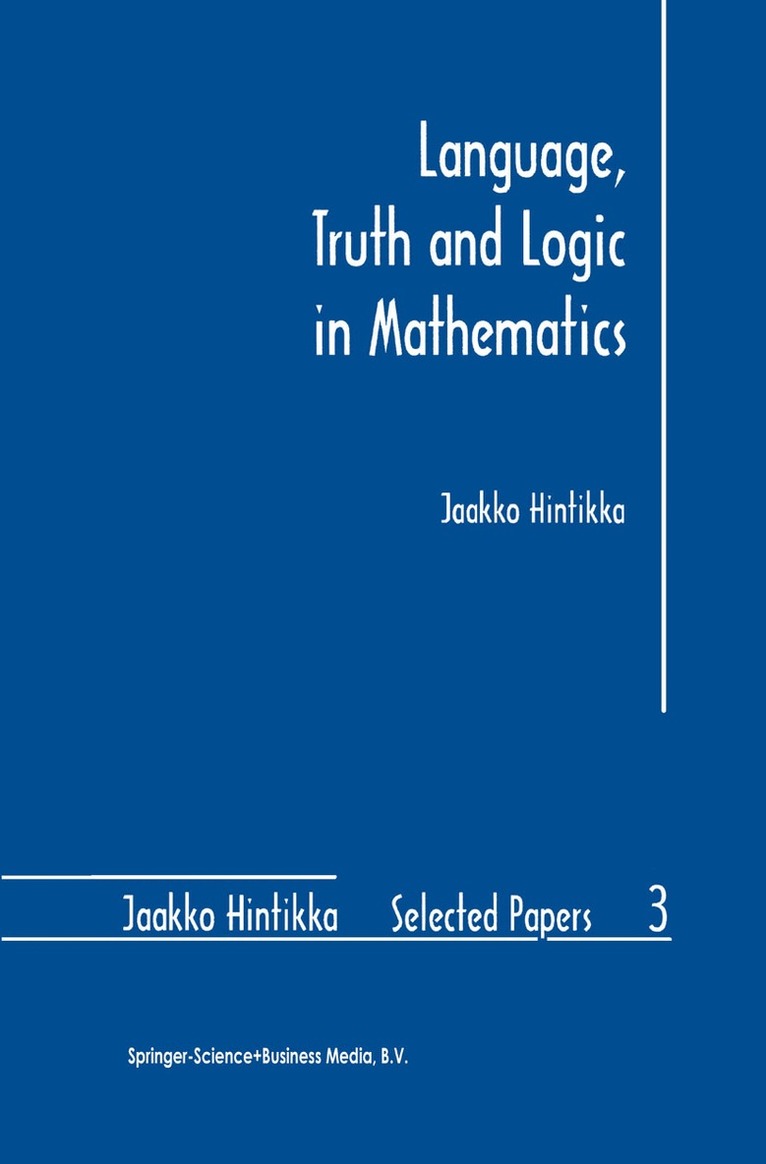
Language, Truth and Logic in Mathematics
Inbunden, Engelska, 1997
1 588 kr
Skickas inom 10-15 vardagar
One can distinguish, roughly speaking, two different approaches to the philosophy of mathematics. On the one hand, some philosophers (and some mathematicians) take the nature and the results of mathematicians' activities as given, and go on to ask what philosophical morals one might perhaps find in their story. On the other hand, some philosophers, logicians and mathematicians have tried or are trying to subject the very concepts which mathematicians are using in their work to critical scrutiny. In practice this usually means scrutinizing the logical and linguistic tools mathematicians wield. Such scrutiny can scarcely help relying on philosophical ideas and principles. In other words it can scarcely help being literally a study of language, truth and logic in mathematics, albeit not necessarily in the spirit of AJ. Ayer. As its title indicates, the essays included in the present volume represent the latter approach. In most of them one of the fundamental concepts in the foundations of mathematics and logic is subjected to a scrutiny from a largely novel point of view. Typically, it turns out that the concept in question is in need of a revision or reconsideration or at least can be given a new twist. The results of such a re-examination are not primarily critical, however, but typically open up new constructive possibilities. The consequences of such deconstructions and reconstructions are often quite sweeping, and are explored in the same paper or in others.
1 588 kr
Skickas inom 10-15 vardagar
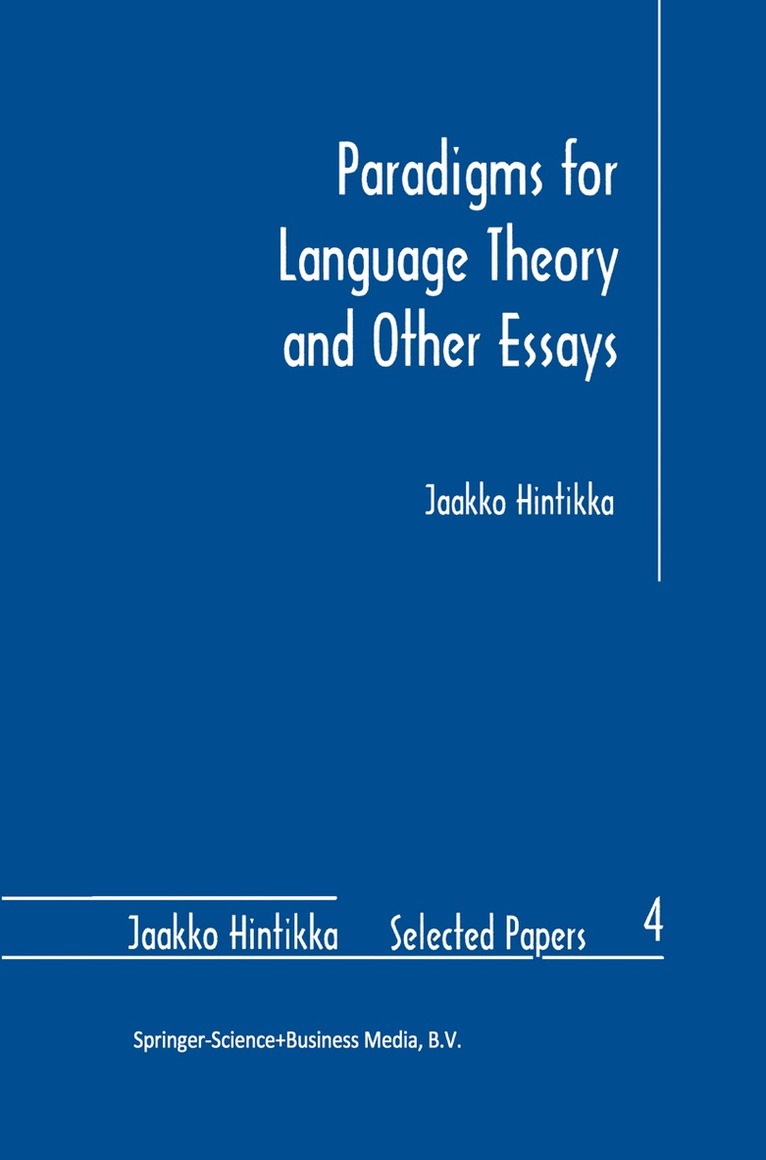
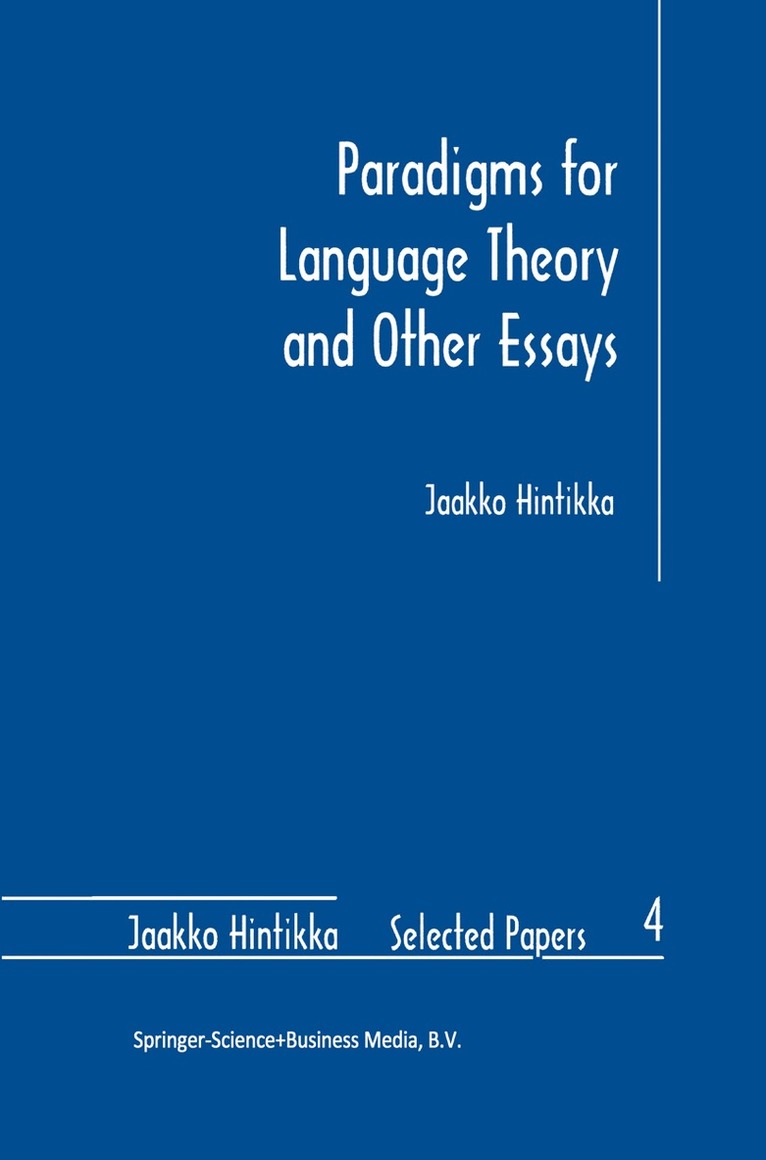
Several central concepts and ideas of language theory are analyzed, criticized and developed in the essays contained in this volume. They include the concept of quantifier and in particular a liberalization of the rules governing the interaction of quantifiers, the ambiguities of the concept of scope, the alleged Frege-Russell ambiguity of words for being, the notion of reference which turns out to be misunderstood by the so-called "new theorists of reference", different modes of identification, the hegemony of generative syntax, recent theories of demonstratives, the relation of verificationist and truth-conditional meaning theories, the notion of metaphor, and differences between alethic and epistemic language-games. A bird's-eye view of current language theory is provided by an examination of the differences between rule-oriented paradigms.
2 115 kr
Skickas inom 10-15 vardagar
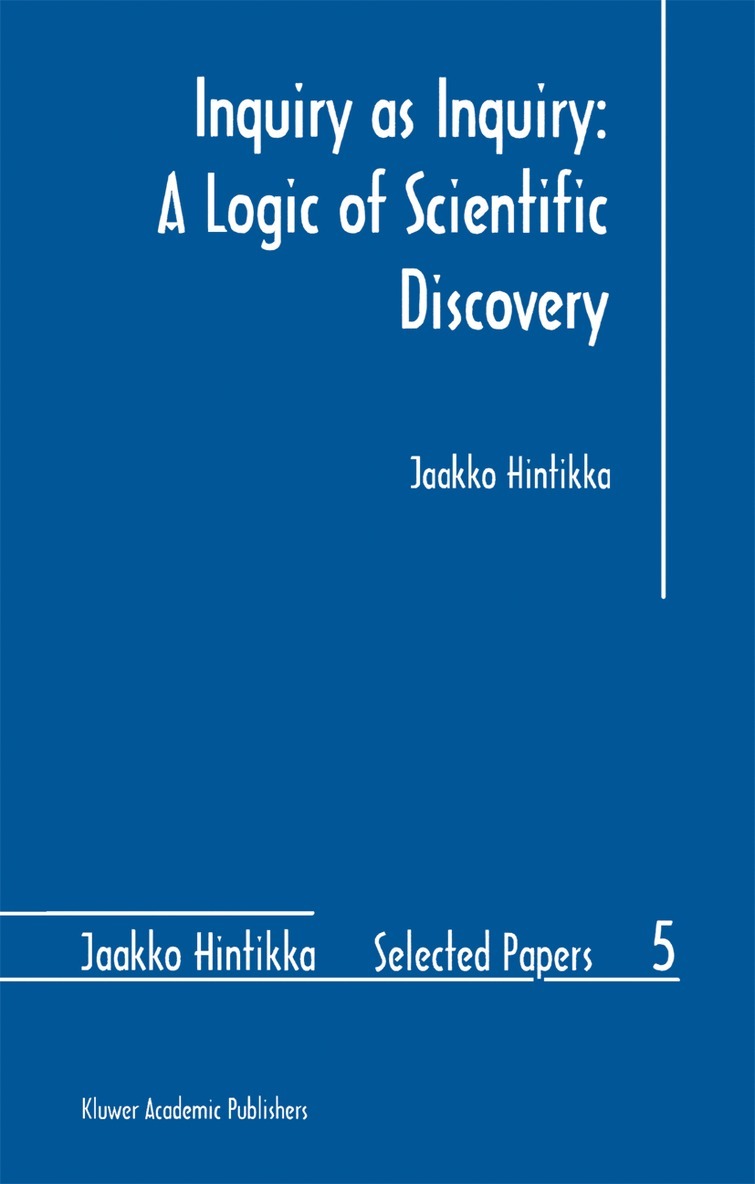
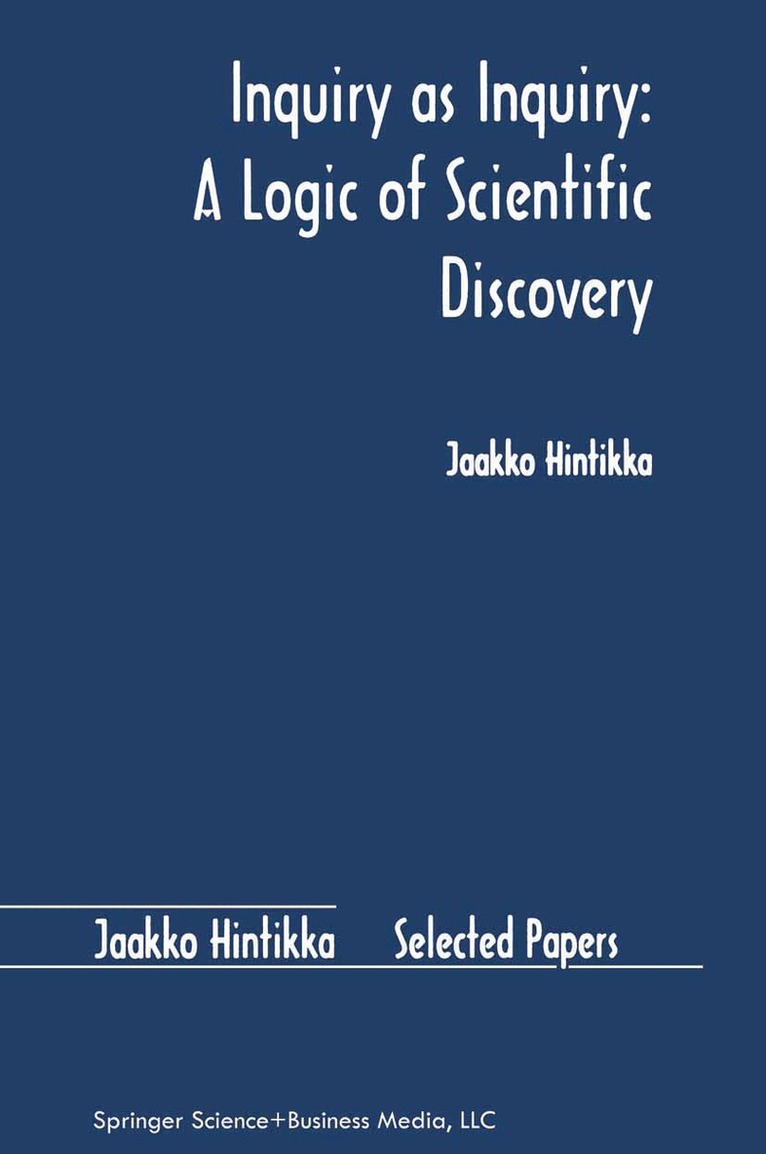
Inquiry in the sense of knowledge-seeking becomes inquiry in the sense of interrogation. Using this new logic, Hintikka establishes a result that will be considered among the fundamental theorems of all epistemology, of the virtual identity of optimal strategies of pure discovery with optimal deductive strategies. Hintikka shows, in fact, how the logic of experimental inquiry can be understood from the interrogative vantage point. Other topics examined include induction (in a forgotten sense that has nevertheless played a role in science), explanation, the incommensurability of theories, theory-ladenness of observations, and identifiability.
2 111 kr
Skickas inom 10-15 vardagar
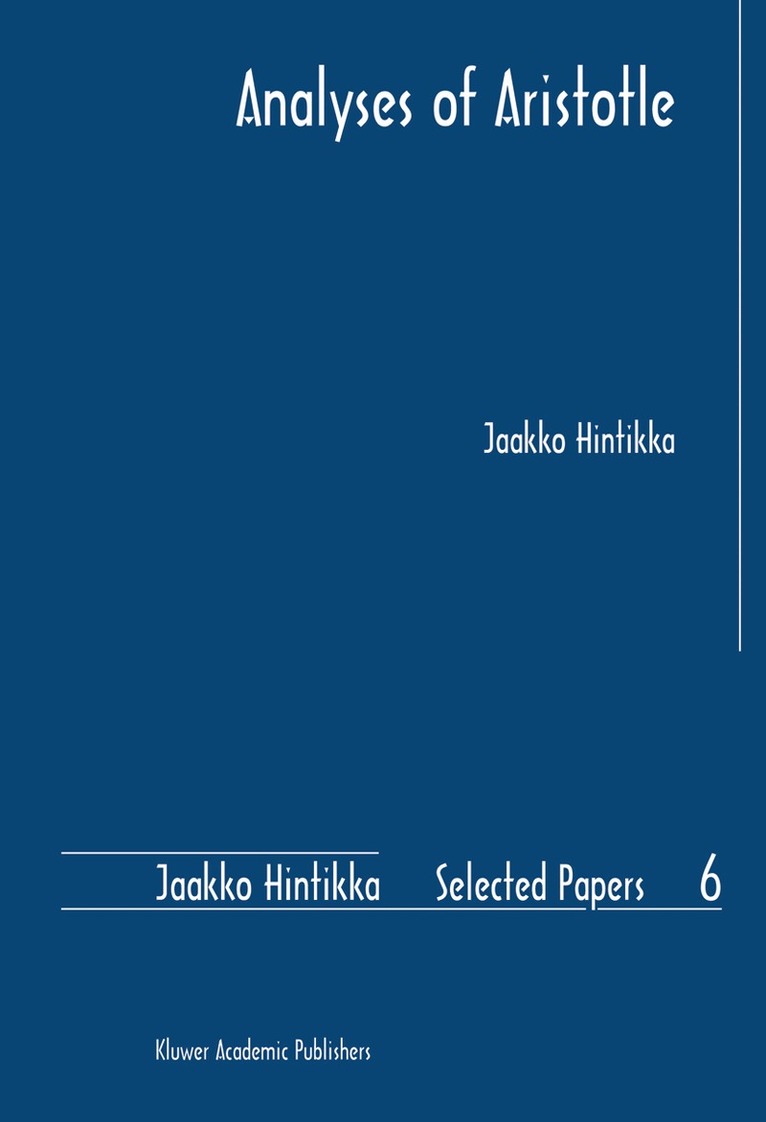
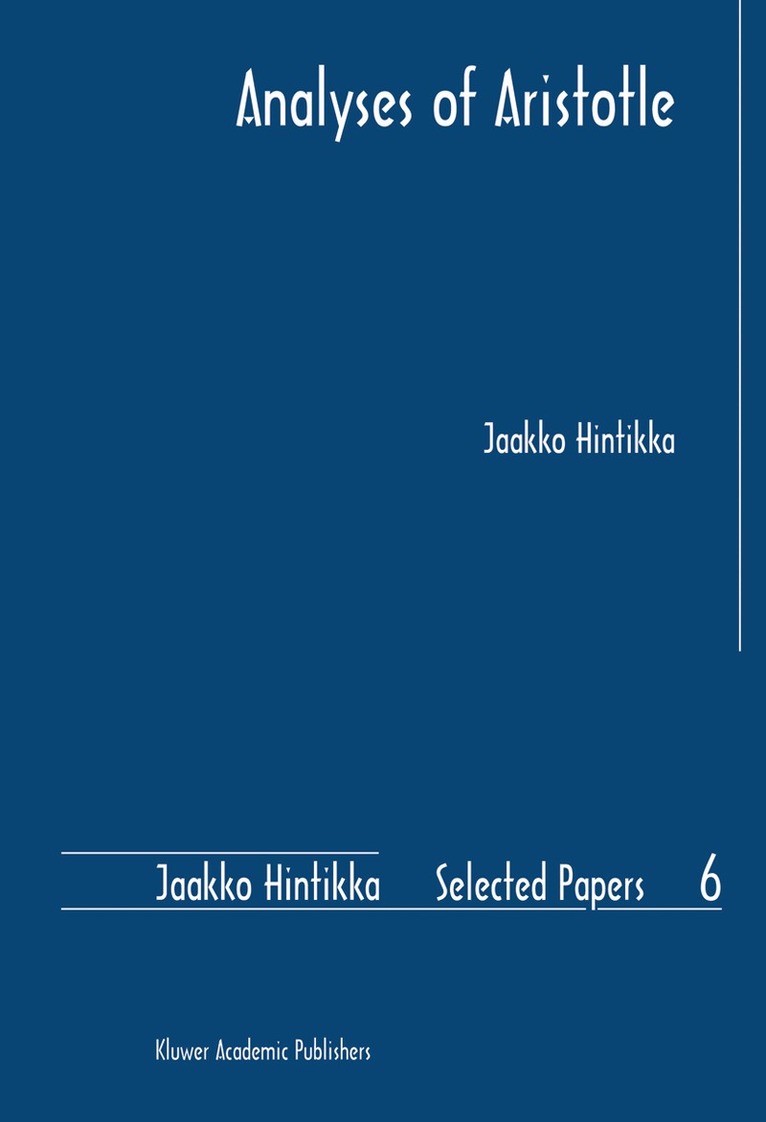
Aristotle thought of his logic and methodology as applications of the Socratic questioning method. In particular, logic was originally a study of answers necessitated by earlier answers. For Aristotle, thought-experiments were real experiments in the sense that by realizing forms in one's mind, one can read off their properties and interrelations. Treating forms as independent entities, knowable one by one, committed Aristotle to his mode of syllogistic explanation. He did not think of existence, predication and identity as separate senses of estin. Aristotle thus serves as an example of a thinker who did not rely on the distinction between the allegedly different Fregean senses, thereby shedding new light on our own conceptual presuppositions. This collection comprises several striking interpretations that Jaakko Hintikka has put forward over the years, constituting a challenge not only to Aristotelian scholars and historians of ideas, but to everyone interested in logic, epistemology or metaphysics and in their history.
3 288 kr
Skickas
Aristotle thought of his logic and methodology as applications of the Socratic questioning method. In particular, logic was originally a study of answers necessitated by earlier answers. For Aristotle, thought-experiments were real experiments in the sense that by realizing forms in one's mind, one can read off their properties and interrelations. Treating forms as independent entities, knowable one by one, committed Aristotle to his mode of syllogistic explanation. He did not think of existence, predication and identity as separate senses of estin. Aristotle thus serves as an example of a thinker who did not rely on the distinction between the allegedly different Fregean senses, thereby shedding new light on our own conceptual presuppositions. This collection comprises several striking interpretations that Jaakko Hintikka has put forward over the years, constituting a challenge not only to Aristotelian scholars and historians of ideas, but to everyone interested in logic, epistemology or metaphysics and in their history.
2 771 kr
Skickas inom 10-15 vardagar
Vol. 1: Ludwig Wittgenstein: Half-Truths and One-and-a-Half-TruthsBecause of his legendary impatience, Wittgenstein's published books are focused on his solutions to his latest problems and consequently often fail to explain not only his earlier solutions but also his problem situation. In the essays collected in this volume, Jaakko Hintikka counteracts the difficulty which this peculiarity of Wittgenstein's poses to his readers by analysing in depth the crucial stages of Wittgenstein's philosophical career and the relation of his ideas to those of other philosophers, especially Russell, Carnap and Husserl, with sometimes surprising results. Vol. 2: Lingua Universalis vs. Calculus RatiocinatorTwentieth-century philosophy has tacitly been dominated by a deep contrast between universalist and model-theoretical visions of language. The role of this contrast is studied here in Peirce, Frege, Wittgenstein, Carnap, Quine, Husserl, Heidegger and in the development of logical theory. Hintikka also develops a new approach to truth-definitions which strongly supports the model-theoretical view.Vol. 3: Language, Truth and Logic in MathematicsThe foundations of mathematics are examined by reference to such crucial concepts as the informational independence of quantifiers, the standard-nonstandard distinction, completeness, computability, parallel processing and the extremality of models.Vol. 4: Paradigms for Language Theory and Other EssaysSeveral of the basic ideas of current language theory are subjected to critical scrutiny and found wanting, including the concept of scope, the hegemony of generative syntax, the Frege-Russell claim that verbs like `is' are ambiguous, and the assumptions underlying the so-called New Theory of Reference. In their stead, new constructive ideas are proposed.Vol. 5: Inquiry as Inquiry: A Logic of Scientific DiscoveryIn the essays collected here, Hintikka both defends and outlines a genuine logic of scientific discovery, the logic of questions and answers. Thus inquiry in the sense of knowledge-seeking becomes inquiry in the sense of interrogation. Using this new logic, Hintikka establishes a result that will undoubtedly be considered the fundamental theorem of all epistemology, viz., the virtual identity of optimal strategies of pure discovery with optimal deductive strategies.Vol. 6: Analyses of AristotleThis collection comprises several striking interpretations of Aristotle's logic and methodology that Jaakko Hintikka has put forward over the years, constituting a challenge not only to Aristotelian scholars and historians of ideas, but to everyone interested in logic, epistemology or metaphysics and in their history.
Lingua Universalis vs. Calculus Ratiocinator:
An Ultimate Presupposition of Twentieth-Century Philosophy
Häftad, Engelska, 2010
2 321 kr
Skickas inom 10-15 vardagar
Twentieth-century philosophy has tacitly been dominated by a deep contrast between universalist and model-theoretical visions of language. The role of this contrast is studied here in Peirce, Frege, Wittgenstein, Carnap, Quine, Husserl, Heidegger and in the development of logical theory. Hintikka also develops a new approach to truth-definitions which strongly supports the model-theoretical view.
Del 3 - Jaakko Hintikka Selected Papers
Language, Truth and Logic in Mathematics
Häftad, Engelska, 2010
1 585 kr
Skickas inom 10-15 vardagar
The foundations of mathematics are examined by reference to such crucial concepts as the informational independence of quantifiers, the standard-nonstandard distinction, completeness, computability, parallel processing and the extremality of models.
1 585 kr
Skickas inom 10-15 vardagar
Several of the basic ideas of current language theory are subjected to critical scrutiny and found wanting, including the concept of scope, the hegemony of generative syntax, the Frege-Russell claim that verbs like `is' are ambiguous, and the assumptions underlying the so-called New Theory of Reference. In their stead, new constructive ideas are proposed.
2 111 kr
Skickas inom 10-15 vardagar
Is a genuine logic of scientific discovery possible? In the essays collected here, Hintikka not only defends an affirmative answer; he also outlines such a logic. It is the logic of questions and answers. Thus inquiry in the sense of knowledge-seeking becomes inquiry in the sense of interrogation. Using this new logic, Hintikka establishes a result that will undoubtedly be considered the fundamental theorem of all epistemology, viz., the virtual identity of optimal strategies of pure discovery with optimal deductive strategies. Questions to Nature, of course, must include observations and experiments. Hintikka shows, in fact, how the logic of experimental inquiry can be understood from the interrogative vantage point. Other important topics examined include induction (in a forgotten sense that has nevertheless played a role in science), explanation, the incommensurability of theories, theory-ladenness of observations, and identifiability.
2 111 kr
Skickas inom 10-15 vardagar
Aristotle thought of his logic and methodology as applications of the Socratic questioning method. In particular, logic was originally a study of answers necessitated by earlier answers. For Aristotle, thought-experiments were real experiments in the sense that by realizing forms in one's mind, one can read off their properties and interrelations. Treating forms as independent entities, knowable one by one, committed Aristotle to his mode of syllogistic explanation. He did not think of existence, predication and identity as separate senses of estin. Aristotle thus serves as an example of a thinker who did not rely on the distinction between the allegedly different Fregean senses, thereby shedding new light on our own conceptual presuppositions. This collection comprises several striking interpretations that Jaakko Hintikka has put forward over the years, constituting a challenge not only to Aristotelian scholars and historians of ideas, but to everyone interested in logic, epistemology or metaphysics and in their history.