Japanese Studies Series - Böcker
Visar alla böcker i serien Japanese Studies Series. Handla med fri frakt och snabb leverans.
4 produkter
4 produkter
2 278 kr
Skickas inom 3-6 vardagar
In this groundbreaking novel, Fumiko Hayashi tells the powerful story of tormented love and one woman's struggle to navigate the cruel realities of postwar Japan. The novel's characters, particularly its resilient heroine Koda Yukiko, find themselves trapped in their own drifting, unable to break out of the morass of indecisiveness. Set in the years during and after World War II, their lives and damaged psyches reflect the confusion of the times in which they live. Floating Clouds follows Yukiko as she moves from the physically lush and beautiful surroundings of Japanese-occupied French Indochina to the desolation and chaos of postwar Japan. Hayashi's spare, affecting novel presents a rare portrait of Japanese colonialism and the harshness of Japan's postwar experience from the perspective of a woman. Its rich cast of characters, drawn from the back alleys of urban Japan and the low rungs of society, offers an unforgettable portrait of Japanese society after the war. The tortured relationship between Yukiko and Tomioka, a minor official with the Department of Agriculture and Forestry, provides the dramatic center of the novel.Yukiko meets Tomioka while working as a typist for the Japanese ministry in Indochina, where they begin their affair. After the war, Tomioka returns to his wife but remains emotionally inscrutable to Yukiko, refusing to break off their relationship. Meanwhile, Yukiko must find her way in a radically changed postwar Japan. When Yukiko and Tomioka's lives once again cross, the two set down a path shaped by their passion and sense of desperation. First published in 1951, Floating Clouds is a classic of modern Japanese literature and was later made into a film by legendary Japanese director Mikio Naruse.
297 kr
Skickas inom 7-10 vardagar
In this groundbreaking novel, Fumiko Hayashi tells the powerful story of tormented love and one woman's struggle to navigate the cruel realities of postwar Japan. The novel's characters, particularly its resilient heroine Koda Yukiko, find themselves trapped in their own drifting, unable to break out of the morass of indecisiveness. Set in the years during and after World War II, their lives and damaged psyches reflect the confusion of the times in which they live. Floating Clouds follows Yukiko as she moves from the physically lush and beautiful surroundings of Japanese-occupied French Indochina to the desolation and chaos of postwar Japan. Hayashi's spare, affecting novel presents a rare portrait of Japanese colonialism and the harshness of Japan's postwar experience from the perspective of a woman. Its rich cast of characters, drawn from the back alleys of urban Japan and the low rungs of society, offers an unforgettable portrait of Japanese society after the war. The tortured relationship between Yukiko and Tomioka, a minor official with the Department of Agriculture and Forestry, provides the dramatic center of the novel.Yukiko meets Tomioka while working as a typist for the Japanese ministry in Indochina, where they begin their affair. After the war, Tomioka returns to his wife but remains emotionally inscrutable to Yukiko, refusing to break off their relationship. Meanwhile, Yukiko must find her way in a radically changed postwar Japan. When Yukiko and Tomioka's lives once again cross, the two set down a path shaped by their passion and sense of desperation. First published in 1951, Floating Clouds is a classic of modern Japanese literature and was later made into a film by legendary Japanese director Mikio Naruse.
912 kr
Skickas inom 7-10 vardagar
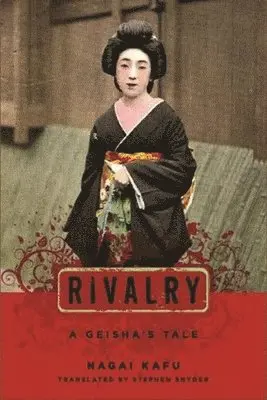
Originally published in 1918, Rivalry is regarded as the masterpiece of Nagai Kafu, a Japanese novelist known for his brilliant renderings of Tokyo in the early years of modern Japan. Stephen Snyder offers the first English translation of the complete, uncensored text, which has long been celebrated as one of the most convincing and sensually rich portraits of the geisha profession. Rivalry tells a sweeping story in which sexual politics compete with sisterly affection in a world ruled by material transaction. Komayo is a former geisha who, upon the death of her husband, must return to the "world of flower and willow" to escape poverty. A chance encounter with an old patron, Yoshioka, leads to a relationship in which both lovers hope to profit: Yoshioka believes Komayo can restore his lost innocence; Komayo plans to use Yoshioka's patronage to compete in the elaborate music and dance performances staged by her fellow geisha. Yoshioka is eager to ransom Komayo, but as she considers his offer, Komayo falls in love with Segawa, a young actor who promises to turn the talented geisha into the finest dancer in the Shimbashi quarter.Though her feelings for Segawa are genuine, Komayo is eager to use her lover's position to become the lead performer among her peers. Her ambition even tempts her to take on a third patron known only as the "Sea Monster," a repellent but wealthy antiques dealer whose deep pockets promise to shoot Komayo to the height of celebrity. Though she finds herself at the pinnacle of a glittering career, Komayo nevertheless becomes the target of a bitter rivalry between her three lovers that leaves her both thrilled and exhausted, both brutalized and redeemed. Kafu's compelling tale takes readers from the intimate corners of the geisha house to the back rooms of assignation, from the dressing areas of the great kabuki theaters to the lonely country villa of a theater critic and connoisseur of Shimbashi women. His lush depictions of architecture and costumes and his incisive descriptions of urban life and individual motive provide a vivid backdrop for Komayo's struggle-one woman's absorbing quest to find fame, affection, and financial security in the refined but ruthless theater of Shimbashi.
252 kr
Skickas inom 7-10 vardagar
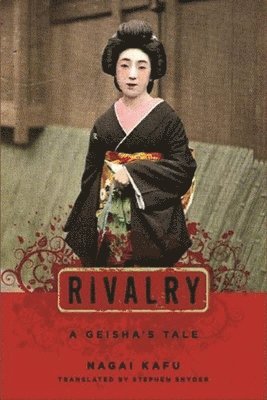
Originally published in 1918, Rivalry is regarded as the masterpiece of Nagai Kafu, a Japanese novelist known for his brilliant renderings of Tokyo in the early years of modern Japan. Stephen Snyder offers the first English translation of the complete, uncensored text, which has long been celebrated as one of the most convincing and sensually rich portraits of the geisha profession. Rivalry tells a sweeping story in which sexual politics compete with sisterly affection in a world ruled by material transaction. Komayo is a former geisha who, upon the death of her husband, must return to the "world of flower and willow" to escape poverty. A chance encounter with an old patron, Yoshioka, leads to a relationship in which both lovers hope to profit: Yoshioka believes Komayo can restore his lost innocence; Komayo plans to use Yoshioka's patronage to compete in the elaborate music and dance performances staged by her fellow geisha. Yoshioka is eager to ransom Komayo, but as she considers his offer, Komayo falls in love with Segawa, a young actor who promises to turn the talented geisha into the finest dancer in the Shimbashi quarter.Though her feelings for Segawa are genuine, Komayo is eager to use her lover's position to become the lead performer among her peers. Her ambition even tempts her to take on a third patron known only as the "Sea Monster," a repellent but wealthy antiques dealer whose deep pockets promise to shoot Komayo to the height of celebrity. Though she finds herself at the pinnacle of a glittering career, Komayo nevertheless becomes the target of a bitter rivalry between her three lovers that leaves her both thrilled and exhausted, both brutalized and redeemed. Kafu's compelling tale takes readers from the intimate corners of the geisha house to the back rooms of assignation, from the dressing areas of the great kabuki theaters to the lonely country villa of a theater critic and connoisseur of Shimbashi women. His lush depictions of architecture and costumes and his incisive descriptions of urban life and individual motive provide a vivid backdrop for Komayo's struggle-one woman's absorbing quest to find fame, affection, and financial security in the refined but ruthless theater of Shimbashi.