Java Ser. - Böcker
Visar alla böcker i serien Java Ser.. Handla med fri frakt och snabb leverans.
7 produkter
7 produkter
395 kr
Skickas inom 7-10 vardagar
JDBC is the key Java technology for relational database access. Oracle is arguably the most widely used relational database platform in the world. In this book, Donald Bales brings these two technologies together, and shows you how to leverage the full power of Oracle's implementation of JDBC. You begin by learning the all-important mysteries of establishing database connections. This can be one of the most frustrating areas for programmers new to JDBC, and Donald covers it well with detailed information and examples showing how to make database connections from applications, applets, Servlets, and even from Java programs running within the database itself. Next comes thorough coverage of JDBC's relational SQL features. You'll learn how to issue SQL statements and get results back from the database, how to read and write data from large, streaming data types such as BLOBs, CLOBs, and BFILEs, and you'll learn how to interface with Oracle's other built-in programming language, PL/SQL.If you're taking advantage of the Oracle's relatively new ability to create object tables and column objects based on user-defined datatypes, you'll be pleased with Don's thorough treatment of this subject. Don shows you how to use JPublisher and JDBC to work seamlessly with Oracle database objects from within Java programs. You'll also learn how to access nested tables and arrays using JDBC. Donald concludes the book with a discussion of transaction management, locking, concurrency, and performance--topics that every professional JDBC programmer must be familiar with. If you write Java programs to run against an Oracle database, this book is a must-have.
289 kr
Skickas inom 7-10 vardagar
"Java Data Objects" aims to revolutionize the way Java developers interact with databases and other datastores. It allows you to store and retrieve objects in a way that's natural toJava programmers. Instead of working with JDBC or EJB's container-managed persistence, you work directly with your Java objects. You don't have to copy data to and from database tables or issue SELECTs to perform queries: your JDO implementation takes care of persistence behind-the-scenes, and you make queries based on the fields of your Java objects, using normal Java syntax. The result is software that is truly object-oriented: not code that is partially object-oriented, with a large database-shaped lump on the back end. JDO lets you save plain, ordinary Java objects, and does not force you to use different data models and types for dealing with storage. As a result, your code becomes easier to maintain, easier to re-use, and easier to test. And you're not tied to a specific database vendor: your JDO code is entirely database-independent. You don't even need to know whether the datastore is a relational database, an object database, or just a set of files.The book offers a thorough introduction to JDO, starting with a simple application that demonstrates many of JDO's capabilities. It shows you how to make classes persistent, how JDO maps persistent classes to the database, how to configure JDO at runtime, how to perform transactions, and how to make queries. More advanced chapters cover optional features such as nontransactional access and optimistic transactions. The book concludes by discussing the use of JDO in web applications and J2EE environments.
254 kr
Skickas inom 7-10 vardagar
Sometimes the simplest answer is the best. Many Enterprise Java developers, accustomed to dealing with Java's spiraling complexity, have fallen into the habit of choosing overly complicated solutions to problems when simpler options are available. Building server applications with "heavyweight" Java-based architectures, such as WebLogic, JBoss, and WebSphere, can be costly and cumbersome. When you've reached the point where you spend more time writing code to support your chosen framework than to solve your actual problems, it's time to think in terms of simplicity. In Better, Faster, Lighter Java authors Bruce Tate and Justin Gehtland argue that the old heavyweight architectures are unwieldy, complicated, and contribute to slow and buggy application code. As an alternative means for building better applications, the authors present two "lightweight" open source architectures: Hibernate--a persistence framework that does its job with a minimal API and gets out of the way, and Spring--a container that's not invasive, heavy or complicated. Hibernate and Spring are designed to be fairly simple to learn and use, and place reasonable demands on system resources. Better, Faster, Lighter
360 kr
Skickas inom 7-10 vardagar
"Java and XML, 3rd Edition", shows you how to cut through all the hype about XML and put it to work. It teaches you how to use the APIs, tools, and tricks of XML to build real-world applications. The result is a new approach to managing information that touches everything from configuration files to web sites. After two chapters on XML basics, including XPath, XSL, DTDs, and XML Schema, the rest of the book focuses on using XML from your Java applications. This third edition of "Java and XML" covers all major Java XML processing libraries, including full coverage of the SAX, DOM, StAX, JDOM, and dom4j APIs as well as the latest version of the Java API for XML Processing (JAXP) and Java Architecture for XML Binding (JAXB). The chapters on web technology have been entirely rewritten to focus on the today's most relevant topics: syndicating content with RSS and creating Web 2.0 applications. You'll learn how to create, read, and modify RSS feeds for syndicated content and use XML to power the next generation of websites with Ajax and Adobe Flash.It includes topics such as: the basics of XML, including DTDs, namespaces, XML Schema, XPath, and Transformations; the SAX API, including all handlers, filters, and writers; the DOM API, including DOM Level 2, Level 3, and the DOM HTML module; the JDOM API, including the core and a look at XPath support; the StAX API, including StAX factories, producing documents and XMLPull; Data Binding with JAXB, using the new JAXB 2.0 annotations; Web syndication and podcasting with RSS; and, XML on the Presentation Layer, paying attention to Ajax and Flash applications. If you are developing with Java and need to use XML, or think that you will be in the future; if you're involved in the new peer-to-peer movement, messaging, or web services; or if you're developing software for electronic commerce, "Java and XML" will be an indispensable companion.
219 kr
Skickas inom 7-10 vardagar
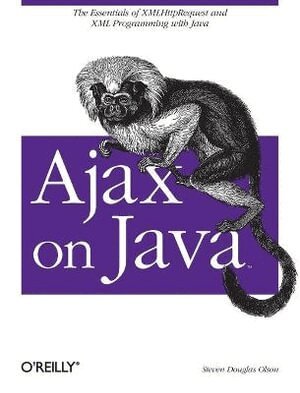
This practical guide shows you how to make your Java web applications more responsive and dynamic by incorporating new Ajaxian features, including suggestion lists, drag-and-drop, and more. Java developers can choose between many different ways of incorporating Ajax, from building JavaScript into your applications "by hand" to using the new Google Web Toolkit (GWT). "Ajax on Java" starts with an introduction to Ajax, showing you how to write some basic applications that use client-side JavaScript to request information from a Java servlet and display it without doing a full page reload. It also presents several strategies for communicating between the client and the server, including sending raw data, and using XML or JSON (JavaScript Object Notation) for sending more complex collections of data. The book then branches out into different approaches for incorporating Ajax, which include: the Prototype and script.aculo.us Javascript libraries, the Dojo and Rico libraries, and DWR; integrating Ajax into Java ServerPages (JSP) applications; using Ajax with Struts; integrating Ajax into Java ServerFaces (JSF) applications; and, using Google's GWT, which offers a pure Java approach to developing web applications: your client-side components are written in Java, and compiled into HTML and JavaScript.Ajax gives web developers the ability to build applications that are more interactive, more dynamic, more exciting and enjoyable for your users. If you're a Java developer and haven't tried Ajax, but would like to get started, this book is essential. Your users will be grateful.
430 kr
Skickas inom 7-10 vardagar
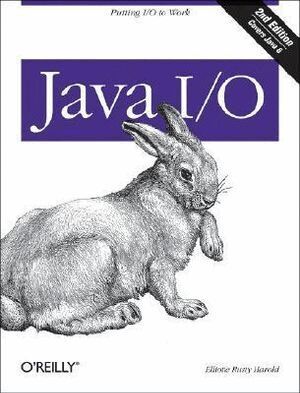
All of Java's Input/Output (I/O) facilities are based on streams, which provide simple ways to read and write data of different types. Java provides many different kinds of streams, each with its own application. The universe of streams is divided into four large categories: input streams and output streams, for reading and writing binary data; and readers and writers, for reading and writing textual (character) data. You're almost certainly familiar with the basic kinds of streams--but did you know that there's a CipherInputStream for reading encrypted data? And a ZipOutputStream for automatically compressing data? Do you know how to use buffered streams effectively to make your I/O operations more efficient? Java I/O, 2nd Edition has been updated for Java 5.0 APIs and tells you all you ever need to know about streams--and probably more. A discussion of I/O wouldn't be complete without treatment of character sets and formatting. Java supports the Unicode standard, which provides definitions for the character sets of most written languages. Consequently, Java is the first programming language that lets you do I/O in virtually any language.Java also provides a sophisticated model for formatting textual and numeric data. Java I/O, 2nd Edition shows you how to control number formatting, use characters aside from the standard (but outdated) ASCII character set, and get a head start on writing truly multilingual software. Java I/O, 2nd Edition includes: * Coverage of all I/O classes and related classes * In-depth coverage of Java's number formatting facilities and its support for international character sets
278 kr
Tillfälligt slut
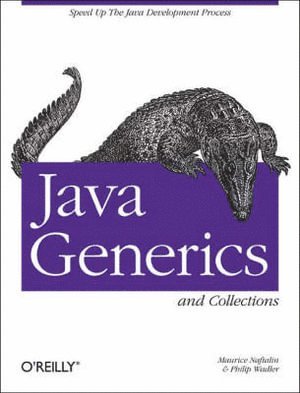
This comprehensive guide shows you how to master the most important changes to Java since it was first released. Generics and the greatly expanded collection libraries have tremendously increased the power of Java 5 and Java 6. But they have also confused many developers who haven't known how to take advantage of these new features. "Java Generics and Collections" covers everything from the most basic uses of generics to the strangest corner cases. It teaches you everything you need to know about the collections libraries, so you'll always know which collection is appropriate for any given task, and how to use it. Topics covered include: Fundamentals of generics: type parameters and generic methods; Other new features: boxing and unboxing, foreach loops, varargs; Subtyping and wildcards; Evolution not revolution: generic libraries with legacy clients and generic clients with legacy libraries; Generics and reflection; Design patterns for generics; Sets, Queues, Lists, Maps, and their implementations; Concurrent programming and thread safety with collections; ane Performance implications of different collections.Generics and the new collection libraries they inspired take Java to a new level. If you want to take your software development practice to a new level, this book is essential reading.