Key Concepts in Systemic Functional Linguistics – serie
Visar alla böcker i serien Key Concepts in Systemic Functional Linguistics. Handla med fri frakt och snabb leverans.
15 produkter
15 produkter
Häftad, Engelska, 2021
463 kr
Skickas inom 5-8 vardagar
Häftad, Engelska, 2026
403 kr
Kommande
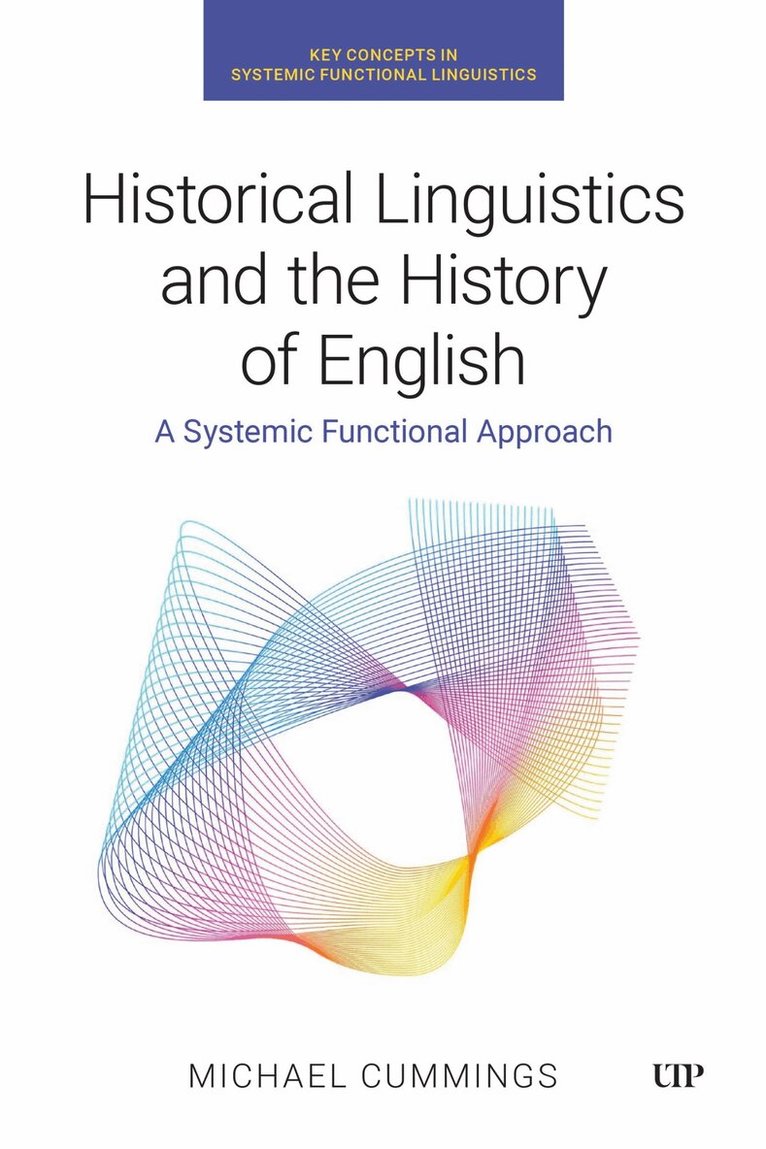
Investigating the gamut of changes that occurred in the course of the English language’s development, Historical Linguistics and the History of English analyses its metamorphosis scaffolded by systemic functional linguistics. Providing an introductory model for the historical description of languages within the systemic functional framework, English professor Michael Cummings utilizes the history of English as a guiding exemplar. At the centre of the model are the historical relationships among successive states of semantics and of lexico-grammar. He takes the reader through a systemic functional analysis of their own modern English and introduces analyses of the historical dialects, while noting differences and similarities. Each successive chapter begins with an analysis of a type of grammatical unit in modern English, then continues with corresponding analyses through the historical dialects Old English, Middle English, and Early Modern English. The types of grammatical units covered are the nominal group, the verbal group, the interpersonal clause, the experiential clause, and the textual clause.Historical Linguistics and the History of English is a vital introduction to the history of the English language from a systemic functional perspective and will be of interest to scholars and students at all levels.
Häftad, Engelska, 2026
263 kr
Skickas
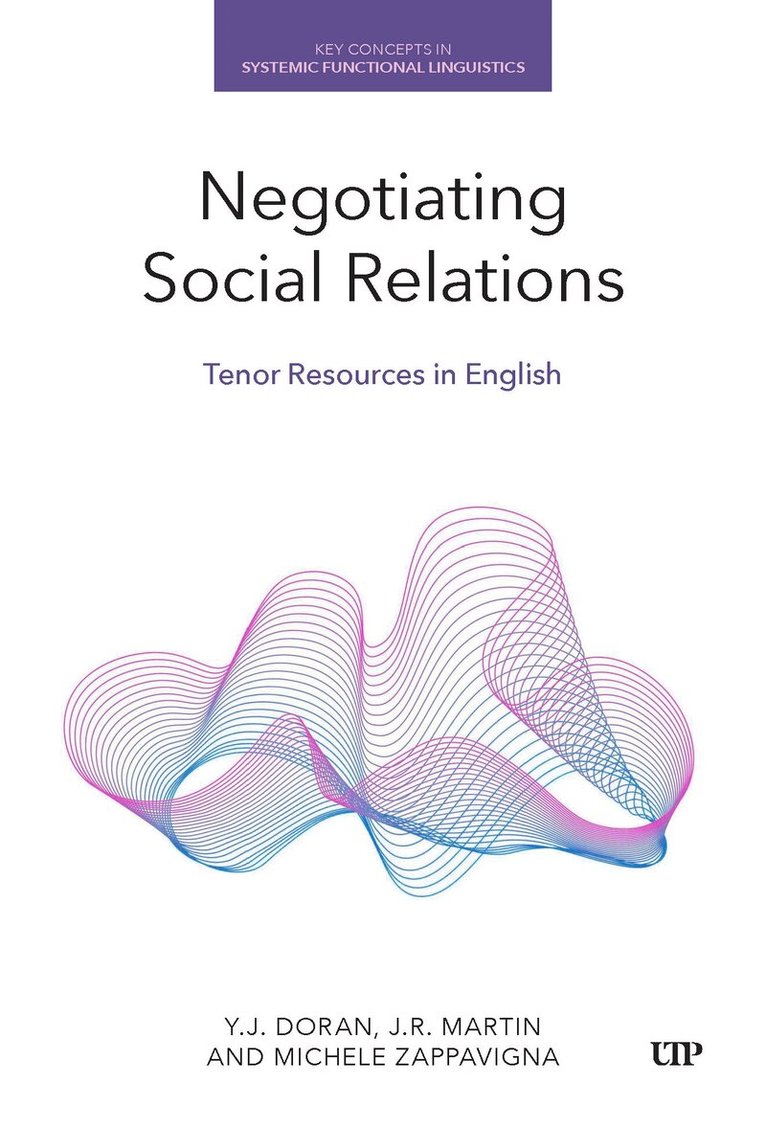
Every day we negotiate our social relations. This may involve small, seemingly inconsequential chats with friends, families, and colleagues that perform our relationships. Or they may involve large, communal events that bring us together or tear us apart. In all cases, we negotiate these social relations through the language, paralanguage, and related systems of meaning that we use. This book introduces a new model for analysing how people negotiate social relations through the framework of Systemic Functional Linguistics (SFL). It focuses on SFL's conception of social context and in particular on the interpersonal component of context known as tenor. Drawing on decades of SFL research, tenor is reworked as a resource for meaning – with the aim of describing in some detail how we go about building and maintaining sociality.The book begins by considering how language varies in relation to social context and the different perspectives we can take to explore this variation. It then introduces our model of tenor as a resource for negotiating social relations. The model comprises three main systems. Positioning considers how people put forward meanings, react to them, and position each other when we talk. Orienting looks at the nature of the meanings we negotiate, attending to the vast background of shared values that underpin our talk, help us build communities, and hold them together. Tuning deals with how we raise or lower the stakes of what is being said, how we broaden or narrow the scope of what it applies to, and how we vary the spirit in which the meanings are being put forward. Taken together, these systems provide us with resources for enacting social relations as we align and disalign with people and communities of various kinds. Examples focus in particular on a range of meanings associated with motherhood, including language and paralanguage (both gesture and emoji) in spoken, written, and social media texts.
Inbunden, Engelska, 2026
878 kr
Skickas inom 5-8 vardagar
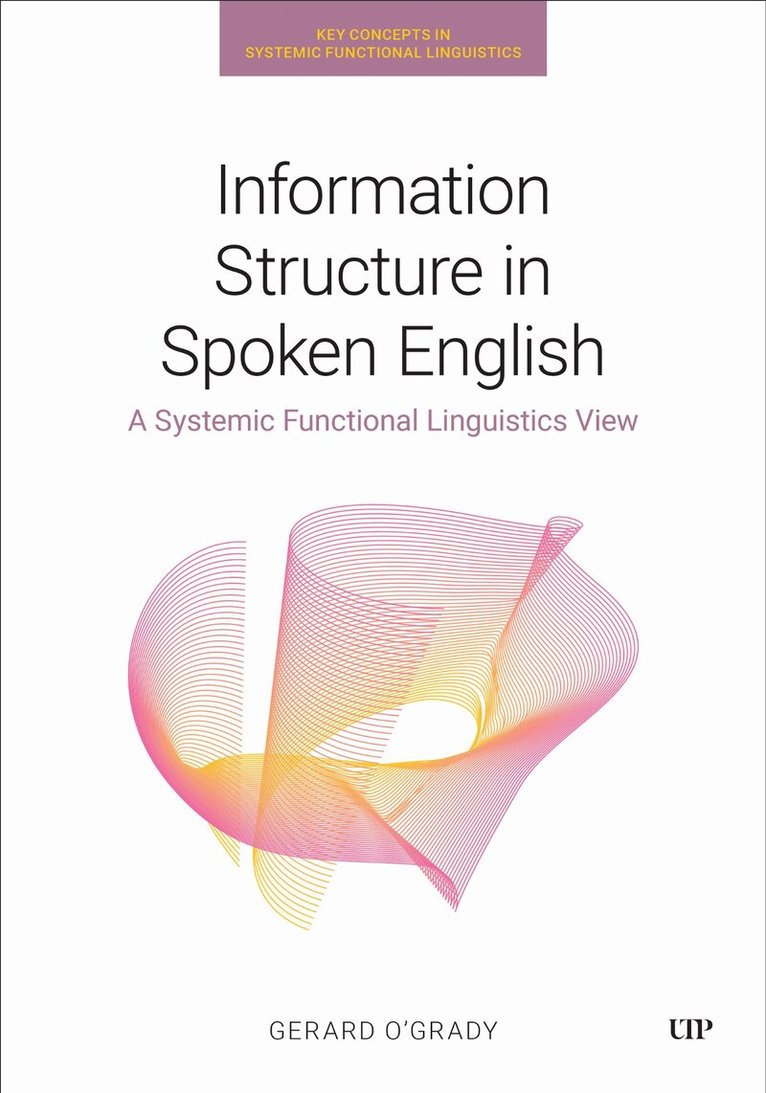
In a series of publications in the 1960s culminating in the 1967 book Intonation and the Grammar of English and the three articles Notes on Transitivity and Theme, Halliday proposed a system of information structure. Tonic items were presented as New or as if they were not recoverable from the context and cotext. Post tonic items were Given or recoverable. The status of pre-tonic items was ambiguous and needed to be considered in context.Halliday’s view has proven to be reliable over the past 50 years but this book aims to revise it. The book argues that Halliday’s system was premised on two views both of which have been questioned over the years. The first is that Halliday’s notion of recoverability was influenced by Shannon and Weaver’s mathematical theory of information predictability where information can be encoded in terms of bits which are transmitted from source A to source B. This is not how SFL theory sees language functioning. Languaging is not simply the transmitting of information but rather a social semiotic practice which interactants deploy to affiliate with others while pursuing their individual needs. Secondly the binary division of information as either New (1 bit) or Given (0 bit) has been questioned in recent years by work which has looked at presuppositions and implications. In addition to these issues the book argues that Halliday’s definition blurs the important distinction between referentiality and identification. The book concludes by presenting an updated Hallidayan model which is sensitive to the above issues.
Häftad, Engelska, 2026
282 kr
Skickas
In a series of publications in the 1960s culminating in the 1967 book Intonation and the Grammar of English and the three articles Notes on Transitivity and Theme, Halliday proposed a system of information structure. Tonic items were presented as New or as if they were not recoverable from the context and cotext. Post tonic items were Given or recoverable. The status of pre-tonic items was ambiguous and needed to be considered in context.Halliday’s view has proven to be reliable over the past 50 years but this book aims to revise it. The book argues that Halliday’s system was premised on two views both of which have been questioned over the years. The first is that Halliday’s notion of recoverability was influenced by Shannon and Weaver’s mathematical theory of information predictability where information can be encoded in terms of bits which are transmitted from source A to source B. This is not how SFL theory sees language functioning. Languaging is not simply the transmitting of information but rather a social semiotic practice which interactants deploy to affiliate with others while pursuing their individual needs. Secondly the binary division of information as either New (1 bit) or Given (0 bit) has been questioned in recent years by work which has looked at presuppositions and implications. In addition to these issues the book argues that Halliday’s definition blurs the important distinction between referentiality and identification. The book concludes by presenting an updated Hallidayan model which is sensitive to the above issues.
Inbunden, Engelska, 2024
878 kr
Skickas inom 5-8 vardagar
This book provides an original, full-scale, exploration in applying the principles and practices of Systemic-Functional Linguistics at the level of word phonology in English, German, Welsh and Tera (Nigeria). The relationship between lexicogrammar and word phonology is demonstrated, and the place of word phonology is set within the full range of a hierarchy of phonological expression. The function of phonology is given a new understanding in its relationship to lexicogrammar, and the notion of system is given extensive illustration in the numerous networks that are proposed. The special characteristic features of Systemic Phonology are compared with with the theory and structures of other approaches to phonology. The choice of the four languages is deliberate: English as the most described language in the world; German as a language in the same linguistic family as English; Welsh as another Indo-European language, but from a different linguistic family; and Tera as a language with absolutely no family connection to the others. The principal units of word phonology are the foot and its equivalent in non-stress languages, the syllable, the phoneme and allophone. Allophonic variants are included, since their phonetic realization is determined by the phonology of a language, rather than on purely phonetic criteria.
Häftad, Engelska, 2024
284 kr
Skickas inom 5-8 vardagar
This book provides an original, full-scale, exploration in applying the principles and practices of Systemic-Functional Linguistics at the level of word phonology in English, German, Welsh and Tera (Nigeria). The relationship between lexicogrammar and word phonology is demonstrated, and the place of word phonology is set within the full range of a hierarchy of phonological expression. The function of phonology is given a new understanding in its relationship to lexicogrammar, and the notion of system is given extensive illustration in the numerous networks that are proposed. The special characteristic features of Systemic Phonology are compared with with the theory and structures of other approaches to phonology. The choice of the four languages is deliberate: English as the most described language in the world; German as a language in the same linguistic family as English; Welsh as another Indo-European language, but from a different linguistic family; and Tera as a language with absolutely no family connection to the others. The principal units of word phonology are the foot and its equivalent in non-stress languages, the syllable, the phoneme and allophone. Allophonic variants are included, since their phonetic realization is determined by the phonology of a language, rather than on purely phonetic criteria.
Inbunden, Engelska, 2026
878 kr
Skickas inom 5-8 vardagar
Every day we negotiate our social relations. This may involve small, seemingly inconsequential chats with friends, families, and colleagues that perform our relationships. Or they may involve large, communal events that bring us together or tear us apart. In all cases, we negotiate these social relations through the language, paralanguage, and related systems of meaning that we use. This book introduces a new model for analysing how people negotiate social relations through the framework of Systemic Functional Linguistics (SFL). It focuses on SFL’s conception of social context and in particular on the interpersonal component of context known as tenor. Drawing on decades of SFL research, tenor is reworked as a resource for meaning – with the aim of describing in some detail how we go about building and maintaining sociality.The book begins by considering how language varies in relation to social context and the different perspectives we can take to explore this variation. It then introduces our model of tenor as a resource for negotiating social relations. The model comprises three main systems. Positioning considers how people put forward meanings, react to them, and position each other when we talk. Orienting looks at the nature of the meanings we negotiate, attending to the vast background of shared values that underpin our talk, help us build communities, and hold them together. Tuning deals with how we raise or lower the stakes of what is being said, how we broaden or narrow the scope of what it applies to, and how we vary the spirit in which the meanings are being put forward. Taken together, these systems provide us with resources for enacting social relations as we align and disalign with people and communities of various kinds. Examples focus in particular on a range of meanings associated with motherhood, including language and paralanguage (both gesture and emoji) in spoken, written, and social media texts.
Inbunden, Engelska, 2021
1 044 kr
Skickas inom 5-8 vardagar
Häftad, Engelska, 2021
491 kr
Skickas inom 5-8 vardagar
Inbunden, Engelska, 2021
1 044 kr
Skickas inom 5-8 vardagar
Häftad, Engelska, 2021
463 kr
Skickas inom 5-8 vardagar
Inbunden, Engelska, 2023
1 044 kr
Skickas inom 5-8 vardagar
Häftad, Engelska, 2023
560 kr
Skickas inom 5-8 vardagar
Inbunden, Engelska, 2021
1 044 kr
Skickas inom 5-8 vardagar