Library of Sinology [LOS] - Böcker
Visar alla böcker i serien Library of Sinology [LOS]. Handla med fri frakt och snabb leverans.
5 produkter
5 produkter
988 kr
Skickas inom 5-8 vardagar
This book is a timely response to a rather urgent call to seek an updated methodology in rereading and reappraising early Chinese texts in light of newly discovered early writings. For a long time, the concept of authorship in the formation and transmission of early Chinese texts has been misunderstood. The nominal author who should mainly function as a guide to text formation and interpretation is considered retrospectively as the originator and writer of the text. This book illustrates that although some notions about the text as the author’s property began to appear in some Eastern Han texts, a strict correlation between the author and the text results from later conceptions of literary history. Before the modern era, there existed a conceptual gap between an author and a writer. A pre-modern Chinese text could have had both an author and a writer, or even multiple authors and multiple writers. This work is the first study addressing these issues by more systematically emphasizing the connection of the text, the author, and the religious and sociopolitical settings in which these issues were embedded. It is expected to constitute a palpable contribution to Chinese studies and the discipline of philology in general
Oracle Bone Inscriptions from Huayuanzhuang East
Translated with an Introduction and Commentary
Inbunden, Engelska, 2019
885 kr
Skickas inom 5-8 vardagar
Since 1899 more than 73,000 pieces of inscribed divination shell and bone have been found inside the moated enclosure of the Anyang-core at the former capital of the late Shang state. Nearly all of these divinations were done on behalf of the Shang kingsand has led to the apt characterization that oracle bone inscriptions describe their motivations, experiences, and priorities. There are, however, much smaller sets of divination accounts that were done on behalf of members of the Shang elite other than the king.First noticed in the early 1930's, grouped and periodized shortly thereafter, oracle bone inscriptions produced explicitly by or on behalf of "royal familygroups" reveal information about key aspects of daily life in Shang societythat are barely even mentioned in Western scholarship. The newly published Huayuanzhuang East Oracle Bone inscriptions are a spectacular addition to the corpus of texts from Anyang: hundreds of intact or largely intact turtle shells and bovine scapulae densely inscribed with records of the divinations in which they were used. They were produced on the behalf of a mature prince of the royal family whose parents, both alive and still very much active, almost certainly were the twenty-first Shang king Wu Ding (r. c. 1200 B.C.) and his consort Lady Hao (fu Hao). The Huayuanzhuang East corpus is an unusually homogeneous set of more than two thousand five hundred divination records, produced over a short period of time on behalf of a prince of the royal family. There are typically multiple records of divinations regarding the same or similar topics that can be synchronized together, which not only allows for remarkable access into the esoteric world of divination practice, but also produce micro-reconstructions of what is essentially East Asia's earliest and most complete "day and month planner." Because these texts are unusually linguistically transparent and well preserved, homogeneous in orthography and content, and published to an unprecedentedly high standard, they are also ideal material for learning to read and interpret early epigraphic texts. The Huayuanzhuang East oracle bone inscriptions are a tremendously important Shang archive of "material documents" that were produced by a previously unknown divination and scribal organization. They expose us to an entirely fresh set of perspectives and preoccupationscentering ona member of the royal family at the commencement of China's historical period. The completely annotated English translation of the inscriptions is the first of its kind, and is a vibrant new source of Shang history that can be accessedto rewrite and supplement what we know about early Chinese civilization and life in the ancient world. Before the discerning reader are the motives, preoccupations, and experiences of a late Shang prince working simultaneously in service both for his Majesty, his parents, and hisown family.
Nivison Annals
Selected Works of David S. Nivison on Early Chinese Chronology, Astronomy, and Historiography
Inbunden, Engelska, 2018
988 kr
Skickas inom 5-8 vardagar
In his last essay just weeks before his death at the age of 91, David S. Nivison says, "Breaking into a formal system - such as a chronology - must be like breaking into a code. If you are successful, success will show right off." Since the late 1970's Nivison has focused his scholarship on breaking the code of Three Dynasties (Xia, Shang, Zhou) chronology by establishing an innovative methodology based on mourning periods, astronomical phenomenon, and numerical manipulations derived from them. Nivison is most readily known in the field for revising (and then revising again) the date of the Zhou conquest of Shang, and for his theory that Western Zhou kings employed two calendars (His so-called "Two yuan" theory), the second being set in effect upon the death of the new king's predecessor and counted from the completion of post-mourning rites for him (i.e., a "second 'first' year"). Nivison's enabling discovery that the Bamboo Annals (BA) had a historical basis was initially designed to make Wang Guowei's analysis of lunar phase terms (the so-called "Four quarter" theory that separated each month into four quarters) work for Western Zhou bronze inscriptions. In order to do so he had to assume that some inscriptions used a second yuan counted from completion of mourning. The king's death was the most important event late in a reign, so this implied that a king's reign-of-record was normally counted from the second yuan, omitting initial mourning years. It follows that when the unexpressed mourning years are forgotten (or edited out) but the dates of the beginning and end of the dynasty are still known, the remaining reigns-of-record cluster toward the beginning and end, and a reign in the middle is enlarged. Problems, ideas, and solutions like the one described above are found throughout this new collection of important works on chronology, astronomy, and historiography.
Del 4 - Library of Sinology [LOS]
Chinese Annals in the Western Observatory
An Outline of Western Studies of Chinese Unearthed Documents
Inbunden, Engelska, 2019
885 kr
Skickas inom 5-8 vardagar
Since the beginning of the twentieth century, hundreds of thousands of documents of all sorts have been unearthed in China, opening whole new fields of study and transforming our modern understanding of ancient China. While these discoveries have necessarily taken place in China, Western scholars have also contributed to the study of these documents throughout this entire period. This book provides a comprehensive survey of the contributions of these Western scholars to the field of Chinese paleography, and especially to study of oracle-bone inscriptions, bronze and stone inscriptions, and manuscripts written on bamboo and silk. Each of these topics is provided with a comprehensive narrative history of studies by Western scholars, as well as an exhaustive bibliography and biographies of important scholars in the field. It is also supplied with a list of Chinese translations of these studies, as well as a complete index of authors and their works. Whether the reader is interested in the history of ancient China, ancient Chinese paleographic documents, or just in the history of the study of China as it has developed in the West, this book provides one of the most complete accounts available to date.
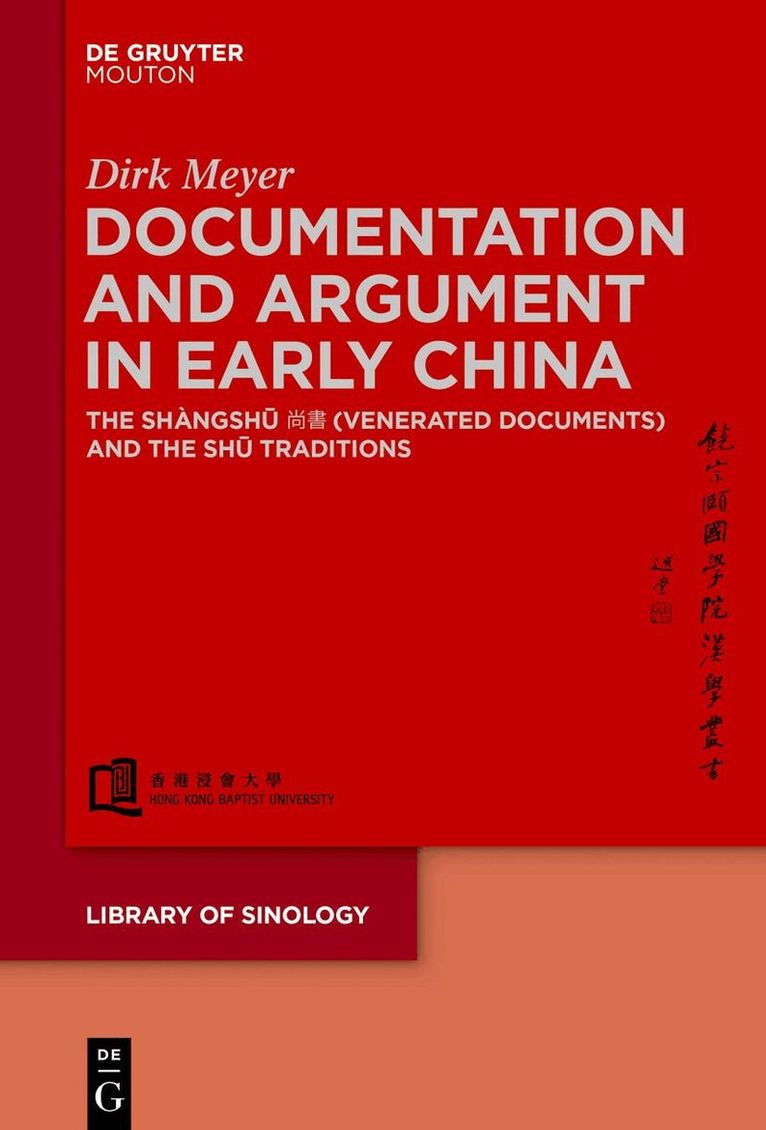
Documentation and Argument in Early China
The Shàngshū 尚書 (Venerated Documents) and the Shū Traditions
Inbunden, Engelska, 2021
845 kr
Skickas inom 5-8 vardagar
This study uncovers the traditions behind the formative Classic Shàngshū (Venerated Documents). It is the first to establish these traditions—“Shū” (Documents)—as a historically evolving practice of thought-production. By focusing on the literary form of the argument, it interprets the “Shū” as fluid text material that embodies the ever-changing cultural capital of projected conceptual communities. By showing how these communities actualised the “Shū” according to their changing visions of history and evolving group interests, the study establishes that by the Warring States period (ca. 453–221 BC) the “Shū” had become a literary genre employed by diverse groups to legitimize their own arguments. Through forms of textual performance, the “Shū” gave even peripheral communities the means to participate in political discourse by conferring their ideas with ancient authority. Analysing this dynamic environment of socio-political and philosophical change, this study speaks to the Early China field, as well as to those interested in meaning production and foundational text formation more widely.