Mary Flexner Lectures of Bryn Mawr College – serie
Visar alla böcker i serien Mary Flexner Lectures of Bryn Mawr College. Handla med fri frakt och snabb leverans.
4 produkter
4 produkter
205 kr
Skickas inom 7-10 vardagar
In the past few decades, scientists of human nature—including experimental and cognitive psychologists, neuroscientists, evolutionary theorists, and behavioral economists—have explored the way we arrive at moral judgments. They have called into question commonplaces about character and offered troubling explanations for various moral intuitions. Research like this may help explain what, in fact, we do and feel. But can it tell us what we ought to do or feel? In Experiments in Ethics, the philosopher Kwame Anthony Appiah explores how the new empirical moral psychology relates to the age-old project of philosophical ethics.Some moral theorists hold that the realm of morality must be autonomous of the sciences; others maintain that science undermines the authority of moral reasons. Appiah elaborates a vision of naturalism that resists both temptations. He traces an intellectual genealogy of the burgeoning discipline of "experimental philosophy," provides a balanced, lucid account of the work being done in this controversial and increasingly influential field, and offers a fresh way of thinking about ethics in the classical tradition.Appiah urges that the relation between empirical research and morality, now so often antagonistic, should be seen in terms of dialogue, not contest. And he shows how experimental philosophy, far from being something new, is actually as old as philosophy itself. Beyond illuminating debates about the connection between psychology and ethics, intuition and theory, his book helps us to rethink the very nature of the philosophical enterprise.
Del 2 - Mary Flexner Lectures of Bryn Mawr College
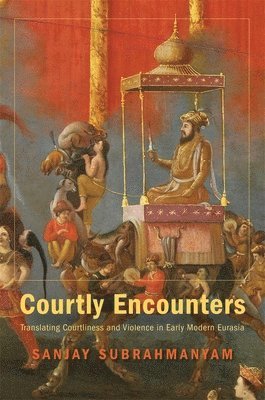
Courtly Encounters
Translating Courtliness and Violence in Early Modern Eurasia
Inbunden, Engelska, 2012
407 kr
Skickas inom 10-15 vardagar
Cross-cultural encounters in Europe and Asia in the sixteenth and seventeenth centuries brought the potential for bafflement, hostility, and admiration. The court was the crucial site where expanding Eurasian states and empires met and were forced to make sense of one another. By looking at these interactions, Courtly Encounters provides a fresh cross-cultural perspective on the worlds of early modern Islam, Counter-Reformation Catholicism, Protestantism, and a newly emergent Hindu sphere.Both individual agents and objects such as texts and paintings helped mediate encounters between courts, which possessed rules and conventions that required decipherment and translation, whether in words or in pictures. Sanjay Subrahmanyam gives special attention to the depiction of South Asian empires in European visual representations, finding a complex history of cultural exchange: the Mughal paintings that influenced Rembrandt and other seventeenth-century Dutch painters had themselves been earlier influenced by Dutch naturalism. Courtly Encounters provides a rich array of images from Europe, the Islamic world, India, and Southeast Asia as aids for understanding the reciprocal nature of cross-cultural exchanges. It also looks closely at how insults and strategic use of martyrdom figured in courtly encounters.As he sifts through the historical record, Subrahmanyam finds little evidence for the cultural incommensurability many ethnohistorians have insisted on. Most often, he discovers negotiated ways of understanding one another that led to mutual improvisation, borrowing, and eventually change.
Del 4 - Mary Flexner Lectures of Bryn Mawr College
Feminist Theory of Refusal
Inbunden, Engelska, 2021
298 kr
Skickas inom 10-15 vardagar
An acclaimed political theorist offers a fresh, interdisciplinary analysis of the politics of refusal, highlighting the promise of a feminist politics that does not simply withdraw from the status quo but also transforms it.The Bacchae, Euripides’s fifth-century tragedy, famously depicts the wine god Dionysus and the women who follow him as indolent, drunken, mad. But Bonnie Honig sees the women differently. They reject work, not out of laziness, but because they have had enough of women’s routine obedience. Later they escape prison, leave the city of Thebes, explore alternative lifestyles, kill the king, and then return to claim the city. Their “arc of refusal,” Honig argues, can inspire a new feminist politics of refusal.Refusal, the withdrawal from unjust political and economic systems, is a key theme in political philosophy. Its best-known literary avatar is Herman Melville’s Bartleby, whose response to every request is, “I prefer not to.” A feminist politics of refusal, by contrast, cannot simply decline to participate in the machinations of power. Honig argues that a feminist refusal aims at transformation and, ultimately, self-governance. Withdrawal is a first step, not the end game.Rethinking the concepts of refusal in the work of Giorgio Agamben, Adriana Cavarero, and Saidiya Hartman, Honig places collective efforts toward self-governance at refusal’s core and, in doing so, invigorates discourse on civil and uncivil disobedience. She seeks new protagonists in film, art, and in historical and fictional figures including Sophocles’s Antigone, Ovid’s Procne, Charlie Chaplin’s Tramp, Leonardo da Vinci’s Madonna, and Muhammad Ali. Rather than decline the corruptions of politics, these agents of refusal join the women of Thebes first in saying no and then in risking to undertake transformative action.
Del 3 - Mary Flexner Lectures of Bryn Mawr College
Notes Toward a Performative Theory of Assembly
Häftad, Engelska, 2018
173 kr
Skickas inom 7-10 vardagar
A Times Higher Education Book of the WeekJudith Butler elucidates the dynamics of public assembly under prevailing economic and political conditions, analyzing what they signify and how. Understanding assemblies as plural forms of performative action, Butler extends her theory of performativity to argue that precarity—the destruction of the conditions of livability—has been a galvanizing force and theme in today’s highly visible protests.“Butler’s book is everything that a book about our planet in the 21st century should be. It does not turn its back on the circumstances of the material world or give any succour to those who wish to view the present (and the future) through the lens of fantasies about the transformative possibilities offered by conventional politics Butler demonstrates a clear engagement with an aspect of the world that is becoming in many political contexts almost illicit to discuss: the idea that capitalism, certainly in its neoliberal form, is failing to provide a liveable life for the majority of human beings.”—Mary Evans, Times Higher Education“A heady immersion into the thought of one of today’s most profound philosophers of action…This is a call for a truly transformative politics, and its relevance to the fraught struggles taking place in today’s streets and public spaces around the world cannot be denied.”—Hans Rollman, PopMatters