Materials Science of Minerals and Rocks – serie
Visar alla böcker i serien Materials Science of Minerals and Rocks. Handla med fri frakt och snabb leverans.
8 produkter
8 produkter
Inbunden, Engelska, 1995
1 603 kr
Skickas inom 10-15 vardagar
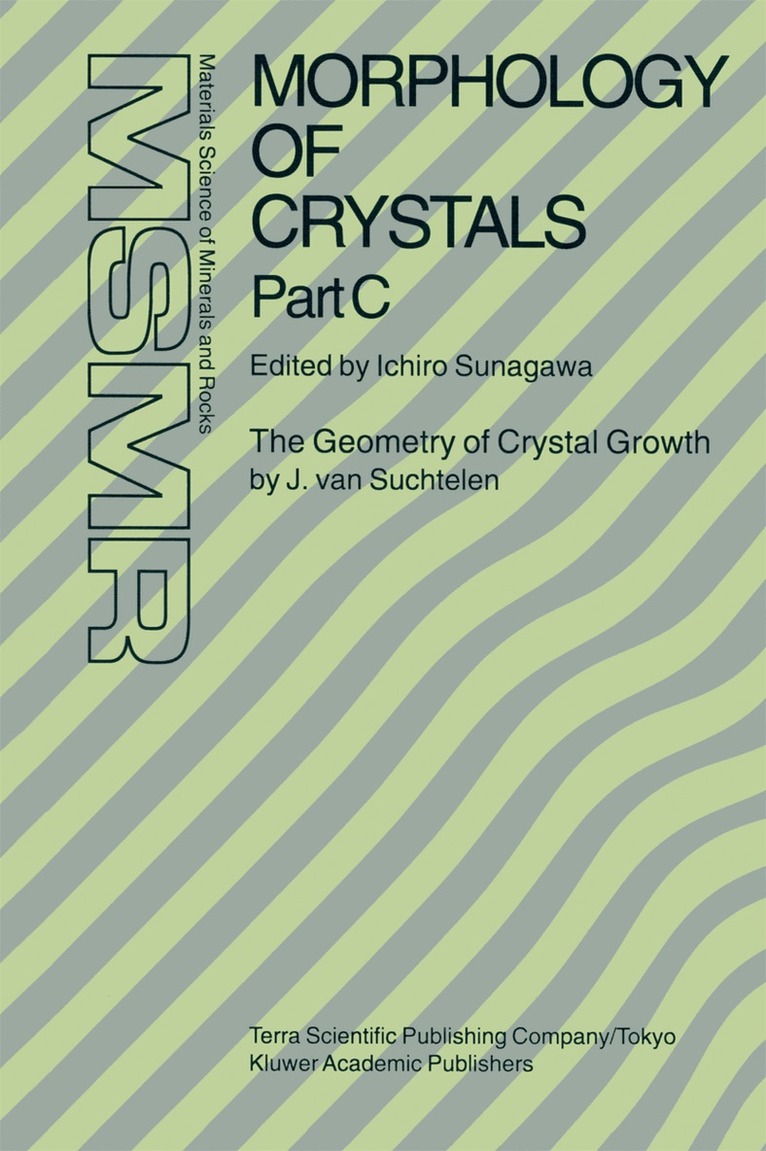
The molecular mechanisms underlying the fact that a crystal can take a variety of external forms is something scientists have come to understand only in the last few decades of the 20th century. This is due to recent developments in theoretical and experimental investigations of crystal growth mechanisms. "Morphology of Crystals" is divided into three separately available volumes. Part A contains chapters on roughening transition; equilibrium form; step pattern theory; modern PBC; and surface microtopography. This part provides essentially theoretical treatments of the problem, particularly the solid-liquid interface. Part B contains chapters on ultra-fine particles; minerals; transition from polyhedral to dendrite; theory of dendrite; and snow crystals. All chapters are written by world leaders in their respective areas, and some can be seen as representing the essence of a life's work. In Parts A: Fundamentals and B: Fine Particles, Minerals and Snow equilibrium and kinetic properties of crystals are generally approached from an "atomistic" point of view.In contrast, Part C: The Geometry of Crystal Growth follows the alternative and complementary "geometrical" description, where bulk phases are considered as continuous media and their interfaces as mathematical surfaces with orientation-dependent properties. Equations of motion for a crystal surface are expressed in terms of vector and tensor operators working on surface free energy and growth rate, both expressed as functions of surface orientation and driving force, or "affinity" for growth. This approach emphasizes the interrelation between equilibrium and kinetic behavior. Part 1 establishes the theoretical framework. Part 2 gives a construction toolbox for explicit (analytic) functions. An extra chapter is devoted to experimental techniques for measuring such functions: a new approach to sphere growth experiments. The emphasis throughout is on principles and new concepts. This boo should be of interest to advanced readers familiar with traditional aspects of crystal growth theory. It can be used as the basis for an advanced course, provided supplementation is provided in the areas of atomistic models of the advancing surface, diffusion fields, etc.
Inbunden, Engelska, 1984
2 135 kr
Skickas inom 10-15 vardagar
Inbunden, Engelska, 1986
1 603 kr
Skickas inom 10-15 vardagar
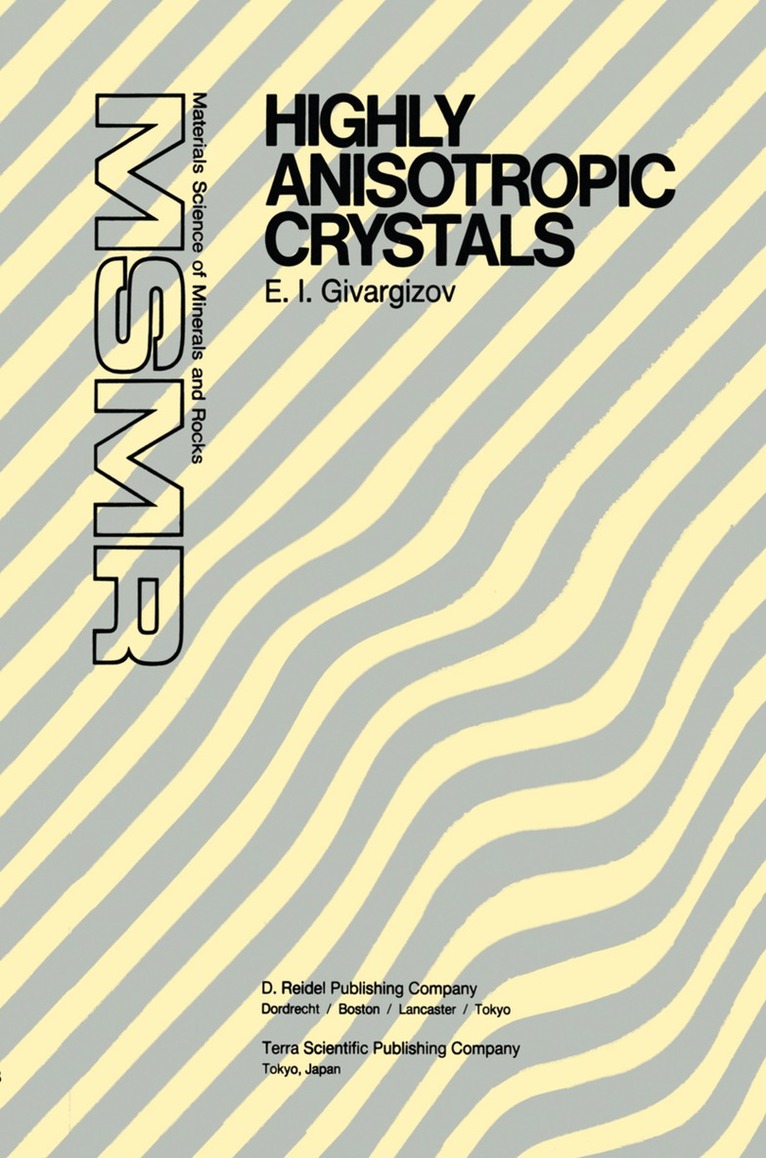
Anisotropy, i.e., the dependence of structure and properties on direction in space, is the most striking characteristic of crystals. Anisotropy is a result of the discrete nature of the crystal lattice, and it is the characteristic which distinguishes the crystalline state from another solid state of matter, the amorphous. The anisotropy of the structure and properties of crystals (this can be called their 'internal anisotropy') is also reflected in their external structure, i.e., morphology. The reflection is, however, non-linear: properties such as mechanical hardness ... do not change strongly (typically several tens of percents, depending on direction) while the morphology ... : the linear sizes in different directions of individual crystals often differ by several multiples or even several orders of magnitude, depending on the symmetry of the crystalline lattice and/or of the crystal prehistory. The enhanced anisotropy of morphology is, as a rule, a result of growth kinetics of different crystalline faces; it reflects a non-linear character of the kinetic laws of growth. This book is devoted to high morphological anisotropy. No strict classification of highly-anisotropic crystals exists. However some typical forms, or habits, can be singled out: first, whiskers (or needles, or fibers) as quasi-one-dimensional crystals, and second, platelets as quasi-two-dimensional crystals.
Inbunden, Engelska, 1988
2 135 kr
Skickas inom 10-15 vardagar
The molecular mechanisms underlying the fact that a crystal can take a variety of external forms is something we have come to understand only in the last few decades. This is due to recent developments in theoretical and experimental investigations of crystal growth mechanisms. Morphology of Crystals is divided into three separately available volumes. Part A contains chapters on roughening transition; equilibrium form; step pattern theory; modern PBC; and surface microtopography. This part provides essentially theoretical treatments of the problem, particularly the solid-liquid interface. Part B contains chapters on ultra-fine particles; minerals; transition from polyhedral to dendrite; theory of dendrite; and snow crystals. All chapters are written by world leaders in their respective areas, and some can be seen as representing the essence of a life's work. This is the first English-language work which covers all aspects of the morphology of crystals - a topic which has attracted top scientific minds for centuries. As such, it is indispensable for anyone seeking an answer to a question relating to this fascinating problem: mineralogists, petrologists, crystallographers, materials scientists, workers in solid-state physics and chemistry, etc. In Parts A: Fundamentals and B: Fine Particles, Minerals and Snow equilibrium and kinetic properties of crystals are generally approached from an `atomistic' point of view. In contrast, Part C: The Geometry of Crystal Growth follows the alternative and complementary `geometrical' description, where bulk phases are considered as continuous media and their interfaces as mathematical surfaces with orientation-dependent properties. Equations of motion for a crystal surface are expressed in terms of vector and tensor operators working on surface free energy and growth rate, both expressed as functions of surface orientation and driving force, or `affinity' for growth. This approach emphasizes the interrelation between equilibrium and kinetic behavior. Part 1 establishes the theoretical framework. Part 2 gives a construction toolbox for explicit (analytic) functions. An extra chapter is devoted to experimental techniques for measuring such functions: a new approach to sphere growth experiments. The emphasis throughout is on principles and new concepts. Audience: Advanced readers familiar with traditional aspects of crystal growth theory. Can be used as the basis for an advanced course, provided supplementation is provided in the areas of atomistic models of the advancing surface, diffusion fields, etc.
Inbunden, Engelska, 1988
2 135 kr
Skickas inom 10-15 vardagar
The molecular mechanisms underlying the fact that a crystal can take a variety of external forms is something we have come to understand only in the last few decades. This is due to recent developments in theoretical and experimental investigations of crystal growth mechanisms. Morphology of Crystals is divided into three separately available volumes. Part A contains chapters on roughening transition; equilibrium form; step pattern theory; modern PBC; and surface microtopography. This part provides essentially theoretical treatments of the problem, particularly the solid-liquid interface. Part B contains chapters on ultra-fine particles; minerals; transition from polyhedral to dendrite; theory of dendrite; and snow crystals. All chapters are written by world leaders in their respective areas, and some can be seen as representing the essence of a life's work. This is the first English-language work which covers all aspects of the morphology of crystals - a topic which has attracted top scientific minds for centuries. As such, it is indispensable for anyone seeking an answer to a question relating to this fascinating problem: mineralogists, petrologists, crystallographers, materials scientists, workers in solid-state physics and chemistry, etc. In Parts A: Fundamentals and B: Fine Particles, Minerals and Snow equilibrium and kinetic properties of crystals are generally approached from an `atomistic' point of view. In contrast, Part C: The Geometry of Crystal Growth follows the alternative and complementary `geometrical' description, where bulk phases are considered as continuous media and their interfaces as mathematical surfaces with orientation-dependent properties. Equations of motion for a crystal surface are expressed in terms of vector and tensor operators working on surface free energy and growth rate, both expressed as functions of surface orientation and driving force, or `affinity' for growth. This approach emphasizes the interrelation between equilibrium and kinetic behavior. Part 1 establishes the theoretical framework. Part 2 gives a construction toolbox for explicit (analytic) functions. An extra chapter is devoted to experimental techniques for measuring such functions: a new approach to sphere growth experiments. The emphasis throughout is on principles and new concepts. Audience: Advanced readers familiar with traditional aspects of crystal growth theory. Can be used as the basis for an advanced course, provided supplementation is provided in the areas of atomistic models of the advancing surface, diffusion fields, etc.
1988
4 350 kr
Skickas inom 10-15 vardagar
The molecular mechanisms underlying the fact that a crystal can take a variety of external forms is something we have come to understand only in the last few decades. This is due to recent developments in theoretical and experimental investigations of crystal growth mechanisms. Morphology of Crystals is divided into three separately available volumes. Part A contains chapters on roughening transition; equilibrium form; step pattern theory; modern PBC; and surface microtopography. This part provides essentially theoretical treatments of the problem, particularly the solid-liquid interface. Part B contains chapters on ultra-fine particles; minerals; transition from polyhedral to dendrite; theory of dendrite; and snow crystals. All chapters are written by world leaders in their respective areas, and some can be seen as representing the essence of a life's work. This is the first English-language work which covers all aspects of the morphology of crystals - a topic which has attracted top scientific minds for centuries. As such, it is indispensable for anyone seeking an answer to a question relating to this fascinating problem: mineralogists, petrologists, crystallographers, materials scientists, workers in solid-state physics and chemistry, etc. In Parts A: Fundamentals and B: Fine Particles, Minerals and Snow equilibrium and kinetic properties of crystals are generally approached from an `atomistic' point of view. In contrast, Part C: The Geometry of Crystal Growth follows the alternative and complementary `geometrical' description, where bulk phases are considered as continuous media and their interfaces as mathematical surfaces with orientation-dependent properties. Equations of motion for a crystal surface are expressed in terms of vector and tensor operators working on surface free energy and growth rate, both expressed as functions of surface orientation and driving force, or `affinity' for growth. This approach emphasizes the interrelation between equilibrium and kinetic behavior. Part 1 establishes the theoretical framework. Part 2 gives a construction toolbox for explicit (analytic) functions. An extra chapter is devoted to experimental techniques for measuring such functions: a new approach to sphere growth experiments. The emphasis throughout is on principles and new concepts. Audience: Advanced readers familiar with traditional aspects of crystal growth theory. Can be used as the basis for an advanced course, provided supplementation is provided in the areas of atomistic models of the advancing surface, diffusion fields, etc.
Häftad, Engelska, 2013
1 603 kr
Skickas inom 10-15 vardagar
The molecular mechanisms underlying the fact that a crystal can take a variety of external forms is something we have come to understand only in the last few decades. This is due to recent developments in theoretical and experimental investigations of crystal growth mechanisms. Morphology of Crystals is divided into three separately available volumes. Part A contains chapters on roughening transition; equilibrium form; step pattern theory; modern PBC; and surface microtopography. This part provides essentially theoretical treatments of the problem, particularly the solid-liquid interface. Part B contains chapters on ultra-fine particles; minerals; transition from polyhedral to dendrite; theory of dendrite; and snow crystals. All chapters are written by world leaders in their respective areas, and some can be seen as representing the essence of a life's work. This is the first English-language work which covers all aspects of the morphology of crystals - a topic which has attracted top scientific minds for centuries.As such, it is indispensable for anyone seeking an answer to a question relating to this fascinating problem: mineralogists, petrologists, crystallographers, materials scientists, workers in solid-state physics and chemistry, etc. In Parts A: Fundamentals and B: Fine Particles, Minerals and Snow equilibrium and kinetic properties of crystals are generally approached from an 'atomistic' point of view. In contrast, Part C: The Geometry of Crystal Growth follows the alternative and complementary 'geometrical' description, where bulk phases are considered as continuous media and their interfaces as mathematical surfaces with orientation-dependent properties. Equations of motion for a crystal surface are expressed in terms of vector and tensor operators working on surface free energy and growth rate, both expressed as functions of surface orientation and driving force, or 'affinity' for growth. This approach emphasizes the interrelation between equilibrium and kinetic behavior. Part 1 establishes the theoretical framework. Part 2 gives a construction toolbox for explicit (analytic) functions.An extra chapter is devoted to experimental techniques for measuring such functions: a new approach to sphere growth experiments. The emphasis throughout is on principles and new concepts. Audience: Advanced readers familiar with traditional aspects of crystal growth theory. Can be used as the basis for an advanced course, provided supplementation is provided in the areas of atomistic models of the advancing surface, diffusion fields, etc.

Häftad, Engelska, 2011
1 710 kr
Skickas inom 10-15 vardagar
Anisotropy, i.e., the dependence of structure and properties on direction in space, is the most striking characteristic of crystals. Anisotropy is a result of the discrete nature of the crystal lattice, and it is the characteristic which distinguishes the crystalline state from another solid state of matter, the amorphous. The anisotropy of the structure and properties of crystals (this can be called their 'internal anisotropy') is also reflected in their external structure, i.e., morphology. The reflection is, however, non-linear: properties such as mechanical hardness ... do not change strongly (typically several tens of percents, depending on direction) while the morphology ... : the linear sizes in different directions of individual crystals often differ by several multiples or even several orders of magnitude, depending on the symmetry of the crystalline lattice and/or of the crystal prehistory. The enhanced anisotropy of morphology is, as a rule, a result of growth kinetics of different crystalline faces; it reflects a non-linear character of the kinetic laws of growth. This book is devoted to high morphological anisotropy. No strict classification of highly-anisotropic crystals exists. However some typical forms, or habits, can be singled out: first, whiskers (or needles, or fibers) as quasi-one-dimensional crystals, and second, platelets as quasi-two-dimensional crystals.