• Fri frakt över 249 kr
  • •
  • Snabba leveranser
  • •
  • Billiga böcker
Kundservice

Du är på sajten för privatpersoner.

Företag, bibliotek eller offentlig verksamhet?

Du handlar på classic.bokus.com, där alla dina funktioner finns intakta.
Till classic.bokus.com
Bokus logotyp. Gå till startsidan.
  • Erbjudanden
  • Student
  • Topplistor
  • Barn & ungdom
  • Bokus Play
  • E-böcker
  • Ljudböcker
  • Pocketböcker
  • Spel och pussel

Pocketfynda! Hundratals böcker för 49 kr/st →

Sidfot

Mina sidor

    Hjälp

    • Kundservice
    • Vanliga frågor och svar
    • Frakt och leverans
    • Retur vid ångerrätt
    • Reklamera vara
    • Betalning
    • Köpvillkor
    • Allmänna villkor
    • Information om webbplatsens tillgänglighet

    Om Bokus

    • Om oss
    • Pressrum
    • För studenter
    • För företag
    • För bibliotek och offentlig verksamhet
    • För leverantörer
    • Hållbarhet

    Populärt

    • Aktuella erbjudanden
    • Presentkort
    • Studentlitteratur
    • Nya böcker
    • Topplistor
    • Signerade böcker
    • Engelska böcker

    Inspiration

    • Boktips
    • BookTok
    • Barnbokskaraktärer
    • Populära författare
    Logotyp för Bokus
    Följ oss på Facebook (extern länk)Följ oss på Instagram (extern länk)Följ oss på YouTube (extern länk)Följ oss på TikTok (extern länk)
    bokus @ CookiesAnpassa cookiesIntegritetspolicyKöpvillkor
    Till Citymail hemsida (extern länk)Till Budbee hemsida (extern länk)Till Postnord hemsida (extern länk)Till Schenker hemsida (extern länk)Till Early Bird hemsida (extern länk)Till Walleys hemsida (extern länk)
    1. Naturvetenskap och teknik
    2. Matematik och naturvetenskap
    3. Kemi

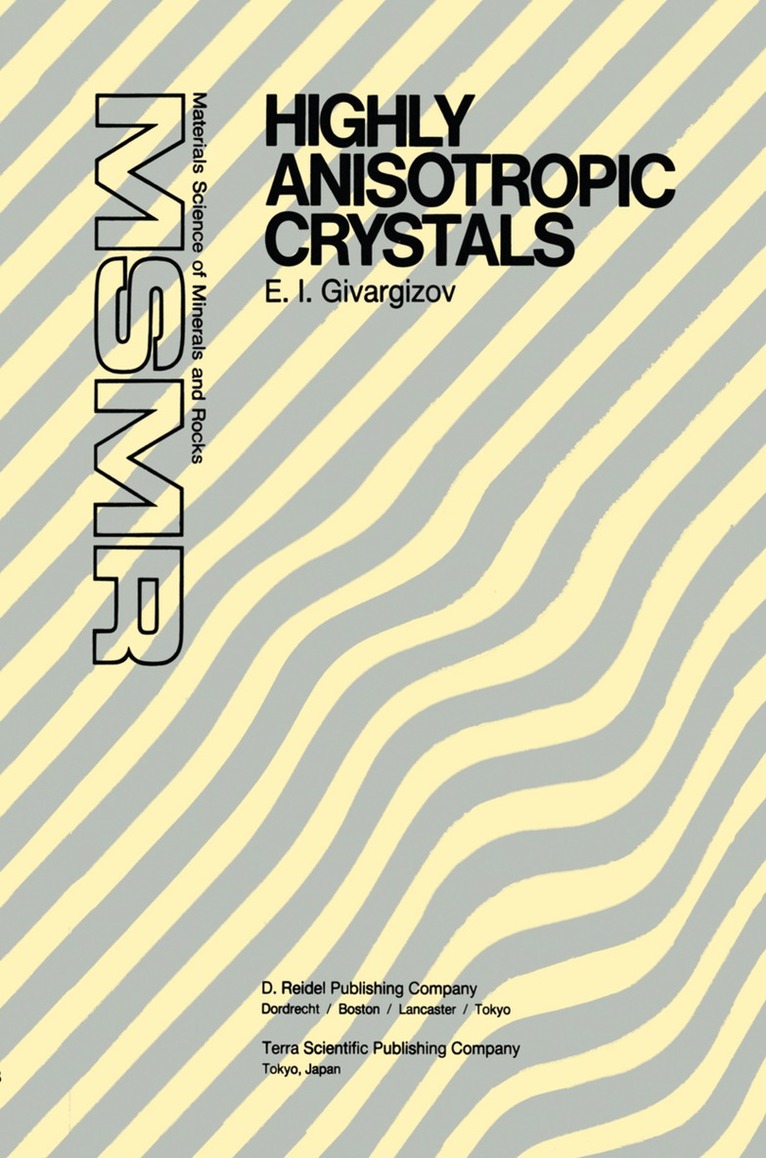
    Highly Anisotropic Crystals

    AvE.I. Givargizov

    Inbunden, Engelska, 1986

    Del i serien Materials Science of Minerals and Rocks

    1 613 kr

    Beställningsvara. Skickas inom 10-15 vardagar. Fri frakt över 249 kr.

    Fler format och utgåvor

    Häftad

    1 721 kr

    Beskrivning

    Anisotropy, i.e., the dependence of structure and properties on direction in space, is the most striking characteristic of crystals. Anisotropy is a result of the discrete nature of the crystal lattice, and it is the characteristic which distinguishes the crystalline state from another solid state of matter, the amorphous. The anisotropy of the structure and properties of crystals (this can be called their 'internal anisotropy') is also reflected in their external structure, i.e., morphology. The reflection is, however, non-linear: properties such as mechanical hardness ... do not change strongly (typically several tens of percents, depending on direction) while the morphology ... : the linear sizes in different directions of individual crystals often differ by several multiples or even several orders of magnitude, depending on the symmetry of the crystalline lattice and/or of the crystal prehistory. The enhanced anisotropy of morphology is, as a rule, a result of growth kinetics of different crystalline faces; it reflects a non-linear character of the kinetic laws of growth. This book is devoted to high morphological anisotropy. No strict classification of highly-anisotropic crystals exists. However some typical forms, or habits, can be singled out: first, whiskers (or needles, or fibers) as quasi-one-dimensional crystals, and second, platelets as quasi-two-dimensional crystals.

    Produktinformation

    • Utgivningsdatum:1986-12-31
    • Mått:156 x 234 x 27 mm
    • Vikt:781 g
    • Format:Inbunden
    • Språk:Engelska
    • Serie:Materials Science of Minerals and Rocks
    • Antal sidor:394
    • Upplaga:1987
    • Förlag:Springer
    • ISBN:9789027721723

    Utforska kategorier

    • Kemi inom Naturvetenskap och teknik

    Innehållsförteckning

    • 1 / Highly-Anisotropic Crystals in Nature.- 1.1. Minerals.- 1.2. Snow Crystals.- 1.3. Highly-Anisotropic Crystals in Living Organisms.- References.- 2 / Growth of Whiskers from the Vapor Phase.- 2.1. Whisker Growth Caused by the Crystal Structure.- 2.2. Growth of Whiskers under External Fields.- 2.3. Principal Models and Theories of Whisker Growth.- 2.4. Kinetics of the VLS Whisker Growth.- 2.5. The Diffusion-Droplet Model of Whisker Growth.- 2.6. Some Processes Related to VLS Whisker Growth.- 2.7. Controlled Growth of Whiskers.- References.- 3 / Growth of Whiskers from the Liquid Phase.- 3.1. Growth from Solutions 230.- 3.2. Growth of Whiskers (‘fibers’) from Melt.- References.- 4 / Growth of Whiskers from the Solid State.- 4.1. Spontaneous Growth from the Solid State.- 4.2. ‘Corrosion Whiskers’ from the Solid State.- 4.3. Growth of Whiskers by Thermal Gradient Transport in Solids.- 4.4. Growth of Whiskers by Electrotransport.- 4.5. Highly-Anisotropic Inclusions in Solids.- 4.6. Concluding Remarks 274.- References.- 5 / Growth of Plate-Like Crystals.- 5.1. Plate-Like Growth Due to Structure of the Material.- 5.2. Growth of Plate-Like Crystals from the Vapor Phase.- 5.3. Growth of Platelets from Solutions.- 5.4. Growth from the Melt.- 5.5. Growth of Hollow Whiskers 305.- References.- 6 / Growth of Highly-Anisotropic Crystalline Structures.- 6.1. In situ Composites.- 6.2. Highly-Anisotropic Surface Textures.- 6.3. Highly-Anisotropic Structures in Deposited Films.- References.- 7 / Properties of Highly-Anisotropic Crystals.- 7.1. Mechanical Properties.- 7.2. Magnetic Properties.- 7.3. Electrical Properties.- 7.4. Optical Properties.- 7.5. Some Physico-Chemical Properties 371.- References.- 8 / Applications.- 8.1. Composites.- 8.2. Textured Surfaces for SolarEnergy Conversion.- 8.3. Electronics.- 8.4. Highly-Anisotropic Crystals as Unique Objects for Physical Investigations.- References.- 9 / Conclusions.- Substance Index.