Mechanics of Fluids and Transport Processes - Böcker
Visar alla böcker i serien Mechanics of Fluids and Transport Processes. Handla med fri frakt och snabb leverans.
13 produkter
13 produkter
1 062 kr
Skickas inom 10-15 vardagar
Liquid metal MHO is within the scope of two series of international conferences. One is the International Congress on "MHD Power Generation", held every four years, which includes technical and economical aspects as well as scientific questions. The other if the Beer-Sheva Seminar on "MHO Flows and Turbulence", held every three years in Israel. In addition to these well established meetings, an IUTAM Symposium was previously organized in Cambridge (UK) in 1982 on "Metallurgical Applications of MHD" by the late Arthur Shercliff. It was focussed on a very specific subject developing radiply from the middle of the 1970's. The magnetic field was generally AC, including frequencies high enough for the skin-depth to be much smaller than the typical length scale of the liquide pool. And the development of new technologies, or the improvement of existing ones, was the main justification of most of the researches presented and discussed. Only two participants from Eastern countries attended this Symposium. By the middle of the 1980's we felt that on this very same topic ideas had reached much more maturity than in 1982. We also realized that a line of research on MHD flows related to fusion reactors (tokamaks) was developing significantly, with particular emphasis on flows at large interaction parameter.
Del 2 - Mechanics of Fluids and Transport Processes
Mechanics of Viscoelastic Fluids
Inbunden, Engelska, 1982
1 589 kr
Skickas inom 10-15 vardagar
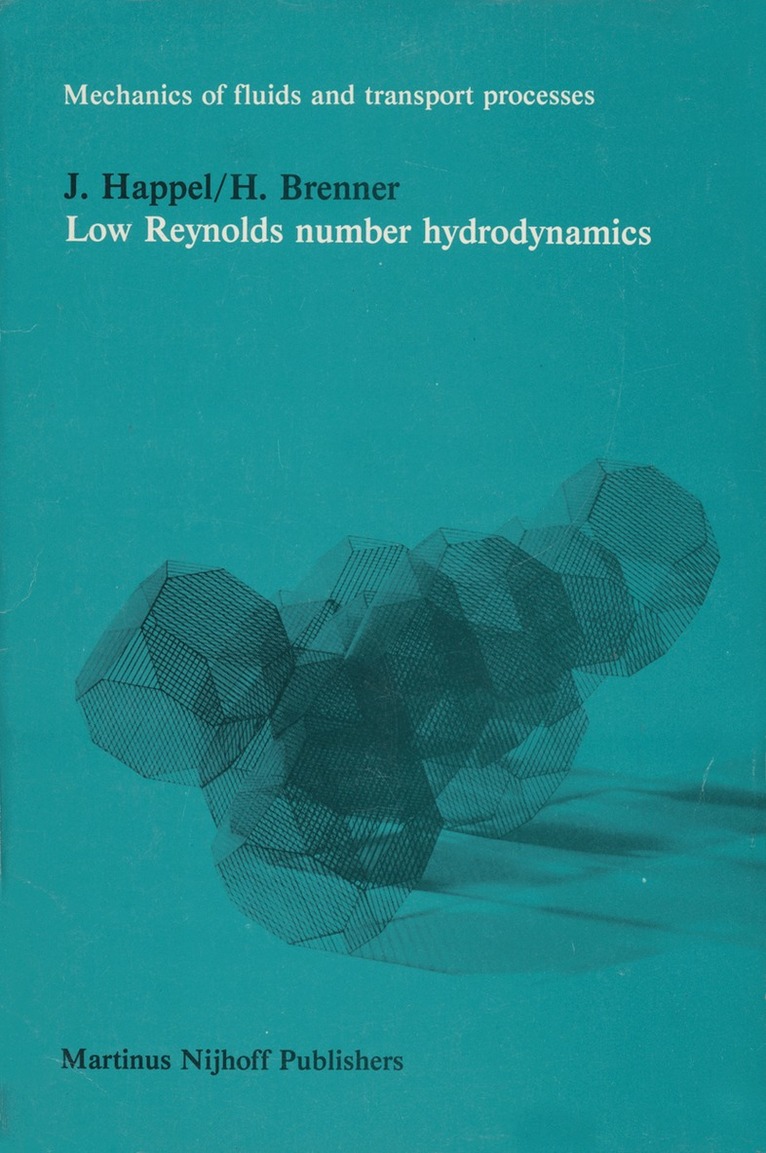
Low Reynolds number hydrodynamics
with special applications to particulate media
Häftad, Engelska, 1983
1 695 kr
Skickas inom 10-15 vardagar
One studying the motion of fluids relative to particulate systems is soon impressed by the dichotomy which exists between books covering theoretical and practical aspects. Classical hydrodynamics is largely concerned with perfect fluids which unfortunately exert no forces on the particles past which they move. Practical approaches to subjects like fluidization, sedimentation, and flow through porous media abound in much useful but uncorrelated empirical information. The present book represents an attempt to bridge this gap by providing at least the beginnings of a rational approach to fluid particle dynamics, based on first principles. From the pedagogic viewpoint it seems worthwhile to show that the Navier-Stokes equations, which form the basis of all systematic texts, can be employed for useful practical applications beyond the elementary problems of laminar flow in pipes and Stokes law for the motion of a single particle. Although a suspension may often be viewed as a continuum for practical purposes, it really consists of a discrete collection of particles immersed in an essentially continuous fluid. Consideration of the actual detailed boundary value problems posed by this viewpoint may serve to call attention to the limitation of idealizations which apply to the overall transport properties of a mixture of fluid and solid particles.
1 062 kr
Skickas inom 10-15 vardagar
In the spring of 1971, Reinier Tirnrnan visited the University of Delaware during which time he gave a series of lectures on water waves from which these notes grew. Those of us privi leged to be present during that time will never forget the experience. Rein Tirnrnan is not easily forgotten. His seemingly inexhaustible energy completely overwhelmed us. Who could forget the numbing effect of a succession of long wine filled evenings of lively conversation on literature, politics, education, you name it, followed early the next day by the appearance of the apparently totally refreshed red haired giant eager to discuss our mathematical problems with keen insight en remarkable understanding, ready to lecture on fluid mechanics or optimal control theory or a host of other subjects and ready to work into the evening until the cycle repeated. He thought faster, he knew more, he drank more and he slept less than any of us mortals and he literally wore us out. What a rare privilege indeed to have participated in this intellectual orgy. Tirnrnan's lively interest in almost every thing coupled with his buoyant enthusiasm and infectious op timism epitomized his approach to life. No delicate nibbling at the fringes, he wanted every morsel of every course. In these times of narrow specialization truly renaissance figures are, if not extinct, at least a highly endangered species. But Tirnrnan was one of that rare breed.
3 172 kr
Skickas inom 10-15 vardagar
This book is written primarily for Earth scientists faced with problems in thermo mechanics such as the flow and evolution of ice-sheets, convection currents in the mantle, isostatic rebound, folding of strata or collapse of cavities in salt domes. Failure, faults, seismic waves and all processes involving inertial terms will not be dealt with. In general such scientists (graduate students beginning a Ph. D. for instance) have too small a background'in continuum mechanics and in numerical computation to model conveniently these problems, which are not elementary at all. Most of them are not linear, and therefore seldom dealt with in treatises. If the study of reality were clearly cut into two successive steps: first to make a physical model, setting up a well-posed problem in thermo-mechanics, and second to solve it, the obvious solution would be to find a specialist in computational mechanics who could spend enough time on a problem which, although maybe crucial for on-going fundamental research, has little practical interest in general, and cannot be considered properly as a noteworthy progress in Mechanics. But this is not the way Science develops. There is a continuous dialectic between the building up of a model and its mathematical treatment. The model should be simple enough to be tractable, but not oversimplified. Its sensitivity to the different components it is made of should be investigated, and more thought is needed when the results contradict hard facts.
1 062 kr
Skickas inom 10-15 vardagar
A variety of nonlinear effects occur in a plasma. First, there are the wave steepening effects which can occur in any fluid in which the propagation speed depends upon the wave-amplitude. In a dispersive medium this can lead to classes of nonlinear waves which may have stationary solutions like solitons and shocks. Because the plasma also acts like an inherently nonlinear dielectric resonant interactions among waves lead to exchange of energy among them. Further, an electromagnetic wave interacting with a plasma may parametrically excite other waves in the plasma. A large-amplitude Langmuir wave undergoes a modulational instability which arises through local depressions in plasma density and the corresponding increases in the energy density of the wave electric field. Whereas a field collapse occurs in two and three dimensions, in a one-dimensional case, spatially localized stationary field structures called Langmuir solitons can result. Many other plasma waves like upper-hybrid waves, lower-hybrid waves etc. can also undergo a modulational instability and produce localized field structures. A new type of nonlinear effect comes into play when an electromagnetic wave propagating through a plasma is strong enough to drive the electrons to relativistic speeds. This leads to a propagation of an electromagnetic wave in a normally overdense plasma, and the coupling of the electromagnetic wave to a Langmuir wave in the plasma. The relativistic mass variation of the electrons moving in an intense electromagnetic wave can also lead to a modulational instability of the latter.
1 062 kr
Skickas inom 10-15 vardagar
In the spring of 1971, Reinier Tirnrnan visited the University of Delaware during which time he gave a series of lectures on water waves from which these notes grew. Those of us privi leged to be present during that time will never forget the experience. Rein Tirnrnan is not easily forgotten. His seemingly inexhaustible energy completely overwhelmed us. Who could forget the numbing effect of a succession of long wine filled evenings of lively conversation on literature, politics, education, you name it, followed early the next day by the appearance of the apparently totally refreshed red haired giant eager to discuss our mathematical problems with keen insight en remarkable understanding, ready to lecture on fluid mechanics or optimal control theory or a host of other subjects and ready to work into the evening until the cycle repeated. He thought faster, he knew more, he drank more and he slept less than any of us mortals and he literally wore us out. What a rare privilege indeed to have participated in this intellectual orgy. Tirnrnan's lively interest in almost every thing coupled with his buoyant enthusiasm and infectious op timism epitomized his approach to life. No delicate nibbling at the fringes, he wanted every morsel of every course. In these times of narrow specialization truly renaissance figures are, if not extinct, at least a highly endangered species. But Tirnrnan was one of that rare breed.
Del 3 - Mechanics of Fluids and Transport Processes
Elements of hydrodynamic propulsion
Häftad, Engelska, 2011
534 kr
Skickas inom 10-15 vardagar
This is a treatment of a number of aspects of the theory of hydrody namic propulsion. It has been written with in mind technical propulsion systems generally based on lift producing profiles. We assume the fluid, which is admitted in conventional hydrody namics, to be incompressible. Further we assume the occurring Reynolds numbers to be sufficiently high such that the inertia forces dominate by far the viscous forces, therefore we take the fluid to be inviscid. Of course it must be realized that viscosity plays an important part in a number of phenomena displayed in real flows, such as flow separation at the nose of a profile and the entrainment of fluid by a ship's hull. Another ap proximation which will be used in general is that the problems are linearized. In other words it is assumed that the induced disturbance velocities are sufficiently small, such that their squares can be neglected with respect to these velocities themselves. Hence it is necessary to evaluate the domain of validity of the results with respect to these two a priori assumptions. Anyhow it seems advisable to have first a good understanding of the linearized non-viscous theory before embarking on complicated theories which describe more or less realistic situations. For elaborations of the theory to realistic situations we will refer to current literature. In low Reynolds number flow, singular external forces and moments are very useful.
1 062 kr
Skickas inom 10-15 vardagar
Liquid metal MHO is within the scope of two series of international conferences. One is the International Congress on "MHD Power Generation", held every four years, which includes technical and economical aspects as well as scientific questions. The other if the Beer-Sheva Seminar on "MHO Flows and Turbulence", held every three years in Israel. In addition to these well established meetings, an IUTAM Symposium was previously organized in Cambridge (UK) in 1982 on "Metallurgical Applications of MHD" by the late Arthur Shercliff. It was focussed on a very specific subject developing radiply from the middle of the 1970's. The magnetic field was generally AC, including frequencies high enough for the skin-depth to be much smaller than the typical length scale of the liquide pool. And the development of new technologies, or the improvement of existing ones, was the main justification of most of the researches presented and discussed. Only two participants from Eastern countries attended this Symposium. By the middle of the 1980's we felt that on this very same topic ideas had reached much more maturity than in 1982. We also realized that a line of research on MHD flows related to fusion reactors (tokamaks) was developing significantly, with particular emphasis on flows at large interaction parameter.
Del 9 - Mechanics of Fluids and Transport Processes
Electrically Induced Vortical Flows
Häftad, Engelska, 2011
534 kr
Skickas inom 10-15 vardagar
Every scientific subject probably conceals unexplored or little investigated strata, which may show up at the proper time when favourable conditions coincide (practical demands, a circle of scientists prepared to recognize the novelty and capable of giving impetus to the development of a new theory, etc.). Something like this occurred in early seventies for magnetohydrodynamics, which at the time was considered to be a relatively complete branch of hydro dynamics with no apparent broad, unexplored areas. It was unexpectedly realized that, in addition to the traditional methods of affecting an electrically conducting medium, there is yet another way, one which subsequently lead to a new direction in magnetohydrodynamics. In the Soviet scientific literature this direction has been termed 'electrically induced vortex flows', the essence of which are hydrodynamic effects due to the interaction of an electric current passing through the fluid with its own magnetic field. It cannot be said that this direction was created ex nihilo: individual studies related to the flows driven in a current-carrying medium in the absence of external magnetic fields appeared in the sixties; in the thirties the flows them selves were known to take place within electrical arcs; and yet the first observa tions on the behaviour of liquid current-carrying conductors were made at the beginning of this century.
1 062 kr
Skickas inom 10-15 vardagar
A variety of nonlinear effects occur in a plasma. First, there are the wave steepening effects which can occur in any fluid in which the propagation speed depends upon the wave-amplitude. In a dispersive medium this can lead to classes of nonlinear waves which may have stationary solutions like solitons and shocks. Because the plasma also acts like an inherently nonlinear dielectric resonant interactions among waves lead to exchange of energy among them. Further, an electromagnetic wave interacting with a plasma may parametrically excite other waves in the plasma. A large-amplitude Langmuir wave undergoes a modulational instability which arises through local depressions in plasma density and the corresponding increases in the energy density of the wave electric field. Whereas a field collapse occurs in two and three dimensions, in a one-dimensional case, spatially localized stationary field structures called Langmuir solitons can result. Many other plasma waves like upper-hybrid waves, lower-hybrid waves etc. can also undergo a modulational instability and produce localized field structures. A new type of nonlinear effect comes into play when an electromagnetic wave propagating through a plasma is strong enough to drive the electrons to relativistic speeds. This leads to a propagation of an electromagnetic wave in a normally overdense plasma, and the coupling of the electromagnetic wave to a Langmuir wave in the plasma. The relativistic mass variation of the electrons moving in an intense electromagnetic wave can also lead to a modulational instability of the latter.
Del 6 - Mechanics of Fluids and Transport Processes
Turbulence in Fluids
Stochastic and Numerical Modelling
Häftad, Engelska, 2012
534 kr
Skickas inom 10-15 vardagar
3 172 kr
Skickas inom 10-15 vardagar
This book is written primarily for Earth scientists faced with problems in thermo mechanics such as the flow and evolution of ice-sheets, convection currents in the mantle, isostatic rebound, folding of strata or collapse of cavities in salt domes. Failure, faults, seismic waves and all processes involving inertial terms will not be dealt with. In general such scientists (graduate students beginning a Ph. D. for instance) have too small a background'in continuum mechanics and in numerical computation to model conveniently these problems, which are not elementary at all. Most of them are not linear, and therefore seldom dealt with in treatises. If the study of reality were clearly cut into two successive steps: first to make a physical model, setting up a well-posed problem in thermo-mechanics, and second to solve it, the obvious solution would be to find a specialist in computational mechanics who could spend enough time on a problem which, although maybe crucial for on-going fundamental research, has little practical interest in general, and cannot be considered properly as a noteworthy progress in Mechanics. But this is not the way Science develops. There is a continuous dialectic between the building up of a model and its mathematical treatment. The model should be simple enough to be tractable, but not oversimplified. Its sensitivity to the different components it is made of should be investigated, and more thought is needed when the results contradict hard facts.