Modern and Contemporary Poetic – serie
Visar alla böcker i serien Modern and Contemporary Poetic. Handla med fri frakt och snabb leverans.
3 produkter
3 produkter
Häftad, Engelska, 2012
367 kr
Skickas inom 5-8 vardagar
The essays in Phenomenal Reading entice readers to cross accepted barriers, and highlight the work of poets who challenge language-as-usual in academia and the culture at large.Phenomenal Reading is comprised of essays that are central to how best to read poetry. This book examines individually and collectively poets widely recognised as formal and linguistic innovators. Why do their words appear in unconventional orders? What end do these arrangements serve? Why are they striking? Brian Reed focuses on poetic form as a persistent puzzle, using historical fact and the views of other key critics to clarify how particular literary works are constructed and how those constructions lead to specific effects.Understanding that explication and contextualisation do not always sufficiently harness the power of poetry, Reed pursues phenomenological methods that take into account each reader’s unique perception of the world. This collection of twelve essays values narrative as a tool for conveying the intricacy, contingency and richness of poetic experience.
Häftad, Engelska, 2013
493 kr
Skickas inom 5-8 vardagar
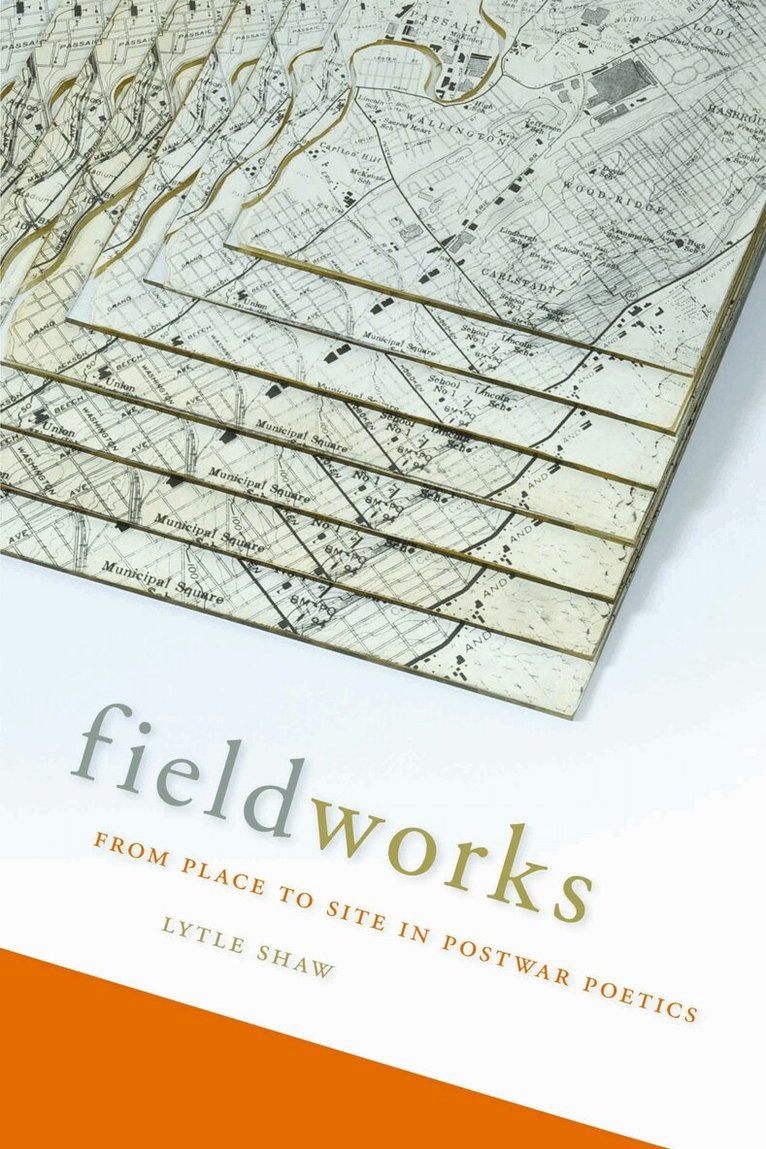
Fieldworks offers a historical account of the social, rhetorical, and material attempts to ground art and poetry in the physicality of a site. Arguing that place-oriented inquiries allowed poets and artists to develop new, experimental models of historiography and ethnography, Lytle Shaw draws out the shifting terms of this practice from World War II to the present through a series of illuminating case studies. Beginning with the alternate national genealogies unearthed by William Carlos Williams in Paterson and Charles Olson in Gloucester, Shaw demonstrates how subsequent poets sought to ground such inquiries in concrete social formations - to in effect live the poetics of place: Gary Snyder in his back-to-the-land familial compound, Kitkitdizze; Amiri Baraka in a black nationalist community in Newark; Robert Creeley and the poets of Bolinas, California, in the capacious 'now' of their poet-run town. Turning to the work of Robert Smithson - who called one of his essays an 'appendix to Paterson,' and who in turn has exerted a major influence on poets since the 1970s - Shaw then traces the emergence of site-specific art in relation both to the poetics of place and to the larger linguistic turn in the humanities, considering poets including Clark Coolidge, Bernadette Mayer, and Lisa Robertson. By putting the poetics of place into dialog with site-specificity in art, Shaw demonstrates how poets and artists became experimental explicators not just of concrete locations and their histories, but of the discourses used to interpret sites more broadly. It is this dual sense of fieldwork that organizes Shaw's groundbreaking history of site-specific poetry.
Häftad, Engelska, 2012
430 kr
Skickas inom 5-8 vardagar
The Darkness of the Present includes essays that collectively investigate the roles of anomaly and anachronism as they work to unsettle commonplace notions of the 'contemporary' in the field of poetics. In the eleven essays of The Darkness of the Present, poet and critic Steve McCaffery argues that by approaching the past and the present as unified entities, the contemporary is made historical at the same time as the historical is made contemporary. McCaffery's writings work against the urge to classify works by placing them in standard literary periods or disciplinary partitions. Instead, McCaffery offers a variety of insights into unusual and ingenious affiliations between poetic works that may have previously seemed distinctive. He questions the usual associations of originality and precedence. In the process, he repositions many texts within genealogies separate from the ones to which they are traditionally assigned. The chapters in The Darkness of the Present might seem to present an eclectic fa\u00e7ade and can certainly be read independently. They are linked, however, by a common preoccupation reflected in the title of the book: the anomaly and the anachronism and the way their empirical emergence works to unsettle a steady notion of the 'contemporary' or 'new.'