Nonlinear Topics in the Mathematical Sciences - Böcker
Visar alla böcker i serien Nonlinear Topics in the Mathematical Sciences. Handla med fri frakt och snabb leverans.
5 produkter
5 produkter
Del 2 - Nonlinear Topics in the Mathematical Sciences
Bifurcations in Flow Patterns
Some Applications of the Qualitative Theory of Differential Equations in Fluid Dynamics
Inbunden, Engelska, 1991
1 589 kr
Skickas inom 10-15 vardagar
The main idea of the present study is to demonstrate that the qualitative theory of diffe rential equations, when applied to problems in fluid-and gasdynamics, will contribute to the understanding of qualitative aspects of fluid flows, in particular those concerned with geometrical properties of flow fields such as shape and stability of its streamline patterns. It is obvious that insight into the qualitative structure of flow fields is of great importance and appears as an ultimate aim of flow research. Qualitative insight fashions our know ledge and serves as a good guide for further quantitative investigations. Moreover, quali tative information can become very useful, especially when it is applied in close corres pondence with numerical methods, in order to interpret and value numerical results. A qualitative analysis may be crucial for the investigation of the flow in the neighbourhood of singularities where a numerical method is not reliable anymore due to discretisation er rors being unacceptable. Up till now, familiar research methods -frequently based on rigorous analyses, careful nu merical procedures and sophisticated experimental techniques -have increased considera bly our qualitative knowledge of flows, albeit that the information is often obtained indirectly by a process of a careful but cumbersome examination of quantitative data. In the past decade, new methods are under development that yield the qualitative infor mation more directly. These methods, make use of the knowledge available in the qualitative theory of differen tial equations and in the theory of bifurcations.
Del 3 - Nonlinear Topics in the Mathematical Sciences
Course on Nonlinear Waves
Inbunden, Engelska, 1993
1 062 kr
Skickas inom 10-15 vardagar
This volume presents an introduction to nonlinear waves in the natural sciences and engineering. It contains many classical results as well as more recent results, dealing with topics such as the forced Korteweg-de Vries equation and material relating to X-ray crystallography. The volume contains nine chapters. Chapter 1 concerns asymptotics and nonlinear ordinary differential equations. Conservation laws are discussed in Chapter 2, and Chapter 3 considers water waves. The scattering and inverse scattering method is described in Chapter 4, which also contains a full explanation of using the inverse scattering method for finding l-, 2- and 3-soliton solutions of the Korteweg-de Vries equation. After dealing with the Burgers equation in Chapter 5, Chapter 6 discusses the forced Korteweg-de Vries equations. Here the emphasis is on steady-state bifurcations and unsteady-state periodic soliton generation. The Sine- Gordon and nonlinear Schroedinger equations are the subject of Chapter 7. The final two chapters consider wave instability and resonance. Every chapter contains problems and exercises, together with guidance for their solution.The volume concludes with some appendices, which describe symbolic derivations of certain results on solitons. Several user-friendly MATHEMATICA packages are included. The prerequisite for using this book is a background knowledge of basic physics, linear algebra and differential equations. For graduates and researchers in mathematics, physics and engineering requiring an introduction to nonlinear wave theory and its applications.
Del 3 - Nonlinear Topics in the Mathematical Sciences
Course on Nonlinear Waves
Häftad, Engelska, 2012
1 062 kr
Skickas inom 10-15 vardagar
The aim of this book is to give a self-contained introduction to the mathe matical analysis and physical explanations of some basic nonlinear wave phe nomena. This volume grew out of lecture notes for graduate courf;!es which I gave at the University of Alberta, the University of Saskatchewan, ·and Texas A&M University. As an introduction it is not intended to be exhaustive iQ its choice of material, but rather to convey to interested readers a basic; yet practical, methodology as well as some of the more important results obtained since the 1950's. Although the primary purpose of this volume is to serve as a textbook, it should be useful to anyone who wishes to understand or conduct research into nonlinear waves. Here, for the first time, materials on X-ray crystallography and the forced Korteweg-de Vries equation are incorporated naturally into a textbook on non linear waves. Another characteristic feature of the book is the inclusion of four symbolic calculation programs written in MATHEMATICA. They emphasize outcomes rather than numerical methods and provide certain symbolic and nu merical results related to solitons. Requiring only one or two commands to run, these programs have user-friendly interfaces. For example, to get the explicit expression of the 2-soliton of the Korteweg-de Vries equation, one only needs to type in soliton[2] when using the program solipac.m.
Del 2 - Nonlinear Topics in the Mathematical Sciences
Bifurcations in Flow Patterns
Some Applications of the Qualitative Theory of Differential Equations in Fluid Dynamics
Häftad, Engelska, 2012
1 589 kr
Skickas inom 10-15 vardagar
The main idea of the present study is to demonstrate that the qualitative theory of diffe rential equations, when applied to problems in fluid-and gasdynamics, will contribute to the understanding of qualitative aspects of fluid flows, in particular those concerned with geometrical properties of flow fields such as shape and stability of its streamline patterns. It is obvious that insight into the qualitative structure of flow fields is of great importance and appears as an ultimate aim of flow research. Qualitative insight fashions our know ledge and serves as a good guide for further quantitative investigations. Moreover, quali tative information can become very useful, especially when it is applied in close corres pondence with numerical methods, in order to interpret and value numerical results. A qualitative analysis may be crucial for the investigation of the flow in the neighbourhood of singularities where a numerical method is not reliable anymore due to discretisation er rors being unacceptable. Up till now, familiar research methods -frequently based on rigorous analyses, careful nu merical procedures and sophisticated experimental techniques -have increased considera bly our qualitative knowledge of flows, albeit that the information is often obtained indirectly by a process of a careful but cumbersome examination of quantitative data. In the past decade, new methods are under development that yield the qualitative infor mation more directly. These methods, make use of the knowledge available in the qualitative theory of differen tial equations and in the theory of bifurcations.
Del 1 - Nonlinear Topics in the Mathematical Sciences
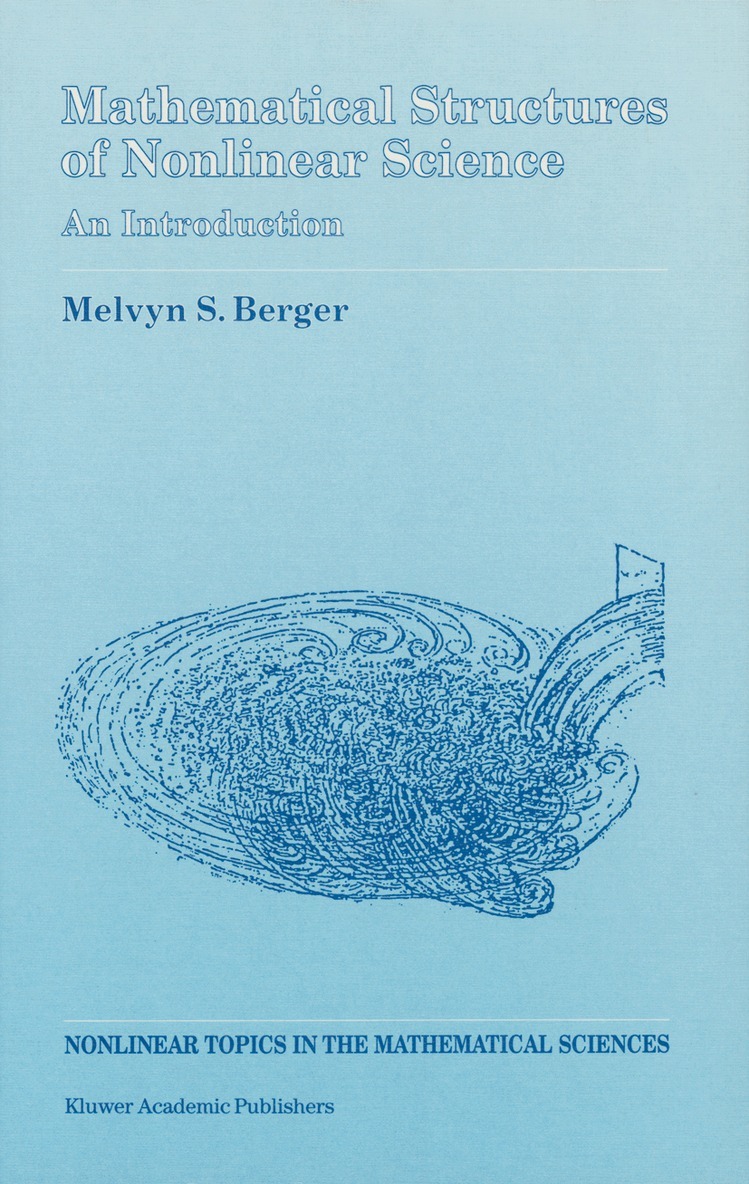
Mathematical Structures of Nonlinear Science
An Introduction
Häftad, Engelska, 2012
534 kr
Skickas inom 10-15 vardagar
This is the first volume of a series of books that will describe current advances and past accompli shments of mathemat i ca 1 aspects of nonlinear sCience taken in the broadest contexts. This subject has been studied for hundreds of years, yet it is the topic in whi ch a number of outstandi ng di scoveri es have been made in the past two decades. Clearly, this trend will continue. In fact, we believe some of the great scientific problems in this area will be clarified and perhaps resolved. One of the reasons for this development is the emerging new mathematical ideas of nonlinear science. It is clear that by looking at the mathematical structures themselves that underlie experiment and observation that new vistas of conceptual thinking lie at the foundation of the unexplored area in this field. To speak of specific examples, one notes that the whole area of bifurcation was rarely talked about in the early parts of this century, even though it was discussed mathematically by Poi ncare at the end of the ni neteenth century. I n another di rect ion, turbulence has been a key observation in fluid dynamics, yet it was only recently, in the past decade, that simple computer studies brought to light simple dynamical models in which chaotic dynamics, hopefully closely related to turbulence, can be observed.