Oxford Series in Cognitive Development - Böcker
Visar alla böcker i serien Oxford Series in Cognitive Development. Handla med fri frakt och snabb leverans.
11 produkter
11 produkter
1 115 kr
Skickas inom 5-8 vardagar
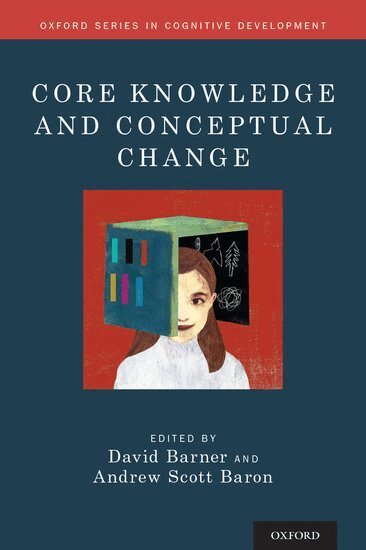
We acquire concepts such as "atom," "force," "integer," and "democracy" long after we are born; these concepts are not part of the initial cognitive state of human beings. Other concepts like "object," "cause," or "agent" may be present early in infancy--if not innately. Processes of change occur throughout our conceptual development, which prompts two key questions: Which human concepts constitute innate, core knowledge? How do humans acquire new concepts, and how do these concepts change in development?Core Knowledge and Conceptual Change provides a unique theoretical and empirical introduction to the study of conceptual development, documenting key advances in case studies, including ground-breaking science on human representations of language, objects, number, events, color, space, time, beliefs, and desires. Additionally, it explores how humans engage in moral reasoning and causal explanation: Are humans born good and tainted by an imperfect world, or do we need to teach children to be moral? Could a concept like "freedom" be woven into the human soul, or is it a historical invention, constructed over generations of humans? Written by an eminent list of contributors renowned in child development and cognitive science, this book delves widely, and deeply, into the cognitive tools available at birth that are repurposed, combined, and transformed to complex, abstract adult conceptual representations, and should be of interest to developmental psychologists, linguists, philosophers, and students of cognitive science.
758 kr
Skickas inom 5-8 vardagar
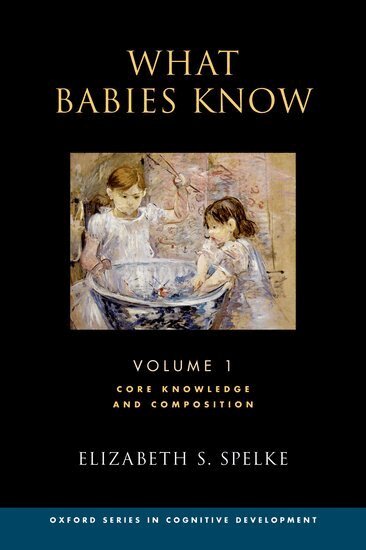
What do infants know? How does the knowledge that they begin with prepare them for learning about the particular physical, cultural, and social world in which they live? Answers to this question shed light not only on infants but on children and adults in all cultures, because the core knowledge possessed by infants never goes away. Instead, it underlies the unspoken, common sense knowledge of people of all ages, in all societies. By studying babies, researchers gain insights into infants themselves, into older children's prodigious capacities for learning, and into some of the unconscious assumptions that guide our thoughts and actions as adults. In this major new work, Elizabeth Spelke shares these insights by distilling the findings from research in developmental, comparative, and cognitive psychology, with excursions into studies of animal cognition in psychology and in systems and cognitive neuroscience, and studies in the computational cognitive sciences. Weaving across these disciplines, she paints a picture of what young infants know, and what they quickly come to learn, about objects, places, numbers, geometry, and people's actions, social engagements, and mental states.A landmark publication in the developmental literature, the book will be essential for students and researchers across the behavioral, brain, and cognitive sciences.
844 kr
Skickas inom 5-8 vardagar
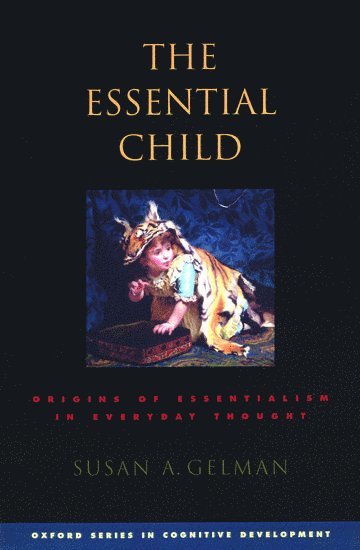
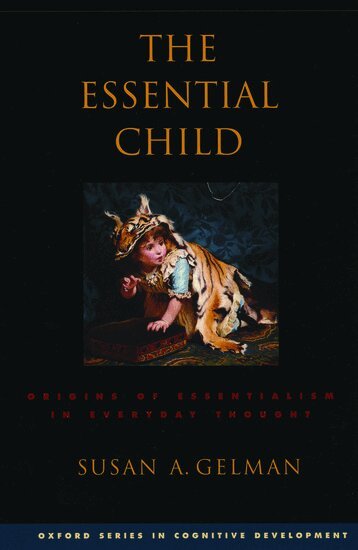
Numerous fields stake claims about essentialism but this is the first book to address the issues surrounding essentialism from the perspective of developmental psychology. Gelman synthesizes 15 years of empirical research on essentialism into a coherent framework, examining children's thinking and ways in which language influences thought. She argues that young children's use of concepts such as "dog," "man," or "intelligence," reflects their deep commitment to the presence of these categories' properties that extends beyond the observable information about objects. The presence of this commitment in children also means that they do not come into the world as passive recipients of data, but rather have an organizational scheme that supports categories. This volume will be of interest to developmental, cognitive, and social psychologists, as well as to scholars in cognitive science and philosophy.
738 kr
Skickas inom 5-8 vardagar
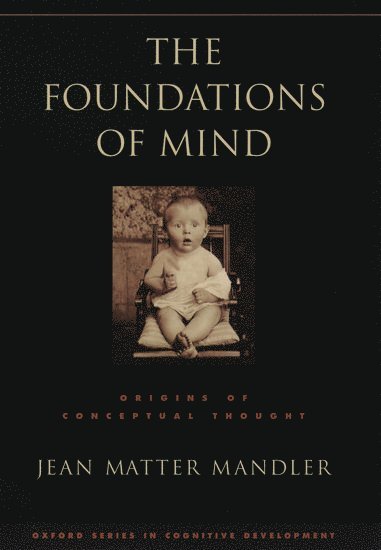
The Foundations of Mind presents a new theory of cognitive development in infancy, focusing on the ways that perceptual information becomes transformed into conceptual thought. Mandler tackles issues such as how babies form concepts and begin to think before they have language, and how they can recall the past and make inductive inferences. Drawing on her extensive research, she illustrates how these processes form the conceptual basis for language and advanced thought, stressing the importance of distinguishing automatic perceptual processes from conceptualizations about what is perceived. She argues that these two kinds of learning, though sometimes confounded in psychological experimentation, follow different principles, and that it is crucial to specify the particular kind of learning required by a given task. Early preverbal concepts, although typically more general than infant perceptual categories, allow infants to make the inductive generalizations necessary for them to form theories about the world and organize their developing conceptual system into a recognizably adult form.Mandler also addresses the neglected issues of how concepts such as animacy, inanimacy, agency, goal, containment, and support are represented in the mind. She suggests that image-schemas, used by cognitive linguists to represent underlying linguistic meanings, also format the basic concepts used by infants for inferential thought and language learning. She also shows how a mechanism that analyzes spatial displays leads to mini-theories about how various objects interact with one another.Countering strong nativist and empiricist views, Mandler provides a fresh and markedly different perspective on early cognitive development, painting a new picture of the abilities and accomplishments of infants and the development of the mind.
860 kr
Skickas inom 5-8 vardagar
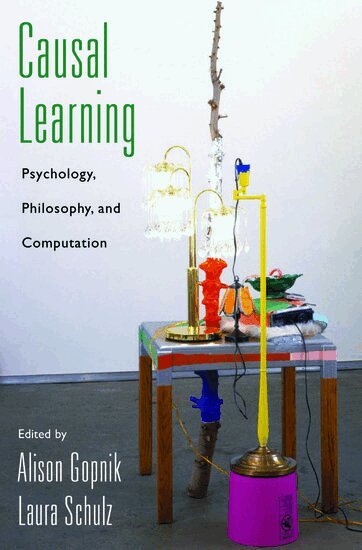
The world has a causal structure, in the sense that some events make other events happen. Although understanding causal structure is essential for predicting and controlling the environment, causal structure is, at least usually, not obvious from superficial, perceptual cues. How then do our minds infer this structure? In the last few years, questions about causal inference and learning have become an important focus of investigation in many different disciplines - developmental psychology, cognitive psychology, ethology, philosophy, and computer science. As is common in scientific research, there has been relatively little interaction on the topic between these disciplines. However, in spite of the minimal interaction, a general review of the research shows the beginning of a formal way of determining how, in principle, the problem of causal inference and learning can be solved, and a wealth of methods for determining how it is, in fact, solved by children, adults, and animals. This volume brings together this research and provides a more sophisticated understanding of causal inference and learning.
451 kr
Skickas inom 5-8 vardagar
Essentialism is the idea that certain categories, such as "dog," "man," or "intelligence," have an underlying reality or true nature that gives objects their identity. Where does this idea come from? In this book, Susan Gelman argues that essentialism is an early cognitive bias. Young children's concepts reflect a deep commitment to essentialism, and this commitment leads children to look beyond the obvious in many converging ways: when learning words, generalizing knowledge to new category members, reasoning about the insides of things, contemplating the role of nature versus nurture, and constructing causal explanations. Gelman argues against the standard view of children as concrete or focused on the obvious, instead claiming that children have an early, powerful tendency to search for hidden, non-obvious features of things. She also attacks claims that children build up their knowledge of the world based on simple, associative learning strategies, arguing that children's concepts are embedded in rich folk theories. Parents don't explicitly teach children to essentialize; instead, during the preschool years, children spontaneously construct concepts and beliefs that reflect an essentialist bias. Essentialist accounts have been offered, in one form or another, for thousands of years, extending back at least to Aristotle and Plato. Yet this book is the first to address the issues surrounding essentialism from a psychological perspective. Gelman synthesizes over 15 years of empirical research on essentialism into a unified framework and explores the broader lessons that the research imparts concerning, among other things, human concepts, children's thinking, and the ways in which language influences thought. This volume will appeal to developmental, cognitive, and social psychologists, as well as to scholars in cognitive science and philosophy.
651 kr
Skickas inom 5-8 vardagar
In Foundations of the Mind, Jean Mandler presents a new theory of cognitive development in infancy, focusing on the processes through which perceptual information is transformed into concepts. Drawing on extensive research, Mandler explores preverbal conceptualisation and shows how it forms the basis for both thought and language. She also emphasises the importance of distinguishing automatic perceptual processes from attentive conceptualisation, and argues that these two kinds of learning follow different principles, so it is crucial to specify the processes required by a given task. Countering both strong nativist and empiricist views, Mandler provides a fresh and markedly different perspective on early cognitive development, painting a new picture of the abilities and accomplishments of infants and the development of the mind.
595 kr
Skickas inom 5-8 vardagar
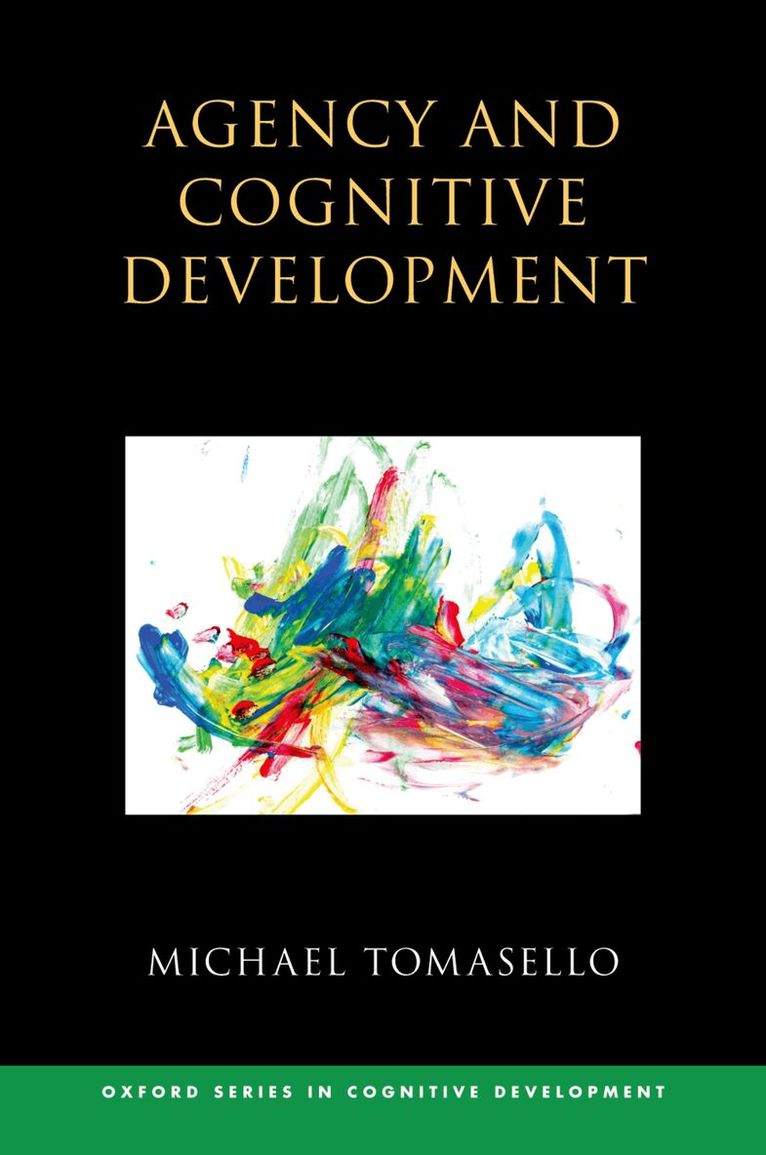
Children of different ages live in different worlds. This is partly due to learning: as children learn more and more about the world they experience it in different ways. But learning cannot be the whole story or else children could learn anything at any age - which they cannot.In a startlingly original proposal, Michael Tomasello argues that children of different ages live and learn in different worlds because their capacities to cognitively represent and operate on their experience change in significant ways over the first years of life. These capacities change because they are elements in a maturing cognitive architecture evolved for agentive decision making and action, including in shared agencies in which individuals must mentally coordinate with others. The developmental proposal is that from birth infants are goal-directed agents who cognitively represent and learn about actualities; at 9 -12 months toddlers become intentional (and joint) agents who also imaginatively and perspectivally represent and learn about possibilities; and at 3-4 years preschool youngsters become metacognitive (and collective) agents who also metacognitively represent and learn about objective/normative necessities. These developing agentive architectures - originally evolved in humans' evolutionary ancestors for particular types of decision making and action - help to explain why children learn what they do when they do.This novel agency-based model of cognitive development recognizes the important role of (Bayesian) learning, but at the same time places it in the context of the overall agentive organization of children at particular developmental periods.
1 370 kr
Skickas inom 3-6 vardagar
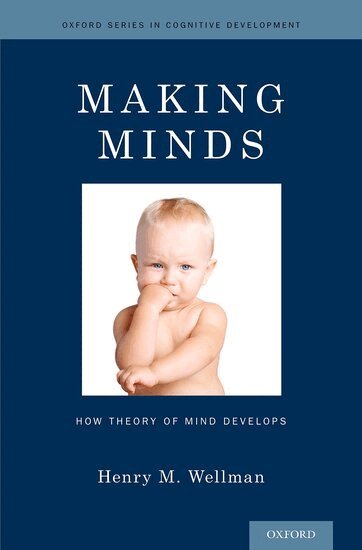
Developmental psychologists coined the term "theory of mind" to describe how we understand our shifting mental states in daily life. Over the past twenty years researchers have provided rich, provocative data showing that from an early age, children develop a sophisticated and consistent "theory of mind" by attributing their desires, beliefs, and emotions to themselves and to others. Remarkably, infants barely a few months old are able to attend closely to otherhumans; two-year-olds can articulate the desires and feelings of others and comfort those in distress; and three- and four-year-olds can talk about thoughts abstractly and engage in lies and trickery.This book provides a deeper examination of how "theory of mind" develops. Building on his pioneering research in The Child's Theory of Mind (1990), Henry M. Wellman reports on all that we have learned in the past twenty years with chapters on evolution and the brain bases of theory of mind, and updated explanations of theory theory and later theoretical developments, including how children conceive of extraordinary minds such as those belonging to superheroes or supernatural beings.Engaging and accessibly written, Wellman's work will appeal especially to scholars and students working in psychology, philosophy, cultural studies, and social cognition.
1 014 kr
Skickas inom 5-8 vardagar
Sentence First, Arguments Afterward collects the most important papers of Lila Gleitman's career, spanning over 50 years of work. These papers explore the nature of linguistic knowledge in children and adults by asking how children acquire language, how language and thought are related, the nature of concepts, and the role of syntax in shaping the direction of word learning. With an exclusive foreword by Noam Chomsky and an essay by Jeffrey Lidz contextualizing Gleitman's work in the emergence of the field of cognitive science, this book promises to be valuable both for its historical perspective on language and its acquisition and for the lessons it offers to current practitioners.
522 kr
Skickas inom 5-8 vardagar
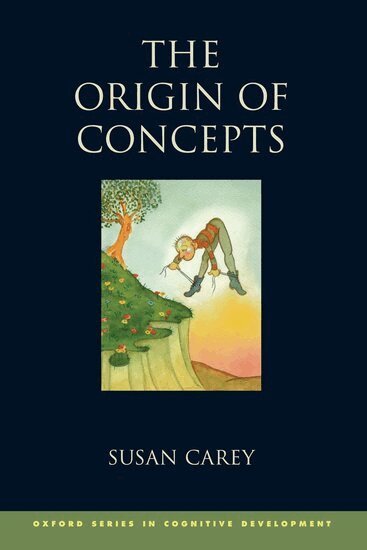
Only human beings have a rich conceptual repertoire with concepts like tort, entropy, Abelian group, mannerism, icon and deconstruction. How have humans constructed these concepts? And once they have been constructed by adults, how do children acquire them? While primarily focusing on the second question, in The Origin of Concepts , Susan Carey shows that the answers to both overlap substantially.Carey begins by characterizing the innate starting point for conceptual development, namely systems of core cognition. Representations of core cognition are the output of dedicated input analyzers, as with perceptual representations, but these core representations differ from perceptual representations in having more abstract contents and richer functional roles. Carey argues that the key to understanding cognitive development lies in recognizing conceptual discontinuities in which new representational systems emerge that have more expressive power than core cognition and are also incommensurate with core cognition and other earlier representational systems. Finally, Carey fleshes out Quinian bootstrapping, a learning mechanism that has been repeatedly sketched in the literature on the history and philosophy of science. She demonstrates that Quinian bootstrapping is a major mechanism in the construction of new representational resources over the course of childrens cognitive development.Carey shows how developmental cognitive science resolves aspects of long-standing philosophical debates about the existence, nature, content, and format of innate knowledge. She also shows that understanding the processes of conceptual development in children illuminates the historical process by which concepts are constructed, and transforms the way we think about philosophical problems about the nature of concepts and the relations between language and thought.