Oxford Studies in Egyptian Archaeology – serie
Visar alla böcker i serien Oxford Studies in Egyptian Archaeology. Handla med fri frakt och snabb leverans.
3 produkter
3 produkter
1 892 kr
Skickas inom 7-10 vardagar
This book provides the first systematic and comprehensive discussion of the intra-urban distribution of high-status goods, and their production or role as a marker of the nature of the settlements known as royal cities of New Kingdom Egypt (c.1550-1069 BC).Using spatial analysis to detect patterns of artefact distribution, the study focuses on Amarna, Gurob, and Malqata, incorporating Qantir/Pi-Ramesse for comparison. Being royal cities, these three settlements had a great need for luxury goods. Such items were made of either highly valuable materials, or materials that were not easily produced and therefore required a certain set of skills. Specifically, the industries discussed are those of glass, faience, metal, sculpture, and textiles.Analysis of the evidence of high-status industrial processes throughout the urban settlements, has demonstrated that industrial activities took place in institutionalized buildings, in houses of the elite, and also in small domestic complexes. This leads to the conclusion that materials were processed at different levels throughout the settlements and were subject to a strict pattern of control. The methodological approach to each settlement necessarily varies, depending on the nature and quality of the available data. By examining the distribution of high-status or luxury materials, in addition to archaeological and artefactual evidence of their production, a deeper understanding has been achieved of how industries were organized and how they influenced urban life in New Kingdom Egypt.
Tomb Robberies at the End of the New Kingdom
The Gurob Burnt Groups Reinterpreted
Inbunden, Engelska, 2018
2 034 kr
Skickas inom 5-8 vardagar
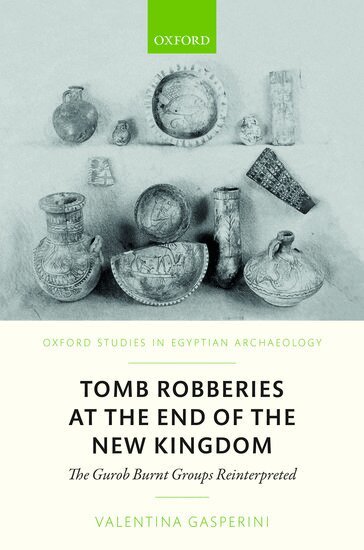
At the end of the 19th century W.M.F. Petrie excavated a series of assemblages at the New Kingdom Fayum site of Gurob. These deposits, known in the Egyptological literature as 'Burnt Groups', were composed by several and varied materials (mainly Egyptian and imported pottery, faience, stone and wood vessels, jewellery), all deliberately burnt and buried in the harem palace area of the settlement. Since their discovery these deposits have been considered peculiar and unparalleled. Many scholars were challenged by them and different theories were formulated to explain these enigmatic 'Burnt Groups'. The materials excavated from these assemblages are now curated at several Museum collections across England: Ashmolean Museum, British Museum, Manchester Museum, and Petrie Museum. For the first time since their discovery, this book presents these materials all together. Gasperini has studied and visually analysed all the items. This research sheds new light on the chronology of deposition of these assemblages, additionally a new interpretation of their nature, primary deposition, and function is presented in the conclusive chapter. The current study also gives new information on the abandonment of the Gurob settlement and adds new social perspective on a crucial phase of the ancient Egyptian history: the transition between the late New Kingdom and the early Third Intermediate Period. Beside the traditional archaeological sources, literary evidence ('The Great Tomb Robberies Papyri') is taken into account to formulate a new theory on the deposition of these assemblages.
1 303 kr
Kommande
This cultural biography of a major ancient Egyptian monument maps the inception, life, and afterlife of the pyramid complex of King Senwosret III at Dahshur in Egypt, spanning five millennia from the beginnings of the ancient Egyptian state to modern times. The study transcends traditional chronological narratives, not only focussing on the primary stages of planning, building, and use of the funerary monument, but also including its later stages, its abandonment, dismantlement, and reuse. The pyramid continues to serve as a resource for social, cultural, and material capital, revealing centuries of interaction tied to identity, memory, and power dynamics.This study draws on a broad range of sources, from the archaeological record and ancient administrative texts, literary works, and graffiti left by early 'tourists' visiting the site to travellers' accounts from Medieval times and the Early Modern period, as well as contemporary observations on the heritage site. It combines Egyptology and landscape archaeology with research history, reception history, and cultural memory studies. The cultural biography of the pyramid of Senwosret III highlights the changing relationship of an ancient culture with its monuments, prefiguring later changes in the reception and use of the sites that ultimately became archaeological heritage and tourist attractions. Dahshur's palimpsest landscape offers insights into socio-political events through time as well as individual histories, positioning the pyramid of Senwosret III as a microcosm of Egypt's enduring cultural dialogue with its monumental past.