Participatory Memory Practices - Böcker
Visar alla böcker i serien Participatory Memory Practices. Handla med fri frakt och snabb leverans.
3 produkter
3 produkter
1 968 kr
Skickas inom 10-15 vardagar
Crafting Museum Social Media for Social Inclusion Work investigates if and how social media can be integrated into the social inclusion initiatives of museums, and the contextual factors that impact this integration.Drawing on a year‑long case study of Glasgow Museums (Scotland), international mini case studies, and interviews with museum professionals, Kist reveals the complex social and technical negotiations that staff participate in to align social media practices with social inclusion work. Kist argues that the staff practices she observed around social media can be usefully understood through the idea of ‘craft’. This reframes staff practices for imagining future museum social media work as iterative, intuitive, and skilled balancing acts. As a craft, staff creatively draw on and work around social media affordances to balance the norms of their social inclusion work with the perceived interests and needs of users and community groups. Understanding the relation between museums’ use of social media and their ability to contribute to social inclusion initiatives is imperative, especially given the increasingly pervasive use of social media across the cultural heritage sector in recent years.Crafting Museum Social Media for Social Inclusion Workwill be valuable for academics, practitioners, and students working in cultural heritage, museum studies, or social work.The Open Access version of this book, available at http://www.taylorfrancis.com, has been made available under a Creative Commons Attribution-Non Commercial-No Derivatives (CC BY-NC-ND) 4.0 license.
2 027 kr
Skickas inom 10-15 vardagar
Future Memory Work addresses a crucial challenge in contemporary pluralistic societies: the organisation of open, participatory and socially inclusive memory practices in digital media ecologies. It brings a novel relational approach to future memory work across institutions, people, and modalities.Advancing inter- and transdisciplinary research and rich empirical cases from across Europe and beyond, the book examines how memory practices in digital media are open for engagement of people with diverse backgrounds. It analyses the modalities of memory making and how they can enable institutional and public memory making with a broad spectrum of people and groups in civil society at local, translocal, national and global levels. The chapters examine the mediatized character of memory making, whilst also critically considering what obstacles and potentials emerge from participatory memory work. As a whole, the book is a comprehensive source of knowledge and ideas for creating socially inclusive, sustainable memory practices and futures. It sets the multidisciplinary research agenda for advancing studies of heritage in contemporary digital media as an element and a driver of cultural and social change.Future Memory Work is essential reading for academics, students and professionals working in the fields of Anthropology, Museum Studies, Digital Cultural Heritage, Memory Studies, Cultural Studies and Design.
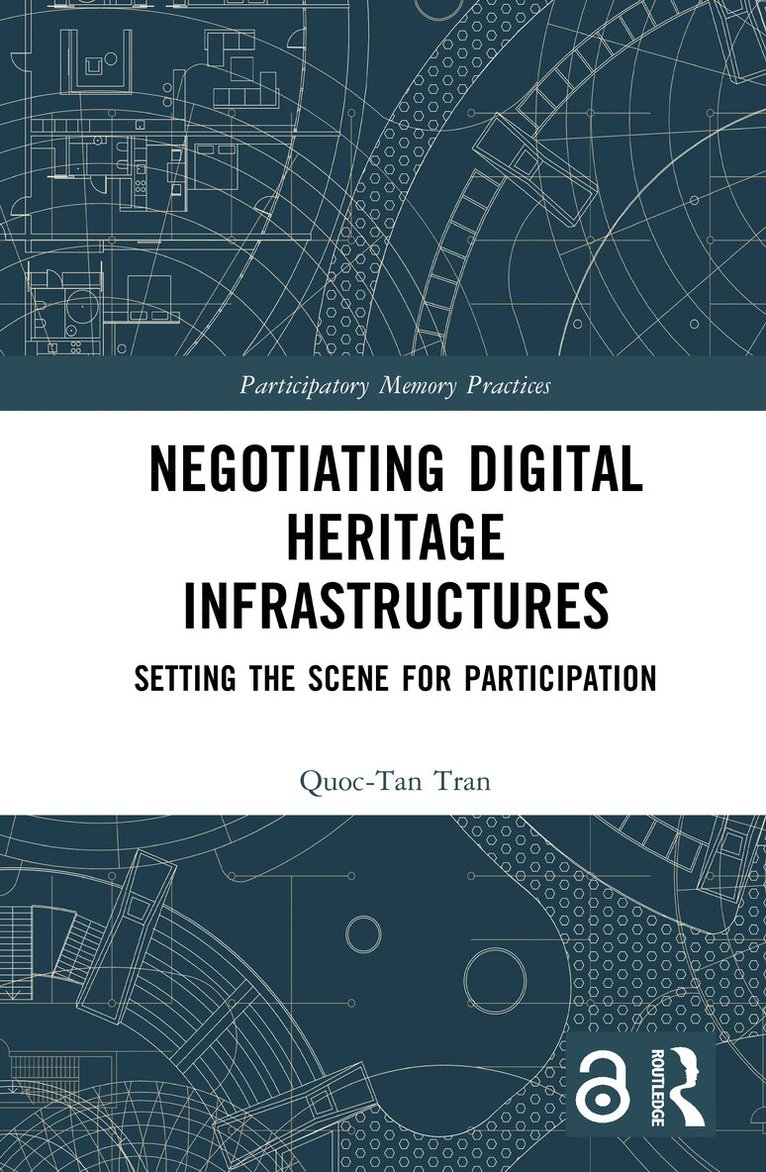
Negotiating Digital Heritage Infrastructures
Setting the Scene for Participation
Inbunden, Engelska, 2025
2 103 kr
Skickas inom 10-15 vardagar
Negotiating Digital Heritage Infrastructures examines the infrastructural qualities of museum work that influence the ability of cultural institutions to support participatory and socially inclusive missions.Drawing on data gathered in Scotland, Sweden, and Germany and taking an infrastructure studies approach, the book focuses on the socio-technical negotiations underpinning the everyday practices of museum staff. The book examines the work that is done behind the scenes, including the everyday tasks of collecting, archiving, displaying museum objects and retrieving information. Tran argues that while the technical components of infrastructure are necessary for memory-making and knowledge production, it is the social part of museum infrastructure that enables more open and decentralised modes of memory-making. The book shows how these negotiations affect the ability of museum infrastructures to accommodate and support growth and development, expanding access and establishing modes of connection to external partners and services. It illuminates the less visible practices of museums, which nevertheless directly affect their more public, outward-facing activities.Negotiating Digital Heritage Infrastructures will be of interest to academics and students who are engaged in the study of museums and heritage. It will be particularly useful to those with an interest in public participation, social inclusion, heritage management, the digitisation of collections, data aggregation, and human-centred design approaches.